Goyal flags 100 GW nuclear, $50B chip push for Viksit Bharat
Synopsis
Commerce Minister Piyush Goyal has highlighted three headline figures — 100 GW nuclear capacity, $50 billion in semiconductor investments, and $130 billion in projected chip consumption by 2030 — as India's technology foundation for becoming a developed nation by 2047.
Key Takeaways
Union Commerce Minister Piyush Goyal outlined India's twin technology ambitions: 100 GW nuclear energy capacity and $50 billion in semiconductor investments.
India projects annual semiconductor consumption of $130 billion by 2030 , positioning itself as one of the world's largest chip markets.
The India Semiconductor Mission and the PLI scheme for semiconductors (outlay over Rs 76,000 crore , approved in 2021 ) form the policy backbone of the chip drive.
Nuclear expansion builds on civil cooperation agreements signed with the US, France, and Russia since 2008 ; current installed capacity is roughly 7-8 GW , making the 100 GW goal a more than tenfold jump.
Both targets are framed under the Viksit Bharat vision of transforming India into a developed economy by 2047 .
Key near-term milestones: parliamentary clearance for new nuclear sites and semiconductor incentive disbursements in the next Union Budget.
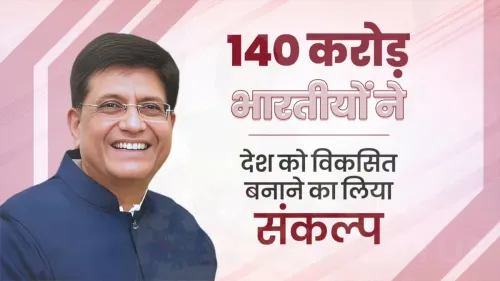
Three numbers. One ambition. Union Commerce and Industry Minister Piyush Goyal has laid out the scale of India's strategic technology bet — 100 GW in nuclear energy capacity, $50 billion in semiconductor investments, and a projected $130 billion in annual semiconductor consumption by 2030 — framing them as the twin pillars that will drive a Viksit Bharat (Developed India).
The two bets India is placing simultaneously
Nuclear and semiconductors might seem like unrelated sectors, but India is pursuing them as a deliberate pair. Clean, uninterrupted baseload power is the prerequisite for running energy-hungry chip fabrication plants. Semiconductors, in turn, are the nervous system of every advanced industry — from electric vehicles to defence electronics to artificial intelligence. Goyal's post makes that logic explicit: these are 'the technologies that will shape a Viksit Bharat.'
The nuclear ambition is vast. India's current installed nuclear capacity stands at roughly 7-8 GW; a 100 GW target represents a more than tenfold expansion. That trajectory depends on parliamentary clearance for new reactor sites, faster project execution, and the civil nuclear cooperation frameworks India has built with the United States, France, and Russia since 2008 — agreements that unlocked access to international fuel and technology after decades of isolation.
India's semiconductor drive: from policy to pipeline
On chips, the foundation was laid in 2021 when the government approved the Production Linked Incentive scheme for semiconductors with an outlay exceeding Rs 76,000 crore — one of the largest single-sector incentive packages in Indian industrial history. The India Semiconductor Mission followed as the operational vehicle to attract global chip designers, manufacturers, and assembly units.
A $130 billion domestic consumption figure by 2030 would make India one of the world's largest chip markets — a demand signal meant to tell global foundries that setting up in India is not charity, it is commerce. The $50 billion investment target is the supply-side answer to that demand. Both figures cited in the post are government projections; they signal ambition and direction, not guaranteed outcomes.
Where the Atmanirbhar arc now points
Goyal's framing connects directly to the Atmanirbhar Bharat self-reliance framework that has driven successive Union Budgets. India's strategic calculus is straightforward: a country that cannot power its industry affordably or manufacture its own chips will always be a price-taker in the global technology economy. Reducing import dependence in both sectors — energy and electronics — is the structural insurance policy against that vulnerability.
The next concrete milestones to watch are parliamentary approvals for new nuclear sites and the disbursement pace of semiconductor fab incentives in the upcoming Union Budget. How fast money moves from policy to plant will determine whether these numbers graduate from targets to track record.
India has announced the destination. The sprint to 2047 has a very specific scoreboard now.
Point of View
Not just aspirational policy. The pairing is analytically coherent: energy security and chip sovereignty are both prerequisites for advanced manufacturing, and presenting them together raises the credibility of the 2047 timeline. For the BJP government, these figures also serve a domestic political function, translating the abstract 'Viksit Bharat' slogan into measurable, auditable targets. The real test will come in the next budget cycle, where disbursement velocity on semiconductor incentives and site approvals for nuclear expansion will reveal whether this is a roadmap or a rhetorical landmark.
NationPress
19 Nov 2026
Frequently Asked Questions
What is India's target for nuclear energy capacity under Viksit Bharat?
India has set a target of 100 GW in nuclear energy capacity as part of its Viksit Bharat development vision. This represents a more than tenfold increase from the current installed nuclear capacity of roughly 7-8 GW.
What is the India Semiconductor Mission?
The India Semiconductor Mission is a central government initiative to promote semiconductor design, manufacturing, and assembly in India. It is backed by a Production Linked Incentive scheme approved in 2021 with an outlay exceeding Rs 76,000 crore .
What is India's projected semiconductor consumption by 2030?
India projects annual semiconductor consumption of $130 billion by 2030 , according to government targets cited by Commerce Minister Piyush Goyal. The country is also targeting $50 billion in semiconductor investments to meet that domestic demand.
What is Viksit Bharat and when is its target year?
Viksit Bharat (Developed India) is the Indian government's national vision to transform India into a fully developed economy by 2047 , the centenary of India's independence, through technology, self-reliance, and advanced manufacturing.
How does India's nuclear cooperation with other countries support its expansion plans?
India signed civil nuclear cooperation agreements with the United States, France, and Russia from 2008 onward. These agreements ended India's international nuclear isolation and gave it access to foreign reactor technology, fuel, and expertise essential for scaling capacity toward the 100 GW target.