Goyal: AI Is an Enabler, Not a Replacement for Human Values
Synopsis
Commerce Minister Piyush Goyal has declared that AI can never replace human intelligence, values, culture, or traditions, positioning artificial intelligence strictly as a growth enabler for India. The statement reinforces India's long-standing human-centric AI policy philosophy rooted in the 2018 NITI Aayog National Strategy for AI.
Key Takeaways
Piyush Goyal , Union Commerce and Industry Minister, posted on 18 June 2026 that AI cannot replace human intelligence, values, culture, or traditions.
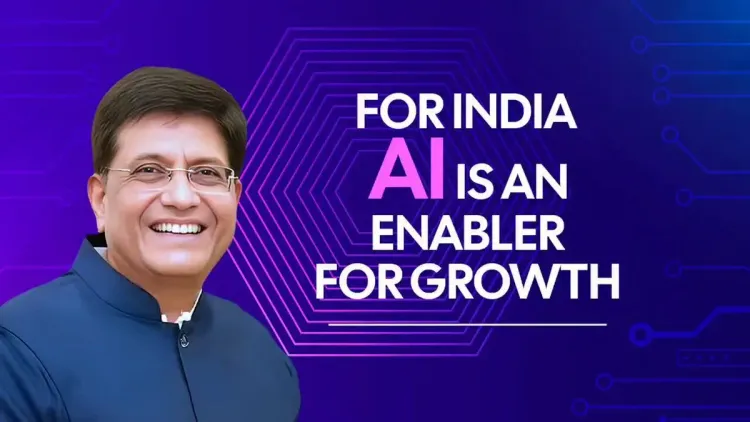
He described AI as 'an enabler for growth' specifically for India , not a replacement for human capacity.
India's AI policy framework traces back to NITI Aayog's 2018 National Strategy for Artificial Intelligence, branded #AIforAll , which prioritised inclusive growth and skilling.
The statement aligns with the broader Digital India programme launched in 2015 and successive government positions balancing AI adoption with job and sovereignty concerns.
Indian tech startups, AI researchers, and workforce communities are key stakeholders watching for follow-through in legislation and regulation.
Parliamentary action on an AI regulatory framework and India's role at GPAI and UN AI summits remain the next major policy milestones to watch.
Union Commerce and Industry Minister Piyush Goyal on Thursday, 18 June 2026 asserted that artificial intelligence can never replace human intelligence, values, culture, and traditions, framing AI as a growth enabler for India rather than a substitute for human capacity.
Context
In his post on X, Goyal stated plainly: 'AI can never replace human intelligence, values, culture, and traditions. For India, AI is an enabler for growth.' The statement, brief but pointed, reflects a position that has become a recurring theme in India's official discourse on emerging technology — that adoption must be anchored in human-centric principles rather than driven purely by automation or efficiency metrics.
As Leader of the House in the Rajya Sabha and the minister overseeing commerce and industry, Goyal occupies a central role in shaping the policy environment for technology-driven sectors, including the rapidly expanding domestic AI ecosystem.
Policy Backdrop
India's formal AI policy posture dates to 2018, when NITI Aayog released the National Strategy for Artificial Intelligence under the banner #AIforAll. That document prioritised inclusive growth, social good, and skilling over pure automation — a philosophy that Goyal's remarks echo closely.
The broader Digital India programme, launched in 2015, established the foundational infrastructure and policy intent within which AI initiatives have since been nested. Successive ministerial statements have consistently balanced the drive for economic competitiveness through AI with concerns over job displacement, data sovereignty, and the preservation of cultural identity.
This framing — AI as a tool that amplifies human potential rather than supplants it — mirrors positions adopted by several other emerging economies as they seek to shape global norms around artificial intelligence governance.
Stakeholders and Impact
Indian technology startups and AI researchers stand to be most directly affected by the policy signals embedded in such statements. A minister-level articulation that AI is an 'enabler' rather than a disruptor provides a degree of regulatory predictability, signalling that the government is unlikely to pursue restrictive curbs on AI development in the near term.
At the same time, the emphasis on values, culture, and traditions carries implications for how AI applications are expected to be designed and deployed — particularly in sectors such as education, healthcare, and public services, where cultural sensitivity and human oversight remain paramount. Workforce communities concerned about automation-driven job losses may also find reassurance in the minister's framing.
What's Next
Attention will now turn to whether India's legislative and regulatory architecture catches up with the government's stated philosophy. Parliamentary deliberations on a formal AI regulatory framework remain closely watched, as does India's participation in multilateral forums such as the Global Partnership on Artificial Intelligence (GPAI) and upcoming United Nations AI summits, where the country's human-centric AI stance could influence international standard-setting.
For now, Goyal's post signals that New Delhi's approach to AI will continue to be shaped as much by questions of identity and social equity as by purely economic or technological calculus.
Point of View
Such ministerial affirmations serve a dual audience: domestic constituencies anxious about job displacement, and international partners evaluating India's AI governance credentials. The framing of AI as an 'enabler' rather than a disruptor also provides political cover for aggressive AI investment and adoption without conceding ground on cultural or labour concerns. The real test will be whether this philosophy translates into a coherent legislative framework or remains at the level of aspirational rhetoric.
NationPress
17 Sept 2026
Frequently Asked Questions
What did Piyush Goyal say about AI?
Piyush Goyal stated on 18 June 2026 that AI can never replace human intelligence, values, culture, and traditions, and that for India, AI is an enabler for growth rather than a substitute for human capacity.
What is India's policy on artificial intelligence?
India's formal AI policy, articulated through NITI Aayog's 2018 National Strategy for Artificial Intelligence (#AIforAll), focuses on inclusive growth, social good, and skilling, treating AI as a tool that amplifies human potential rather than replaces it.
Is India developing its own AI regulations?
India has been deliberating on a formal AI regulatory framework, and parliamentary action on such a framework is closely watched. India also participates in multilateral forums like the Global Partnership on Artificial Intelligence (GPAI) where it advocates a human-centric approach.
How does India's AI approach differ from other countries?
India's approach mirrors that of several other emerging economies in emphasising ethical guardrails, cultural preservation, and human oversight alongside economic competitiveness, rather than prioritising pure automation or speed of deployment.
What is Digital India and how does it relate to AI?
Digital India is a programme launched in 2015 to build foundational technology infrastructure and policy intent in India. AI initiatives, including the government's human-centric AI philosophy, have been developed within this broader Digital India framework.