Goyal at Festival of Ideas: Young Indians Must Build Global Brands
Synopsis
At the Festival of Ideas in Delhi, Commerce Minister Piyush Goyal urged young Indians to build globally competitive brands by leveraging India's startup ecosystem, FTAs with UAE and Australia, and growing manufacturing capabilities — calling out manufacturing, deep tech, and high-value services as priority sectors.
Key Takeaways
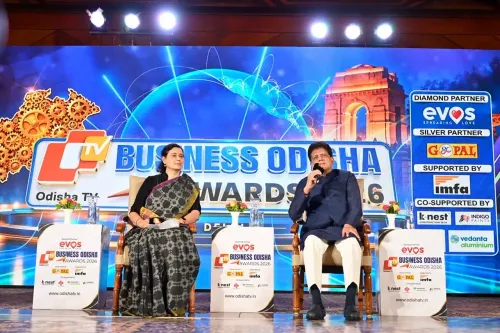
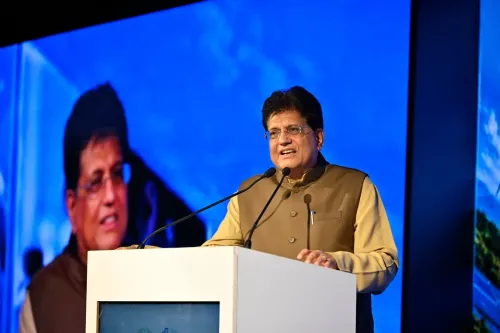
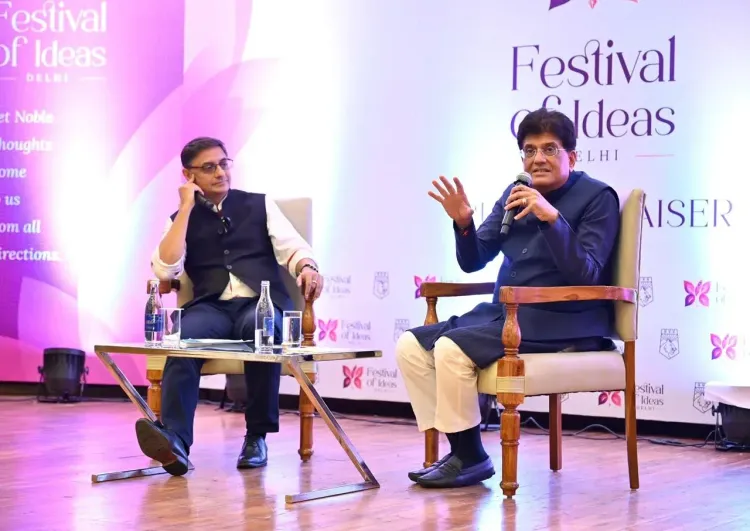
Piyush Goyal held a fireside chat with economist Sanjeev Sanyal at the Festival of Ideas, Delhi on 30 October 2026 .
The session theme was 'From Campus to International Markets: How Young Indians Can Win Globally.' Goyal stressed that India's next economic phase must be driven by young entrepreneurs targeting global markets, not just domestic ones.
He cited India's startup ecosystem, Startup India (2016) , Make in India (2014) , and CEPAs signed with UAE and Australia in 2022 as structural enablers.
Priority sectors identified: manufacturing , deep technology , and high-value services .
Goyal called for globally benchmarked quality, industry-relevant skills, and an export-oriented mindset among young founders.
The next wave of India's economic rise will not be built by those who stop at the country's borders — that was the central message Union Commerce and Industry Minister Piyush Goyal delivered at the Festival of Ideas in Delhi on Friday, 30 October 2026, during a fireside chat with economist and Prime Minister's Economic Advisory Council member Sanjeev Sanyal.
Speaking on the theme 'From Campus to International Markets: How Young Indians Can Win Globally,' Goyal argued that India's next phase of economic transformation must be powered by young entrepreneurs who look beyond the domestic market and 'aspire to build world-class brands.' The audience: a hall packed with the kind of energetic, purpose-driven students he was openly banking on.
The Policy Stack Goyal Handed Young Entrepreneurs
The Minister did not arrive empty-handed. He pointed to a converging set of structural enablers — India's expanding startup ecosystem, growing manufacturing capabilities, a string of new free trade agreements, and the country's deepening integration with global value chains — as the scaffolding young founders can now climb. Two landmark Comprehensive Economic Partnership Agreements, signed with the UAE and Australia in 2022, have already widened market access in ways earlier generations of Indian entrepreneurs simply did not have.
That trade architecture sits on top of older foundations: the Make in India programme, announced in 2014 to build domestic manufacturing muscle, and the Startup India initiative, launched in 2016 to seed an innovation and entrepreneurship culture. Goyal's message was effectively that the scaffolding is up — now build on it.
Three Sectors, One Mindset
He was specific about where he sees the opportunity clustering: manufacturing, deep technology, and high-value services. His prescription for young founders was equally concrete — an export-oriented mindset, globally benchmarked quality, industry-relevant skills, and the willingness to take calculated risks. Each of those four conditions, notably, is something a policy environment can either nurture or undermine. The implicit signal: the government sees its job as creating the conditions; the execution belongs to the next generation.
The pairing with Sanjeev Sanyal — a prominent voice on India's macroeconomic strategy — gave the session an intellectual weight beyond the ceremonial. Together, they represent the intersection of political will and economic thinking that the government has leaned on to frame India's global ambition.
Why Export Orientation Is the Through-Line
India's growth story has historically been led by domestic consumption and services. The government's consistent push over the last decade has been to pivot toward export-led, globally competitive enterprise — the model that transformed South Korea, Taiwan, and more recently Vietnam. Goyal's remarks land squarely in that tradition: India generates employment at scale only if its enterprises can compete and win in global markets, not just at home.
For a country that adds millions of young workers to its labour force every year, the stakes of that pivot could not be higher. Watch for whether today's messaging translates into concrete export-incentive or skilling programmes targeted specifically at founders in manufacturing and deep tech — the sectors Goyal singled out by name.
Point of View
Startup incentives, manufacturing schemes — with calls for entrepreneurial ambition, the BJP is seeking to own the 'global India' story ahead of key economic milestones. The choice of Sanjeev Sanyal as interlocutor signals that this is not just political messaging but an attempt to ground the vision in credible macroeconomic thinking. The real test will be whether the incentive architecture — skilling, export credits, quality infrastructure — catches up with the rhetoric.
NationPress
31 Oct 2026
Frequently Asked Questions
What did Piyush Goyal say at the Festival of Ideas 2026?
Goyal urged young Indians to build globally competitive brands and adopt an export-oriented mindset, highlighting manufacturing, deep technology, and high-value services as priority sectors. He pointed to India's FTAs, startup ecosystem, and integration with global value chains as key enablers.
Who is Sanjeev Sanyal and why did he join Piyush Goyal at the event?
Sanjeev Sanyal is an Indian economist serving as a member of the Economic Advisory Council to the Prime Minister. He joined Goyal for a fireside chat at the Festival of Ideas in Delhi, lending macroeconomic perspective to the discussion on India's global competitiveness.
What is the Startup India initiative?
Startup India was launched by the government in 2016 to promote entrepreneurship and innovation across the country, offering regulatory support, funding access, and tax benefits to early-stage companies.
Which free trade agreements has India signed recently to boost exports?
India signed Comprehensive Economic Partnership Agreements with the UAE and Australia, both in 2022, expanding market access for Indian goods and services in both countries.
What sectors did Piyush Goyal highlight for young Indian entrepreneurs?
Goyal specifically highlighted manufacturing, deep technology, and high-value services as the three sectors offering the greatest opportunities for young Indians to build globally competitive enterprises.