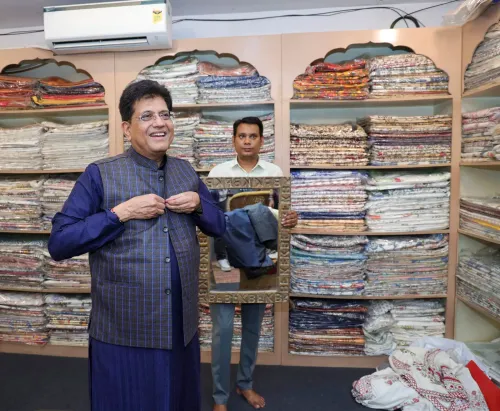
Goyal: FTAs opening global markets for Bihar's exports
Synopsis
Union Commerce Minister Piyush Goyal says the Modi government's Free Trade Agreements are opening global markets for Bihar's agriculture, textiles, leather, footwear, engineering, chemicals, and pharma sectors, positioning the state for a new export identity.
Key Takeaways
Union Commerce Minister Piyush Goyal stated on 8 August 2026 that Bihar's products are building a new global identity through the Modi government's FTAs.
Sectors named: agriculture, agri-processing, textiles, leather, footwear, engineering, chemicals, and pharmaceuticals .
The India-UAE Comprehensive Economic Partnership Agreement (February 2022) and India-Australia Economic Cooperation and Trade Agreement (April 2022) are key pillars of this market-opening strategy.
Both agreements cover tariff lines that directly match the Bihar sectors Goyal highlighted.
Bihar has historically been a lower-export-intensity state, making FTA-driven access particularly significant for the state's producers.
Bihar's export figures for FY 2025-26 will be the key metric to assess whether policy gains are translating into real shipment growth.
Bihar's farmers, weavers, leather workers, and factory floors are being handed a new global stage — and Union Commerce and Industry Minister Piyush Goyal says the Modi government's new Free Trade Agreements are the key that unlocks it. Posting on Saturday, 8 August 2026, Goyal declared that Bihar's talent and products are carving out a fresh identity in world markets.
In his post, Goyal wrote: 'बिहार की प्रतिभा और उत्पाद अब दुनिया के बाजारों में अपनी नई पहचान बना रहे हैं' — 'Bihar's talent and products are now making a new identity for themselves in global markets.' He specifically named agriculture and agri-processing, textiles, leather, footwear, engineering, chemicals, and pharmaceuticals as the sectors set to benefit from newly opened international doors.
Which FTAs are doing the heavy lifting
The trade architecture underpinning Goyal's claim began taking shape in 2022. The India-UAE Comprehensive Economic Partnership Agreement, signed in February 2022, delivered duty concessions covering textiles, agriculture, chemicals, and pharma — precisely the sectors the minister highlighted for Bihar. The India-Australia Economic Cooperation and Trade Agreement, inked in April 2022, added fresh market access for Indian agricultural and processed food exports. Both agreements sit squarely in the government's broader push, accelerated since 2020, to diversify India's export destinations through bilateral deals rather than waiting on slow-moving multilateral negotiations.
Why Bihar, and why now
Bihar is one of India's most populous states, with deep roots in agriculture and a growing footprint in leather and light manufacturing — yet it has historically ranked among the lower-export-intensity states. That gap between productive capacity and global reach is exactly what the FTA strategy is designed to close. When tariff lines on agri-processed goods, footwear, and engineering products fall in markets like the UAE and Australia, exporters from states like Bihar — who often compete on labour cost and raw-material proximity — stand to gain disproportionately.
The sectors Goyal listed map almost exactly onto the tariff lines liberalised in these agreements. Bihar's Muzaffarpur litchis, its leather clusters, its textile units, and its chemical and pharma manufacturers now face lower barriers in key destination markets than they did four years ago.
What the export numbers will tell us
The real test arrives in Bihar's export figures for FY 2025-26. Trade analysts and state exporters will be watching whether the tariff headroom translates into actual shipment growth — or whether infrastructure, logistics, and credit access remain the ceiling. Any state-level outreach events tied to the operationalisation of these FTAs will be an early signal of how seriously the government intends to convert policy into ground-level momentum.
Bihar's moment in the global supply chain is being written in trade agreements. Whether the state's exporters can turn that opening into a sustained surge is the next chapter to watch.
Point of View
Framing trade policy as a direct economic dividend for Bihar's producers. The sectors he lists — agri-processing, leather, textiles, pharma — are not random; they map precisely onto the tariff concessions already secured in the UAE and Australia agreements, giving the claim a concrete policy foundation rather than mere rhetoric. This fits a broader BJP pattern of highlighting FTA gains in Hindi-heartland states to build a 'trade benefits you' narrative ahead of state-level political cycles. The real credibility test, however, will come from actual export data — not ministerial posts.
NationPress
8 Aug 2026
Frequently Asked Questions
Which Free Trade Agreements is Piyush Goyal referring to for Bihar?
Goyal did not name specific FTAs in his post, but the Modi government's key agreements include the India-UAE Comprehensive Economic Partnership Agreement (February 2022) and the India-Australia Economic Cooperation and Trade Agreement (April 2022), both of which cover sectors he highlighted for Bihar.
Which sectors in Bihar will benefit from India's new FTAs?
Minister Goyal specifically named agriculture and agri-processing, textiles, leather, footwear, engineering, chemicals, and pharmaceuticals as the Bihar sectors set to gain from newly opened global markets.
What is the India-UAE trade agreement and how does it help Bihar?
The India-UAE Comprehensive Economic Partnership Agreement, signed in February 2022, provides duty concessions on textiles, agriculture, chemicals, and pharma — sectors where Bihar has significant production capacity.
Why is Bihar's export potential important under India's FTA strategy?
Bihar has historically been among India's lower-export-intensity states despite sizeable agricultural and manufacturing output. FTAs that lower tariff barriers in key markets give Bihar-based exporters a direct cost advantage and a new route to global buyers.
How can we track whether Bihar actually benefits from these trade agreements?
Bihar's export figures for FY 2025-26 will be the primary indicator. Growth in shipments of agri-processed goods, leather, and textiles to UAE and Australian markets would confirm that policy access is translating into real trade gains.