Goyal: India-New Zealand FTA Enters Into Force Today
Synopsis
Union Commerce Minister Piyush Goyal declared the India-New Zealand Free Trade Agreement in force on 20 October 2026, completing a negotiation journey that began in 2010 and restarted in 2022, adding another Indo-Pacific bilateral deal to India's expanding trade architecture.
Key Takeaways
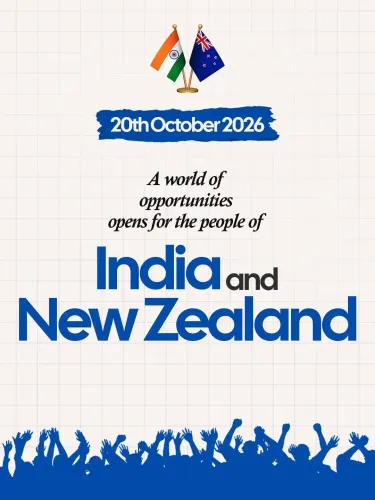
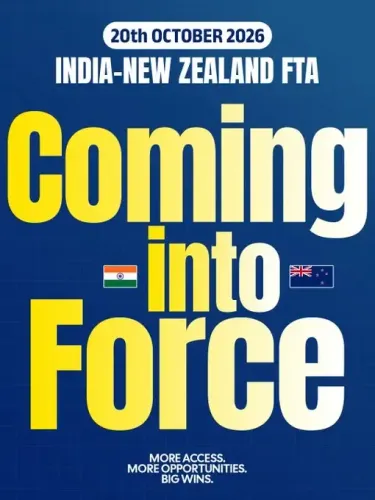
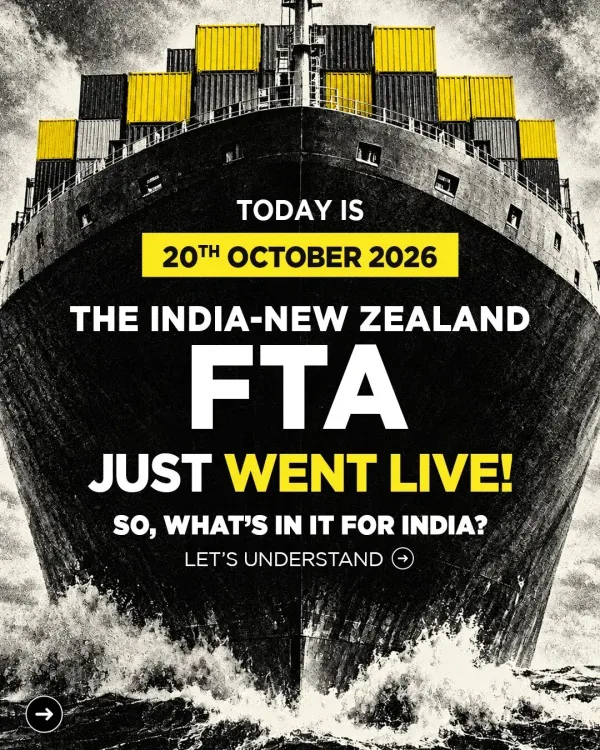
The India-New Zealand Free Trade Agreement officially entered into force on 20 October 2026 , as announced by Union Commerce Minister Piyush Goyal .
Negotiations were first launched in 2010 , later suspended, and resumed following a bilateral commitment in 2022 .
The deal follows India's earlier bilateral trade agreements with Australia and the UAE , both signed in 2022 , reflecting a broader Indo-Pacific engagement strategy.
Key stakeholders include Indian exporters in services, textiles and pharma, and New Zealand's dairy and agriculture sector .
Tariff schedules and the full agreement text now await public and parliamentary scrutiny.
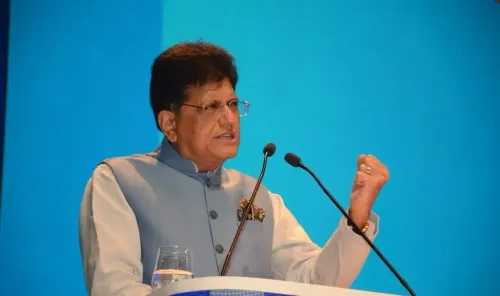
A trade relationship years in the making crossed a historic threshold on Tuesday, 20 October 2026, as Union Commerce and Industry Minister Piyush Goyal announced that the India-New Zealand Free Trade Agreement has officially entered into force — opening a new corridor of market access between two Indo-Pacific economies that had spent over a decade navigating the road to a deal.
A 16-Year Journey From Launch to Entry Into Force
The story of this agreement is one of extraordinary patience. Negotiations for a Comprehensive Economic Partnership Agreement (CEPA) between India and New Zealand were first launched in 2010, then stalled and suspended. It took a fresh bilateral commitment in 2022 to restart the talks — a restart that has now culminated in a deal coming into effect. Sixteen years from the first handshake to the ink drying: that is how long the two sides took to align on the details.
India's Indo-Pacific Trade Playbook Gains Another Piece
India has moved with notable speed on bilateral trade in recent years. The landmark deals with Australia and the UAE — both inked in 2022 — signalled a deliberate pivot away from prolonged multilateral negotiations toward faster, focused bilateral agreements. The India-New Zealand FTA fits squarely into that playbook: a targeted Indo-Pacific partner with complementary strengths in agriculture, dairy, and services, sectors where the two economies can generate genuine two-way trade growth rather than compete head-on.
Who Stands to Gain — and What Comes Next
Indian exporters — particularly in textiles, pharmaceuticals, IT services, and engineering goods — gain structured market access into New Zealand under the new framework. On the other side, New Zealand's dairy and agriculture sector has long sought better entry into the world's fifth-largest economy. The precise tariff schedules and sector-by-sector liberalisation timelines will now be the subject of close scrutiny by trade bodies on both sides, as the official gazette notification and agreement text enter the public domain. The devil, as always in trade law, lives in the schedules.
Minister Goyal's announcement signals not just an economic event but a diplomatic one — New Zealand becomes one of a growing list of economies that have chosen to deepen structured trade ties with India outside of larger regional frameworks, betting on bilateral depth over multilateral breadth.
Point of View
Each concluded FTA is both an economic deliverable and a diplomatic signal — that India is open for structured, reciprocal commerce on its own terms. The New Zealand deal is particularly notable given the long negotiating history, suggesting the current administration has found a formula to close deals that previous governments could not. The real test, however, will be in implementation: whether tariff concessions translate into actual trade flows, and whether sensitive sectors like dairy remain flashpoints in domestic political discourse.
NationPress
20 Oct 2026
Frequently Asked Questions
When did the India-New Zealand FTA enter into force?
The India-New Zealand Free Trade Agreement entered into force on 20 October 2026 , as announced by Union Commerce Minister Piyush Goyal .
When did India and New Zealand start FTA negotiations?
Negotiations for a Comprehensive Economic Partnership Agreement were first launched in 2010 , later suspended, and then formally resumed following a bilateral meeting in 2022 .
What sectors does the India-New Zealand FTA cover?
The agreement is expected to cover agriculture, dairy, services, and technology , with Indian exporters in sectors like IT services, textiles and pharmaceuticals set to gain structured market access in New Zealand.
How does the India-New Zealand FTA fit into India's broader trade strategy?
It is part of India's deliberate Indo-Pacific bilateral trade push that also produced deals with Australia and the UAE in 2022 , aiming to diversify trade partners without waiting for larger multilateral frameworks.
What happens now that the India-New Zealand FTA is in force?
The official gazette notification and full tariff schedules will be published, and trade bodies on both sides will scrutinise the sector-by-sector liberalisation timelines to assess the practical impact on exporters and importers.