Goyal shares Modi's article on Shyama Prasad Mookerjee's vision
Synopsis
Commerce Minister Piyush Goyal amplified PM Narendra Modi's article in Dainik Jagran on Dr. Shyama Prasad Mookerjee, calling it an outstanding guide to the BJP founder's vision of national unity and self-reliant India — connecting 1950s nationalist thought to present-day policy.
Key Takeaways
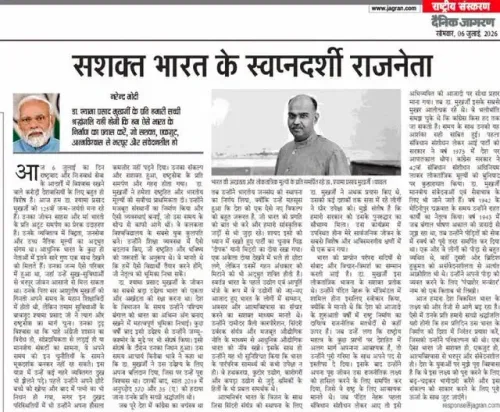
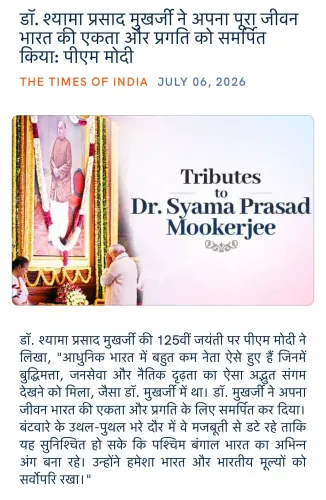
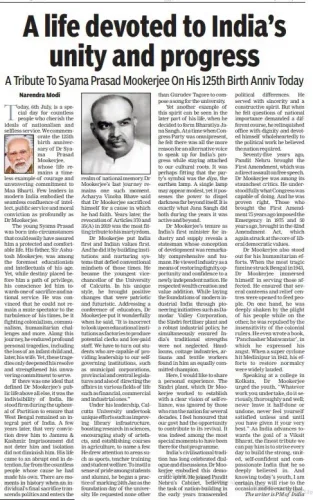
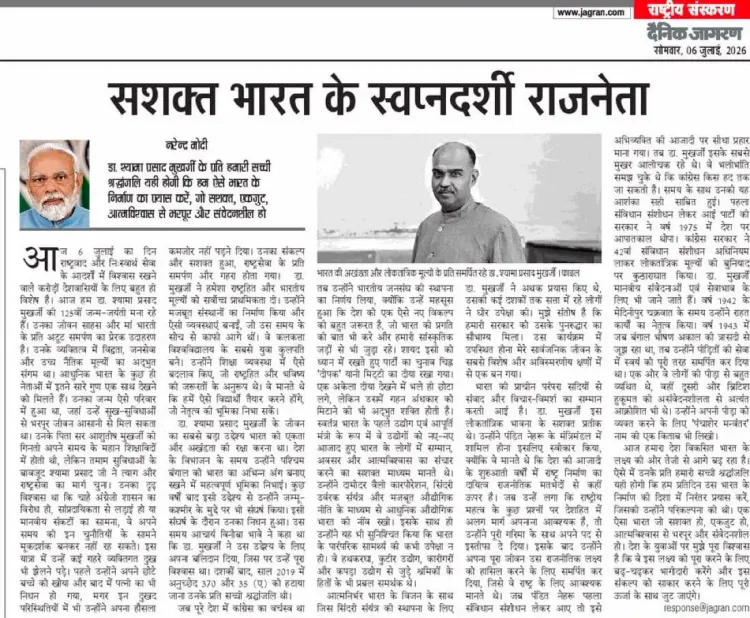
Piyush Goyal shared PM Modi 's article published in Dainik Jagran on 6 July 2026 .
The article focuses on Dr.
Shyama Prasad Mookerjee 's ideas on nation-building, national unity, and self-reliant India.
Mookerjee founded the Bharatiya Jana Sangh in 1951 , the ideological predecessor of the BJP .
The BJP government has linked Mookerjee 's legacy to the Article 370 abrogation in 2019 and the Atmanirbhar Bharat Abhiyan launched in 2020 .
Senior ministers amplifying PM-authored pieces on historical nationalist figures is part of the party's established social media communication strategy.
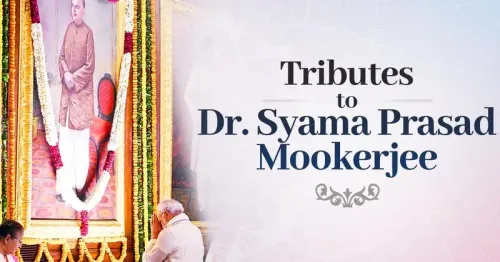
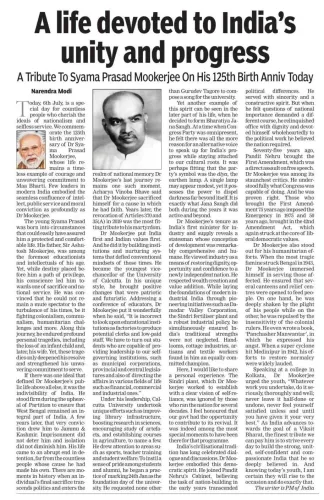
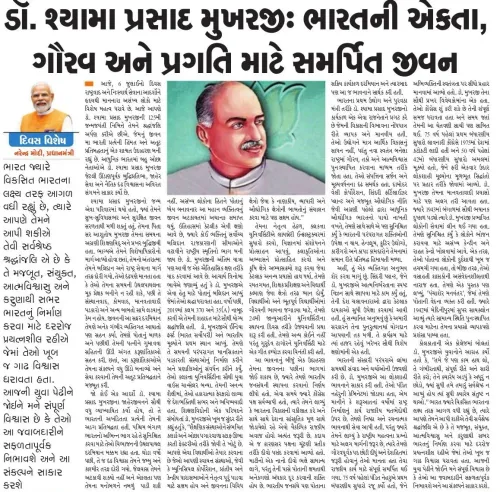
Union Commerce and Industry Minister Piyush Goyal on Monday, 6 July 2026, shared a piece authored by Prime Minister Narendra Modi published in Dainik Jagran, calling it an excellent medium to understand the nationalist vision of Dr. Shyama Prasad Mookerjee on nation-building, national unity, and the foundations of a self-reliant India.
Context
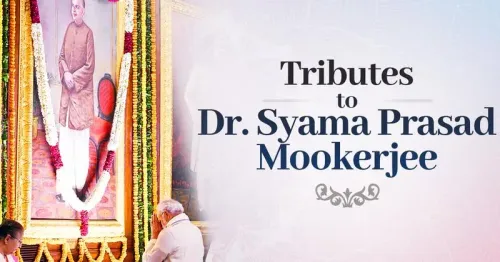
In his post, Goyal described PM Modi as a 'sashakt Bharat ke swapnadarshi rajneta' (visionary statesman of a strong India) and urged followers to read the article as an 'outstanding medium' to understand Mookerjee's ideas on 'rashtra nirman, rashtriya ekta aur atmanirbhar Bharat' (nation-building, national unity, and self-reliant India). The post was accompanied by an image and a link to the article on Dainik Jagran's website.
Dr. Shyama Prasad Mookerjee founded the Bharatiya Jana Sangh in 1951, which is widely regarded as the ideological forerunner of the present-day Bharatiya Janata Party (BJP). He is remembered for his fierce advocacy of national integration and his opposition to what he considered differential constitutional treatment of Jammu and Kashmir.
Policy Backdrop
The BJP government has consistently invoked Mookerjee's legacy to contextualise major policy decisions. The abrogation of Article 370 in 2019, which ended the special status of Jammu and Kashmir, was presented as a fulfilment of Mookerjee's long-standing demand for complete national integration.
Similarly, the Atmanirbhar Bharat Abhiyan, launched in May 2020 with a focus on domestic manufacturing and reduced import dependence, has been framed by government spokespersons as rooted in the economic self-reliance philosophy that nationalist leaders like Mookerjee championed decades ago. Goyal, as Commerce and Industry Minister, sits at the centre of that policy agenda.
Stakeholders and Impact
The amplification of PM Modi's article by a senior cabinet minister and Leader of the House in the Rajya Sabha extends the reach of the piece well beyond its original readership in the Hindi-language press. Such social media circulation by senior BJP leaders is a recognised part of the party's communication strategy to reinforce ideological continuity between its founding figures and current governance priorities.
For policy historians and BJP supporters, the article serves as a reminder of the intellectual lineage the party draws upon. For opposition voices and political analysts, it underscores how the ruling party uses historical figures to legitimise contemporary policy choices, from trade policy to territorial integration.
What's Next
Mookerjee's death anniversary in June and his birth anniversary in July typically prompt a cycle of commemorative events, articles, and social media activity by BJP leaders. Observers will watch for whether this renewed focus on his legacy is accompanied by any explicit policy announcements in the areas of domestic manufacturing, trade, or national integration that the government could link to his vision. Minister Goyal's amplification suggests the narrative around Mookerjee's ideas will remain prominent in official communication in the weeks ahead.
Point of View
Goyal draws a deliberate line of continuity between the party's founding philosophy and its current leadership. This kind of narrative architecture — timed around anniversaries and ahead of policy milestones — serves both a historical legitimisation function and a contemporary political one. It signals that the government intends to keep the ideological conversation around self-reliance and national integration alive in the public sphere.
NationPress
5 Oct 2026
Frequently Asked Questions
Why did Piyush Goyal share PM Modi's article on Shyama Prasad Mookerjee?
Goyal shared the article to highlight Mookerjee 's vision on nation-building, national unity, and self-reliant India, calling it an excellent medium for readers to understand the founding ideals the BJP traces its roots to.
Who was Shyama Prasad Mookerjee and why is he significant for the BJP?
Dr. Shyama Prasad Mookerjee founded the Bharatiya Jana Sangh in 1951 , the direct ideological predecessor of the BJP . He championed national integration, opposed differential constitutional status for Jammu and Kashmir , and advocated economic self-reliance.
What is the connection between Mookerjee's vision and Atmanirbhar Bharat?
The BJP government has framed the Atmanirbhar Bharat Abhiyan , launched in May 2020 , as rooted in the economic self-reliance philosophy that Mookerjee and other early nationalist leaders advocated, drawing a policy lineage from the 1950s to the present.
Where was PM Modi's article on Mookerjee published?
PM Modi 's article on Dr. Shyama Prasad Mookerjee 's vision was published in Dainik Jagran , one of India's largest Hindi-language newspapers.
Is Piyush Goyal a senior figure in the BJP government?
Yes. Piyush Goyal is the Union Minister of Commerce and Industry , a senior BJP leader, and serves as the Leader of the House in the Rajya Sabha , making him one of the most prominent figures in Parliament's upper house.