Great Nicobar project: India's strategic shield in the Indo-Pacific
Synopsis
Great Nicobar Island — just 40 nautical miles from the Strait of Malacca, through which over 80% of China's oil imports flow — is being transformed into India's most consequential strategic asset. From a greenfield airport near Galathea Bay to upgraded runways for Su-30 MKIs, the project redefines India's reach in the Indo-Pacific and its leverage over Beijing's most critical maritime artery.
Key Takeaways
Great Nicobar Island lies 40 nautical miles from the Strait of Malacca , through which more than 80% of China's oil imports transit.
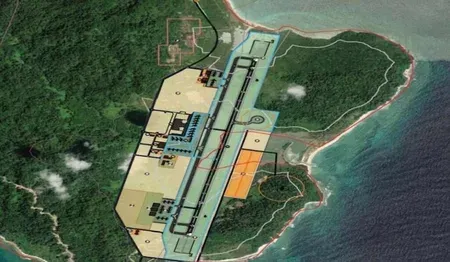
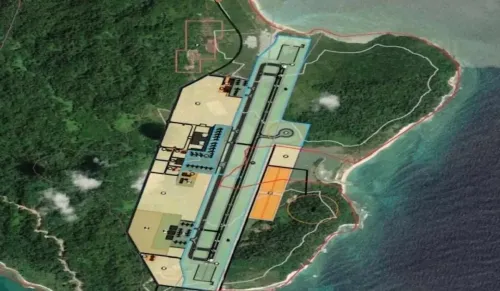
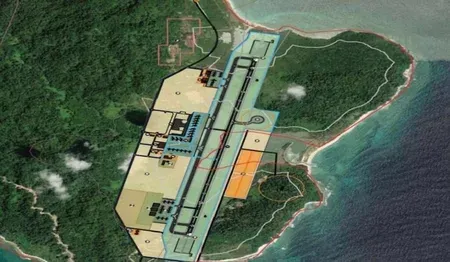
A greenfield dual-use airport with a 3,300-metre runway is planned near Galathea Bay , to be operated by the Indian Air Force .
AFS Carnicobar 's upgraded runway, inaugurated in January 2026 , can now host Su-30 MKIs , Mirage-2000s , and Boeing P-8Is .
17 PLAN vessels were spotted in the Indian Ocean Region in a single year, with sub-surface deployments rising sharply through 2024 .
India's naval doctrine since 2015 encompasses both sea control and sea denial , with Great Nicobar anchoring an A2/AD grid supported by the BrahMos missile system.
The island hosts two indigenous communities — the Shompen (200–400 individuals) and the Great Nicobarese , who were displaced by the 2004 tsunami .
Great Nicobar Island, situated roughly 1,000 miles from the Indian mainland and approximately 40 nautical miles from the Strait of Malacca, is fast emerging as the centrepiece of India's multi-layered Indo-Pacific defence strategy. The ongoing development project on the island is widely described by strategic analysts as a necessity rather than a choice, given the intensifying maritime competition with China in the Indian Ocean Region (IOR).
The Island's Strategic Geography
Great Nicobar is one of more than 500 islands forming the Andaman and Nicobar archipelago. It is home to two historically distinct indigenous communities — the Shompen, an isolated group of roughly 200 to 400 individuals who maintain a traditional hunter-gatherer lifestyle, and the Great Nicobarese, who were largely displaced from the island's western coastline by the catastrophic 2004 tsunami.
Its geographic position is what makes the island militarily invaluable. The Strait of Malacca channels more than 80% of China's oil imports, and Great Nicobar's proximity enables continuous surveillance over the eastern Indian Ocean's Sea Lines of Communication (SLOCs), rapid deployment of aerial and maritime assets, and sustained logistical operations without dependence on the mainland.
China's Growing Sub-Surface Footprint
The Indian Navy has publicly acknowledged that its anti-submarine warfare efforts are a direct response to an expanding People's Liberation Army Navy (PLAN) sub-surface presence in the IOR. As early as January 2016, the Navy deployed two Boeing P-8I maritime patrol aircraft — its premier intelligence, surveillance and reconnaissance assets — to the Andaman and Nicobar Islands to track PLAN submarine activity.
The following year, 17 PLAN vessels were spotted in the IOR, ostensibly on anti-piracy operations but supported by submarines. 2024 saw another significant uptick in PLAN and supporting-vessel deployments in the region. Separately, India's own submarine, INS Sindhukesari (S60), became the first Indian submarine to transit the Sunda Strait in February 2023, signalling New Delhi's intent to extend its own sub-surface reach.
Infrastructure Build-Up and Force Modernisation
Concrete steps are already under way. In January 2026, Chief of Defence Staff General Anil Chauhan inaugurated an upgraded runway at Air Force Station (AFS) Carnicobar, now capable of operating Sukhoi Su-30 MKIs, Mirage-2000s, SEPECAT Jaguars, Lockheed Martin C-130J Super Hercules, Mil Mi-17 V5 helicopters, and Boeing P-8Is.
According to Lieutenant Governor Admiral DK Joshi, existing airport runways across the islands will be extended to 3,000 metres, two new airports will be built at Sri Vijayapuram and on Great Nicobar, and all facilities will be dual-use — serving both civilian and military purposes. The Indian Government has dropped earlier plans to extend the runway of INS Baaz, citing aviation safety, environmental, and societal concerns. In its place, a greenfield dual-use airport with a 3,300-metre runway will be built near Galathea Bay on Great Nicobar, to be operated by the Indian Air Force.
On the procurement front, India's modernisation drive includes a third indigenous aircraft carrier (nuclear-powered, on a 15-year roadmap), an order for 114 Dassault Rafale jets, additional P-8Is, MQ-9B SeaGuardian UAVs, Airbus C-295-based Multi-Mission Maritime Aircraft (MMMA), Dornier DO-228s, and an Air-Ship Based High Altitude Pseudo Satellite (AS-HAPS). Together, these assets underpin both sea control and an anti-access/area denial (A2/AD) grid anchored by the BrahMos missile system.
Sea Control, Sea Denial and Regional Partnerships
India's naval doctrine, articulated formally in 2015, encompasses both sea control — the freedom to use an area for one's own purposes while denying it to an adversary — and sea denial, which aims to prevent an opposing force from exploiting maritime space. Great Nicobar sits at the intersection of both strategies.
New Delhi is simultaneously deepening defence ties across the region. The export of the BrahMos missile system to the Philippines is a prominent example of growing defence cooperation and interoperability. Indonesia and Vietnam have also reportedly signed deals for the missile system. Multilateral naval exercises such as Exercise Malabar continue to sharpen coordination and readiness among like-minded partners committed to a free, open, and rules-based Indo-Pacific.
India's naval doctrine envisions three aircraft carriers — two operational and one in reserve — to manage a simultaneous two-front contingency involving China and Pakistan. With only two currently operational, forward bases like the Andaman and Nicobar chain serve as critical force-multipliers, extending the operational reach of Carrier Strike Groups (CSGs) and compensating for the current capacity gap.
The 'Unsinkable Aircraft Carrier' Argument
Strategic analysts describe Great Nicobar's land-based infrastructure as an 'unsinkable aircraft carrier' — permanent, resilient, and far less vulnerable than a surface vessel. Unlike a warship, it cannot be neutralised at sea, reducing India's dependence on external military assets and reinforcing self-reliance. The island provides unmatched surveillance of adversarial movements across critical SLOCs, logistical depth for long-duration operations, and a credible deterrence platform that supports regional stability.
This comes amid a broader shift in India's surveillance posture toward a 'space-to-seabed' approach — integrating surface, sub-surface, seabed, air, space, and cyber assets into a single networked system. As strategic competition in the IOR intensifies, the Great Nicobar project is increasingly viewed as the geographic anchor of India's maritime future.
Point of View
But the Great Nicobar project carries tensions that mainstream coverage tends to underplay. The Shompen — one of the world's last uncontacted communities — and the displaced Great Nicobarese inhabit the same island being developed for strategic infrastructure; their interests rarely surface in the geopolitical calculus. On the military side, the project's deterrence logic is sound, but deterrence is only credible if operationalised — and India's track record of long-gestating defence projects means the 3,300-metre Galathea Bay runway must be built and operationally ready before the strategic window it is designed to exploit narrows. The BrahMos exports to Manila and Jakarta are genuine force-multipliers, but a network of partners is not a substitute for indigenous capacity. The real test of this strategy is execution speed, not architectural elegance.
NationPress
28 Jun 2026
Frequently Asked Questions
Why is Great Nicobar Island strategically important for India?
Great Nicobar Island sits roughly 40 nautical miles from the Strait of Malacca, through which more than 80% of China's oil imports pass. This position allows India to monitor critical Sea Lines of Communication in the eastern Indian Ocean, deploy assets rapidly, and maintain credible deterrence against adversarial naval activity in the region.
What infrastructure is being built on Great Nicobar Island?
A greenfield dual-use airport with a 3,300-metre runway is planned near Galathea Bay, to be operated by the Indian Air Force. Existing runways across the Andaman and Nicobar Islands are also being extended to 3,000 metres, and two new airports will be constructed — one at Sri Vijayapuram and one on Great Nicobar.
Who are the indigenous communities on Great Nicobar Island?
The island is home to two groups: the Shompen, an isolated community of roughly 200 to 400 individuals who live as hunter-gatherers and avoid outside contact, and the Great Nicobarese, who originally inhabited the western coastline but were largely displaced by the 2004 tsunami.
How does the Great Nicobar project fit into India's naval strategy?
India's naval doctrine, formalised in 2015, encompasses both sea control and sea denial. Great Nicobar anchors an anti-access/area denial (A2/AD) grid supported by the BrahMos missile system and a growing fleet of maritime patrol aircraft, UAVs, and carrier strike groups — compensating for the current gap between India's two operational carriers and its doctrine-mandated three.
What is China's naval presence in the Indian Ocean Region?
China's People's Liberation Army Navy (PLAN) has significantly expanded its Indian Ocean presence. In one year, 17 PLAN vessels were spotted in the IOR on ostensible anti-piracy operations, supported by submarines. The Indian Navy deployed Boeing P-8I aircraft to the Andaman and Nicobar Islands as early as January 2016 specifically to track PLAN submarine activity, and deployments continued to rise through 2024.