Gujarat CM Reviews Tata Electronics Semiconductor Fab at Dholera
Synopsis
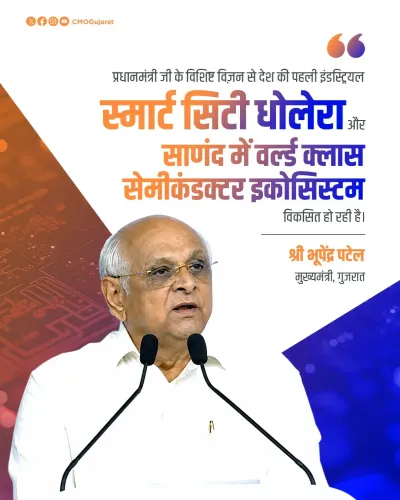
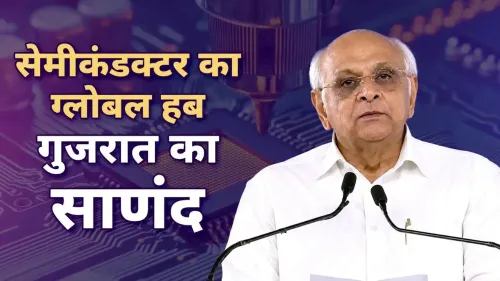
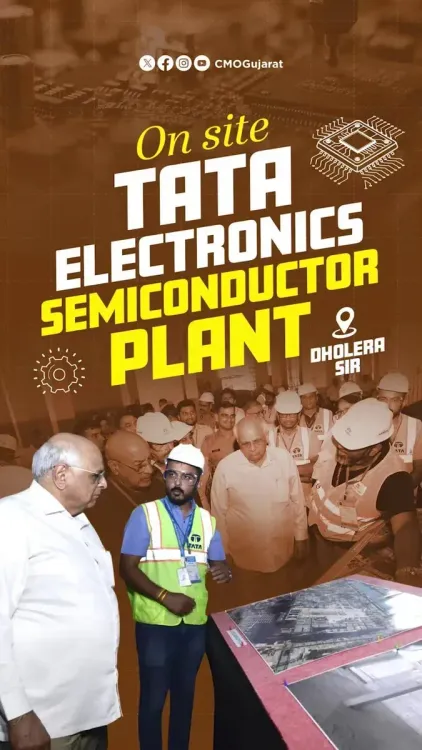
Gujarat Chief Minister Bhupendra Patel visited Tata Electronics' semiconductor fabrication facility at Dholera Smart City on 16 October 2026, reviewing construction progress as part of PM Modi's vision to make India a global semiconductor hub under the Rs 76,000 crore India Semiconductor Mission.
Key Takeaways
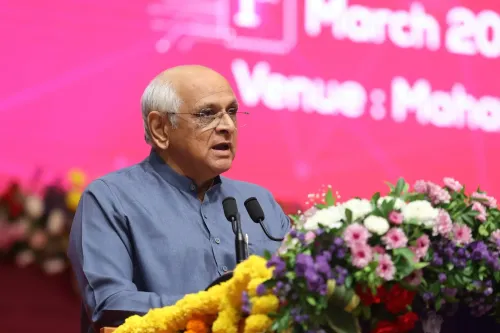
CM Bhupendra Patel conducted an on-site review of Tata Electronics' semiconductor fabrication facility at Dholera Smart City on 16 October 2026 .
Dholera is being developed as India's first 'Semicon City' — an end-to-end semiconductor manufacturing district, not just a single plant.
The facility is backed by the India Semiconductor Mission , approved in December 2021 with a Rs 76,000 crore central outlay.
Tata Electronics signed the Dholera agreement in 2023–24 ; it is the most high-profile project under the Mission.
The ecosystem is expected to generate output across semiconductor production, ancillary industries, technology firms, and large-scale skilled employment.
The next critical milestone is the facility's commissioning and production start date, which will test India's semiconductor self-reliance ambitions in practice.
India's chip ambitions have a new checkpoint: Gujarat Chief Minister Bhupendra Patel toured Tata Electronics' semiconductor fabrication facility at Dholera Smart City on Friday, 16 October 2026, reviewing construction progress at the site that the state is positioning as the nucleus of India's first 'Semicon City'.
What Dholera's Semicon City ambition actually means
Dholera is no ordinary industrial zone. Conceived as a greenfield smart city under the Delhi-Mumbai Industrial Corridor framework, it has been earmarked specifically to anchor India's semiconductor ecosystem — the kind of dense cluster of fabs, equipment suppliers, design houses, and skilled labour that currently exists only in Taiwan, South Korea, and a handful of other Asian economies. CM Patel's visit, framed explicitly as part of Prime Minister Narendra Modi's vision to make India a global semiconductor hub, signals that the project has moved from blueprint to active construction review.
The Chief Minister's Office stated that the facility will power a broad ecosystem: semiconductor production, ancillary industries, technology companies, and large-scale skilled employment. The Gujarati post described it as 'સેમિકોન સિટી' — 'Semicon City' — underscoring that Dholera is being built not just as a single factory but as an end-to-end manufacturing district.
Tata Electronics and the India Semiconductor Mission behind the project
The facility under review belongs to Tata Electronics, the Tata Sons subsidiary that signed an agreement in 2023–24 to build a semiconductor assembly and test plant at Dholera under the India Semiconductor Mission (ISM). The ISM, approved by the Union Cabinet in December 2021 with an outlay of Rs 76,000 crore, was designed precisely to de-risk large-scale chip manufacturing investments through central incentives — a recognition that building fabs requires state support on a scale comparable to aerospace or defence.
Tata's entry into semiconductor manufacturing represents a landmark shift for an Indian industrial group historically associated with steel, autos, and software services. The Dholera facility is among the most visible proofs-of-concept for whether that Rs 76,000 crore commitment can translate into actual silicon production on Indian soil.
Gujarat's industrial edge and the Atmanirbhar play
India's semiconductor push sits squarely within the Atmanirbhar Bharat framework — the government's strategy to build self-reliance in critical technologies after global supply-chain shocks exposed the country's near-total dependence on East Asian chip imports. Gujarat has emerged as the preferred proving ground for this ambition, leveraging existing industrial corridors, state-level incentives, and the sheer scale of land available at Dholera — a greenfield site with room to grow into a full semiconductor district rather than retrofitting an existing industrial estate.
Multiple states have received approvals under the ISM, but the coordinated central-state architecture visible in Dholera — where national policy money, Tata's industrial muscle, and Gujarat's administrative bandwidth converge — makes it the most watched project in India's chip race.
The commissioning clock is now ticking
A CM-level site inspection at this stage typically precedes formal milestone reviews tied to disbursement conditions or commissioning timelines. The key open question is when the Dholera fab moves from construction to actual production — the moment that will determine whether India's semiconductor ambitions graduate from policy document to global supply-chain reality.
If Dholera delivers, India will have proved it can build the industrial infrastructure to compete in the world's most strategically contested technology sector. That, more than any single inspection visit, is the story being written here.
Point of View
Where semiconductor self-reliance has become as symbolically potent as space launches. The real test, however, is commissioning: India has made chip manufacturing announcements before; Dholera's ability to deliver production-ready output will determine whether this policy cycle breaks from the pattern. Gujarat's administrative and industrial convergence at this site makes it the benchmark against which all other ISM-backed projects will be measured.
NationPress
16 Oct 2026
Frequently Asked Questions
What is the Tata Electronics semiconductor facility in Dholera?
It is a semiconductor fabrication and assembly facility being built by Tata Electronics at Dholera Smart City in Gujarat under the India Semiconductor Mission, which was approved in December 2021 with a Rs 76,000 crore central outlay.
What is Dholera Smart City and why is it called Semicon City?
Dholera is a planned greenfield smart city in Gujarat under the Delhi-Mumbai Industrial Corridor. It is being branded 'Semicon City' because it is being developed as an integrated semiconductor ecosystem — covering fabs, ancillary industries, tech companies, and skilled employment — rather than a single factory.
What is the India Semiconductor Mission?
The India Semiconductor Mission (ISM) is a central government programme approved in December 2021 with a Rs 76,000 crore outlay to attract and support semiconductor manufacturing investments in India and build a domestic chip ecosystem.
Why did Gujarat CM Bhupendra Patel visit the Dholera semiconductor site?
CM Patel visited the Tata Electronics facility on 16 October 2026 to review construction progress and the overall advancement of the project, which forms a key part of PM Modi's vision for India to become a global semiconductor hub.
When will the Tata Electronics Dholera semiconductor facility start production?
The exact commissioning date has not been officially announced. The facility is currently under construction, and the production start date is the most closely watched milestone for India's semiconductor ambitions.