Gujarat CMO Hails India's 300 GW Renewable Energy Milestone
Synopsis
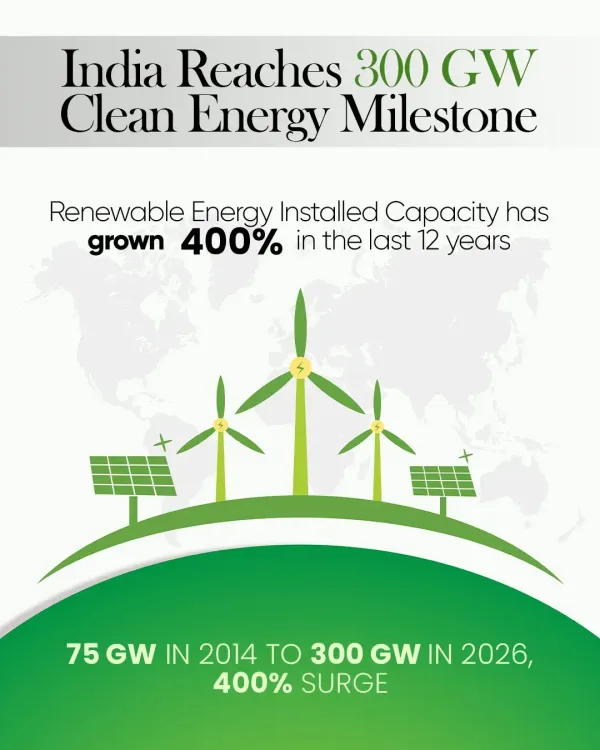
India has crossed 300 GW of installed renewable energy capacity, a 400 per cent rise from 75 GW in 2014. The Chief Minister's Office of Gujarat hailed the milestone on 8 August 2026 as a step toward the Viksit Bharat vision and India's 500 GW non-fossil target by 2030.
Key Takeaways
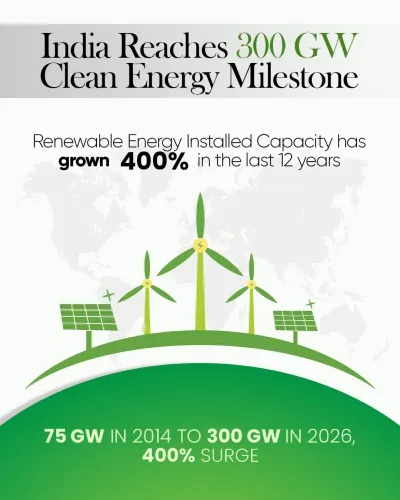
India's renewable energy installed capacity crossed 300 GW as of August 2026 , up from 75 GW in 2014 — a 400 per cent increase over 12 years.
The Chief Minister's Office of Gujarat credited the achievement to PM Narendra Modi 's policy direction.
India's Panchamrit strategy, announced at COP26 in 2021 , set a target of 500 GW non-fossil fuel capacity by 2030 — the next major benchmark.
India also holds a net-zero by 2070 commitment under its Paris Agreement obligations.
Gujarat has been a leading contributor to national renewable capacity through solar and wind policies.
The PLI scheme for solar modules aims to ensure domestic manufacturing keeps pace with capacity expansion.
India has crossed 300 gigawatts of installed renewable energy capacity — a fourfold jump from the 75 GW the country held when Prime Minister Narendra Modi took office in 2014. The Chief Minister's Office of Gujarat marked the milestone on 8 August 2026, calling it a 'historic leap towards a greener tomorrow' and a testament to India's resolve to lead the global clean energy transition.
From 75 GW to 300 GW: Twelve Years That Rewired India's Energy Map
The numbers tell a stark story. In 2014, India's total renewable installed capacity stood at 75 GW — respectable for a developing economy, but far short of a global leader. Twelve years later, that figure has quadrupled to 300 GW, a 400 per cent surge the CMO's office described as 'phenomenal.' The trajectory was not accidental: it was built on a sequence of escalating policy bets, each bigger than the last.
The inflection point came in 2015, when the government dramatically revised the National Solar Mission target to 100 GW of solar capacity by 2022 — a number that seemed audacious at the time. Then, at COP26 in Glasgow in 2021, India unveiled its Panchamrit climate strategy, anchored by a pledge to reach 500 GW of non-fossil fuel capacity by 2030 and achieve net-zero emissions by 2070. The 300 GW crossing is the clearest proof yet that those pledges were more than diplomatic theatre.
Gujarat's Role in the Green Surge
Gujarat has been one of the engine states behind the national push. Dedicated solar and wind policies, including early hybrid renewable zones and the Dholera Solar Park corridor, gave the state an outsized share of India's capacity additions. The CMO's decision to amplify this national milestone is also a quiet assertion of Gujarat's contribution to a story the Centre is rightly proud of.
The domestic manufacturing angle matters too. The Production Linked Incentive (PLI) scheme for solar modules was designed precisely to ensure that India's capacity growth did not simply mean importing panels — it was meant to build an industrial base. That bet is now being tested at scale as the 300 GW figure invites scrutiny of how much of the hardware is made in India.
What the 300 GW Mark Means for Viksit Bharat
The CMO's post explicitly links the milestone to Viksit Bharat — the government's flagship vision of transforming India into a fully developed economy by 2047, with sustainability as a non-negotiable pillar. Renewable energy is not a side agenda in that framework; it is load-bearing. A grid increasingly powered by solar and wind reduces India's chronic dependence on imported fossil fuels, tightens the current account, and gives industry a credible green-energy story to tell global buyers demanding clean supply chains.
The harder challenge now is the gap between 300 GW and the 500 GW non-fossil target by 2030. Four years, 200 more gigawatts — and the next tranche will require not just more panels and turbines, but a grid robust enough to absorb intermittent generation without blackouts. Storage, transmission infrastructure, and state-level grid integration are the unsexy but decisive variables that will determine whether India actually lands on 500 GW or falls short.
India did not just build capacity. It built credibility — and now it has to build the grid to match.
Point of View
Not merely a round-number photo opportunity — it validates the government's decade-long strategy of setting targets that once seemed reckless and then engineering policy ecosystems to chase them. For PM Modi, it reinforces a clean-energy narrative that travels well internationally, particularly as India courts green-bond investors and seeks to position itself as a credible alternative to China in global supply chains. The harder political economy question is whether grid infrastructure investment will match generation capacity, or whether the 500 GW target by 2030 risks becoming a nameplate figure disconnected from actual power delivery. Gujarat's eagerness to amplify the announcement also signals that state governments see electoral and reputational value in being associated with the national green story.
NationPress
8 Aug 2026
Frequently Asked Questions
Has India really crossed 300 GW of renewable energy capacity?
According to the Chief Minister's Office of Gujarat's post on 8 August 2026 , India has crossed 300 GW of installed renewable energy capacity. The exact verified date of crossing has not been independently confirmed in available records.
What was India's renewable energy capacity in 2014?
India's total installed renewable energy capacity stood at approximately 75 GW in 2014 , the year PM Narendra Modi's government took office. The jump to 300 GW represents a roughly 400 per cent increase over 12 years.
What is India's renewable energy target for 2030?
Under the Panchamrit strategy announced at COP26 in Glasgow in 2021 , India has committed to achieving 500 GW of non-fossil fuel electricity capacity by 2030 . The 300 GW milestone marks significant progress toward that goal.
What is Viksit Bharat and how does renewable energy connect to it?
Viksit Bharat is the Indian government's national vision to transform India into a fully developed economy by 2047 . Renewable energy is a core pillar of that framework, reducing import dependence on fossil fuels and supporting India's net-zero commitment by 2070 .
What role has Gujarat played in India's renewable energy growth?
Gujarat has been one of India's leading states for solar and wind energy deployment, with dedicated renewable energy zones and large solar parks contributing significantly to the national installed capacity total.