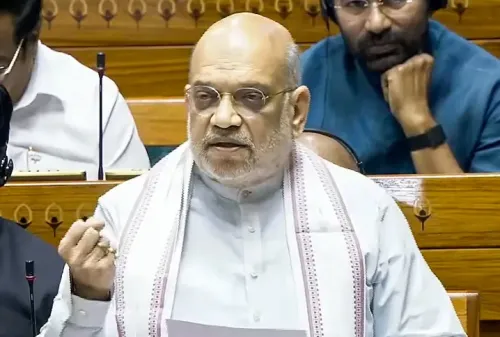
Gujarat's Chief Minister Bhupendra Patel Introduces UCC Bill in Assembly

Synopsis
On March 24, 2026, Chief Minister Bhupendra Patel introduced the Gujarat Uniform Civil Code Bill in the State Assembly, aiming to unify laws on marriage, divorce, and live-in relationships, amidst public scrutiny and political discussion.
Key Takeaways
Introduction of UCC Bill: Presented by CM Bhupendra Patel.
Unified Legal Framework: Covers marriage, divorce, inheritance, and live-in relationships.
Penalties: Includes fines and imprisonment for non-compliance and related offences.
Community Rights: Maintains exemptions for groups with customary rights.
Legislative Comparison: Similar to Uttarakhand's UCC initiative.
Gandhinagar, March 24 (NationPress) The Gujarat Uniform Civil Code (UCC) Bill, 2026, was officially presented in the State Assembly on Tuesday by Chief Minister Bhupendra Patel.
This legislation, introduced in the concluding phase of the ongoing budget session, seeks to create a unified legal structure governing marriage, divorce, inheritance, live-in relationships, and other related issues for all citizens in the state.
The Bill was introduced amidst significant public and political scrutiny, following the release of a comprehensive committee report the previous week.
While presenting the Bill in the Assembly, Chief Minister Patel highlighted the essential aspects of the proposed legislation, underlining its emphasis on legal protection and gender justice.
He stated that a penalty of Rs 10,000 would be enforced for any failures in registration, and actions involving multiple marriages could incur a prison term of up to seven years for cheating and bigamy.
Furthermore, Chief Minister Patel indicated that divorces executed outside the judicial framework would be deemed invalid, carrying a potential imprisonment of up to three years.
The Bill also mandates the formal registration of all live-in relationships within one month, with fines applicable for non-compliance.
He asserted, "It is our duty to protect the rights and dignity of our daughters. This Bill embodies a commitment to women's respect and empowerment."
The proposed legislation encompasses measures to regulate live-in partnerships and establish a legal framework for them through compulsory registration, marking a significant shift from the current situation where such relationships lack uniform codification.
Drafted based on the recommendations from a committee led by retired Supreme Court Judge Ranjana Desai, the UCC Bill represents the government's intention to standardize civil laws across diverse communities, although it maintains exemptions for groups with constitutionally recognized customary rights.
With its introduction, the Bill is now set to undergo thorough deliberation and a clause-by-clause review in the State Assembly.
Discussions will likely encompass both the core provisions and constitutional issues related to personal law reforms.
This move positions Gujarat on a legislative trajectory akin to Uttarakhand, which previously enacted its own Uniform Civil Code to oversee personal laws across communities.
Point of View
The introduction of the UCC Bill signifies an important shift towards standardized legal frameworks in India. It raises vital discussions on personal law reform and gender justice, showcasing the government's commitment to addressing these issues while balancing community rights.
NationPress
24 Sept 2026
Frequently Asked Questions
What is the purpose of the Gujarat UCC Bill?
The Gujarat UCC Bill aims to establish a common legal framework for marriage, divorce, inheritance, and live-in relationships, ensuring uniformity across communities.
What penalties are included in the UCC Bill?
The Bill imposes a fine of Rs 10,000 for failure to register necessary documents and includes severe penalties for offences like bigamy and invalid divorces.
Who drafted the Gujarat UCC Bill?
The Bill was drafted based on recommendations from a committee led by retired Supreme Court Judge Ranjana Desai.
How does the UCC Bill affect live-in relationships?
The Bill mandates that all live-in relationships be formally registered within one month, with penalties for non-compliance.
What are the next steps for the UCC Bill after its introduction?
After being tabled, the Bill will undergo detailed discussions and clause-by-clause consideration in the State Assembly.