CM Himanta Announces ₹82,000 Cr Siliguri–Silchar Corridor

Synopsis
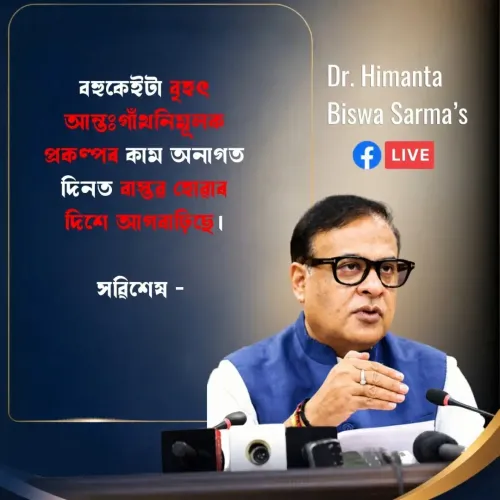
Assam CM Himanta Biswa Sarma announced the Siliguri–Silchar Express Corridor, backed by ₹82,000 crore from the central government, promising to cut Silchar–Guwahati travel to 5 hours and Silchar–Siliguri travel to 13 hours in the coming years.
Key Takeaways
The Siliguri–Silchar Express Corridor will reduce Silchar to Guwahati travel time to 5 hours .
The Silchar to Siliguri journey will be completed in 13 hours via the new corridor.
The Government of India is investing ₹82,000 crore in the highway project.
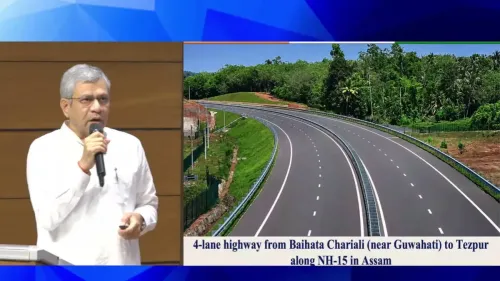
The project is part of a sustained central push for Northeast connectivity under programmes like Bharatmala Pariyojana and SARDP-NE .
Silchar , in Assam's Barak Valley , stands to gain the most from improved links to both the state capital and the Northeast's gateway city Siliguri .
Land acquisition, environmental clearances, and construction milestones remain key factors to watch as the project advances.
A journey that currently devours an entire day could soon fit inside a morning. Assam Chief Minister Himanta Biswa Sarma announced on Wednesday, 30 September 2026 that the Siliguri–Silchar Express Corridor will slash the travel time between Silchar and Guwahati to just 5 hours, and between Silchar and Siliguri to 13 hours — a transformation he said the Government of India is backing with a staggering ₹82,000 crore outlay.
What the Corridor Promises for Barak Valley
Silchar, the principal city of Assam's Barak Valley, has long been one of the Northeast's most connectivity-starved urban centres. Hemmed in by the Barail range and the complex terrain of southern Assam, residents face arduous multi-hour drives just to reach the state capital. Sarma's post, written in Hindi, states plainly: 'आने वाले कुछ वर्षों में सिलचर से गुवाहाटी का सफर केवल 5 घंटे में... पूरा किया जा सकेगा' ('In the coming years, the journey from Silchar to Guwahati will be completed in just 5 hours').
The corridor also bridges a larger regional gap. Siliguri in West Bengal is the de facto gateway city for all of Northeast India — the narrow Chicken's Neck corridor connects the Seven Sisters to the Indian mainland. A fast, high-capacity expressway linking Siliguri directly to Silchar would mean goods, people, and economic opportunity can move with an ease the region has never known.
₹82,000 Crore and the Long Road to This Moment
The headline investment figure of ₹82,000 crore dwarfs most single-project allocations the Northeast has seen. It reflects both the engineering complexity of cutting highways through the hilly terrain of Assam, Meghalaya, and the foothills approaching West Bengal, and the political weight successive central governments have placed on integrating the region.
That political will has a documented history. The Special Accelerated Road Development Programme for North East (SARDP-NE), approved in 2005, was an early structured attempt to upgrade road networks across the northeastern states. The Bharatmala Pariyojana, launched in 2015, folded multiple expressway and national highway projects in the Northeast into a single national programme — and the Siliguri–Silchar corridor fits squarely within that broader architecture.
The Real Test: Land, Clearances, and Deadlines
Announcements of this scale are only as good as their execution. Large highway projects in the Northeast have historically faced delays tied to land acquisition disputes, environmental clearances through ecologically sensitive zones, and the sheer logistical challenge of building in difficult terrain. The corridor will require sustained monitoring through upcoming Union Budgets and National Highways Authority of India (NHAI) milestone updates to confirm construction is on track.
For now, the announcement signals that Barak Valley's long-standing demand for world-class connectivity has reached the very top of the national infrastructure agenda. When the highway opens, the first truck that rolls from Siliguri to Silchar in 13 hours will mark something more than a road — it will mark a region, finally, connected.
Point of View
A region with a distinct linguistic and cultural identity that has historically felt peripheral within the state. For CM Sarma, championing a project of this scale reinforces his positioning as a transformational administrator bridging the longstanding development gap between Brahmaputra Valley and Barak Valley constituencies. The ₹82,000 crore figure, if realised, would represent one of the largest single highway investments ever directed at the subregion, deepening the BJP's narrative of Northeast integration under the current central government. The harder test will come at execution — Northeast megaprojects have a well-documented record of cost overruns and timeline slippage, and the project's credibility will ultimately rest on NHAI delivery, not announcement energy.
NationPress
30 Sept 2026
Frequently Asked Questions
What is the Siliguri–Silchar Express Corridor?
The Siliguri–Silchar Express Corridor is a proposed high-speed highway project connecting Siliguri in West Bengal with Silchar in Assam, designed to dramatically cut travel times across the Northeast.
How much will the Siliguri–Silchar highway cost?
The Government of India is investing ₹82,000 crore in the construction of the Siliguri–Silchar Express Corridor, according to Assam CM Himanta Biswa Sarma's announcement.
How long will it take to travel from Silchar to Guwahati after the corridor is built?
Once the Siliguri–Silchar Express Corridor is operational, the Silchar to Guwahati journey is expected to take just 5 hours .
What is the current travel time from Silchar to Siliguri?
The current road journey from Silchar to Siliguri is significantly longer than the projected 13 hours the new corridor aims to achieve; exact current durations vary by route and mode but typically exceed 20 hours by road.
Is the Siliguri–Silchar corridor part of Bharatmala Pariyojana?
The corridor aligns with the broader Bharatmala Pariyojana framework launched in 2015, which includes multiple national highway and expressway projects targeting Northeast connectivity, though the specific project linkage has not been formally confirmed in official gazette records.