Maurice Sedwell's Prof. Andrew Ramroop: A modern epic in bespoke tailoring
Synopsis
From a framed certificate in a Mumbai tailor's shop to a full biography launched in New Delhi — 'Bespoken' tells the story of Prof. Andrew Ramroop, who overcame poverty, racism, and displacement to own Maurice Sedwell on Savile Row and become the first tailor appointed a Visiting Professor of the London Institute. It is a diaspora story India has rarely stopped to tell.
Key Takeaways
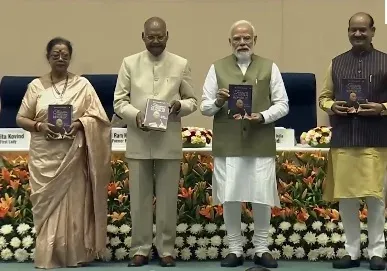
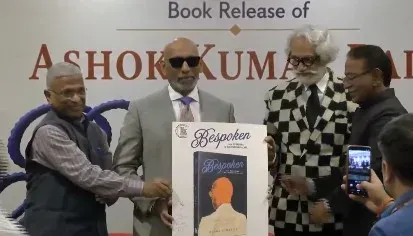
Ashok Kumar Bal launched the book 'Bespoken' at the India Habitat Centre, New Delhi on 22 August .
Ramroop is the Indian-origin owner of Maurice Sedwell on Savile Row and founder of the Savile Row Bespoke Academy .
Ramroop was born in Trinidad and Tobago and is the first tailor appointed a Visiting Professor of the London Institute .
Ramroop spoke candidly about facing racial discrimination early in his career, saying he was 'too naive to know what racism meant' at the time.
High Commissioner Chandradath Singh noted that Trinidad and Tobago's President traces roots to Uttar Pradesh and the Prime Minister to Bihar .
Author Ashok Kumar Bal launched his book 'Bespoken' at the India Habitat Centre in New Delhi on 22 August, celebrating the extraordinary life of Prof. Andrew M. Ramroop — Indian-origin owner of London's storied tailoring house Maurice Sedwell and founder of the Savile Row Bespoke Academy. Bal described Ramroop's journey from poverty in Trinidad and Tobago to the pinnacle of British bespoke tailoring as 'no less than a modern epic.'
How the Book Came to Be
The idea for 'Bespoken' was sparked during an unlikely moment. While visiting a tailoring shop in Mumbai, Bal's attention was drawn to a framed certificate on the wall bearing the name Savile Row Bespoke Academy and Andrew M. Ramroop's signature. 'The owner of the shop went on to talk about Andrew. He told me that Andrew is a legend, a craftsman of extraordinary order,' Bal recounted. 'That left an impression on me about Andrew. Then I carried the name back home, and found a wealth of information online.'
Bal said he was moved to document Ramroop's life after recognising him as 'an extraordinary man of innovation, sartorial art, workmanship and a source of information.' He added, 'His story deserves to be told in the form of a book.'
Ramroop's Journey: From Trinidad to Savile Row
Prof. Andrew M. Ramroop, born in Trinidad and Tobago to a family of Indian-origin descent, rose to become the owner of Maurice Sedwell on Savile Row and the first tailor to be appointed a Visiting Professor of the London Institute. Despite his global stature, Ramroop was initially reluctant to be the subject of a book. According to Bal, it was the mention of a chapter dedicated to his Indian ancestral roots that changed his mind. 'He became emotional and excited, as many people think of him as African,' Bal said.
Ramroop himself spoke candidly about the hardships he faced. 'It was a challenge to leave Trinidad and go to England,' he said. 'The challenges were deep — not being trained in a field in a different way of working, but it went beyond that. The challenges were how I looked, the colour of my skin, the colour of my hair when I used to have it. There were so many challenges, even the way I spoke.'
Ramroop said his background left him initially unaware of the discrimination he encountered. 'Given my background, I was too naive to know what racism meant. So, when someone turned me down, I thought that I was just not suitable. I didn't realise until much later,' he said.
The Diaspora Dimension
High Commissioner of Trinidad and Tobago to India, Chandradath Singh, attended the launch and reflected on the broader significance of Ramroop's story. 'It shows that it doesn't matter about the beginning of anybody's life, what matters is what happens at the end. You may start very humble and very simple, but what you achieve in the end is really what matters,' Singh said.
Singh also highlighted the deep ties between Trinidad and Tobago and India, noting that several senior leaders of his country trace their roots to India. 'Our current President is from Uttar Pradesh while the Prime Minister hails from Bihar,' he said. He added that the book 'is giving meaning to the relationship between the Indian diaspora and the world.'
Legacy and Recognition
Ramroop's ascent to the top of one of the world's most exclusive crafts — despite systemic barriers of race, class, and origin — has made him a symbol of resilience within the global Indian diaspora. This is the first full-length biography dedicated to his life and work. With the Savile Row Bespoke Academy continuing to shape the next generation of tailors, Ramroop's influence on the craft extends well beyond his own atelier. The book's launch in New Delhi underscores the growing recognition of diaspora narratives as an integral part of India's cultural story.
Point of View
Yet rarely receive the long-form biographical treatment they deserve. Ramroop's story is not simply one of individual triumph — it is a lens on how race, class, and colonial geography shaped access to craft and commerce in mid-twentieth-century Britain. What mainstream coverage of the book launch missed is the structural dimension: Ramroop did not just succeed despite discrimination, he built an institution — the Savile Row Bespoke Academy — that now trains others, potentially breaking the very barriers he once encountered. That is the more durable legacy, and the book would do well to centre it.
NationPress
22 Aug 2026
Frequently Asked Questions
Who is Prof. Andrew M. Ramroop?
Prof. Andrew M. Ramroop is an Indian-origin master tailor born in Trinidad and Tobago who owns Maurice Sedwell, a bespoke tailoring house on London's Savile Row. He is also the founder of the Savile Row Bespoke Academy and the first tailor to be appointed a Visiting Professor of the London Institute.
What is the book 'Bespoken' about?
'Bespoken,' authored by Ashok Kumar Bal, chronicles the life and work of Prof. Andrew M. Ramroop — his origins in Trinidad and Tobago, his Indian ancestral roots, and his rise to the top of British bespoke tailoring despite racial and social barriers. It was launched at the India Habitat Centre in New Delhi on 22 August.
How did author Ashok Kumar Bal discover Andrew Ramroop's story?
Bal first encountered Ramroop's name on a framed Savile Row Bespoke Academy certificate in a tailoring shop in Mumbai. The shop owner described Ramroop as 'a legend, a craftsman of extraordinary order,' prompting Bal to research further and eventually write the biography.
What challenges did Prof. Ramroop face in his career?
Ramroop faced racial discrimination, cultural displacement, and professional barriers after moving from Trinidad to England. He has said he was initially unaware that rejections he faced were rooted in racism, only realising it much later in his career.
What is the significance of the book for the Indian diaspora?
High Commissioner of Trinidad and Tobago to India, Chandradath Singh, said the book gives meaning to the relationship between the Indian diaspora and the world, noting that senior leaders of Trinidad and Tobago — including the President and Prime Minister — trace their roots to Indian states Uttar Pradesh and Bihar respectively.