HP CM Office Unveils Revenue-Share Model for Clean Energy Projects
Synopsis
The Chief Minister's Office of Himachal Pradesh has announced a four-way revenue-sharing model for clean energy projects, allocating 25% each to gram panchayat development and welfare of orphans and widows, 20% to the state government, and 20% to HimUrja.
Key Takeaways
The Chief Minister's Office of Himachal Pradesh announced a revenue-sharing framework for renewable energy projects on 14 July 2026 .
25 per cent of project revenues will go to gram panchayat development works.
25 per cent is earmarked for the welfare of orphaned children and widowed women .
HimUrja , the state's nodal renewable energy agency, will retain 20 per cent .
The state government receives the remaining 20 per cent .
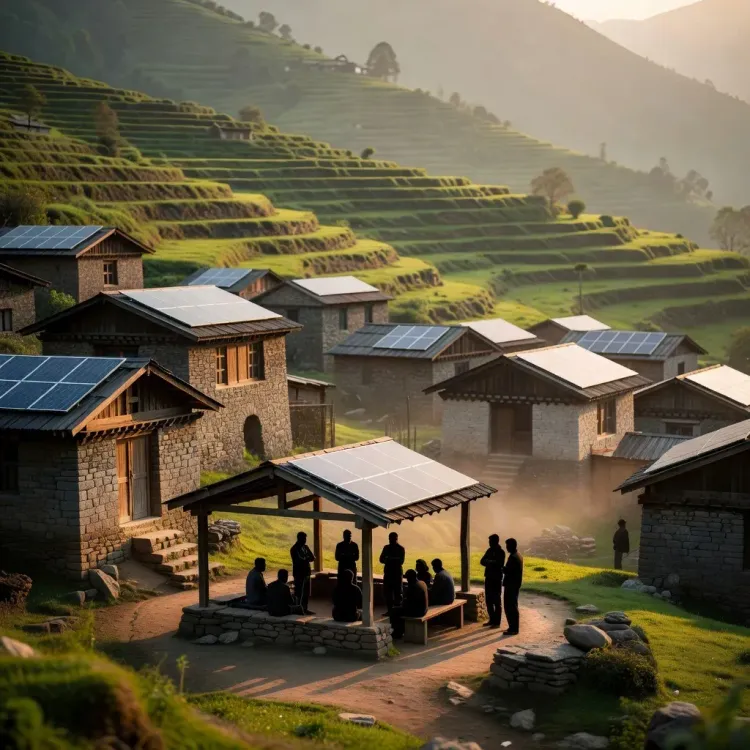
The model is designed to link clean energy generation with rural economic empowerment and social welfare.
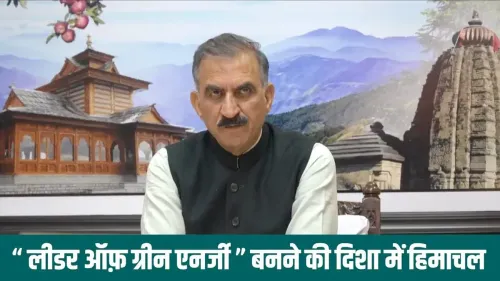
The Chief Minister's Office of Himachal Pradesh on Tuesday, 14 July 2026 announced a structured revenue-sharing framework for renewable energy projects in the state, outlining how income generated from clean-energy installations will be distributed among village bodies, welfare beneficiaries, the state government, and the nodal energy agency HimUrja.
Context
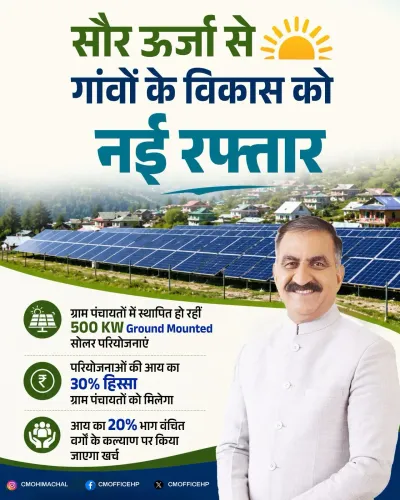
The post, shared by @CMOFFICEHP, spells out a four-way split of project revenues: '25% ग्राम पंचायत के विकास कार्यों के लिए' (25 per cent for gram panchayat development works), '25% अनाथ बच्चों एवं विधवा बहनों के कल्याण के लिए' (25 per cent for the welfare of orphaned children and widowed women), '20% प्रदेश सरकार' (20 per cent to the state government), and '20% हिमऊर्जा' (20 per cent to HimUrja). The announcement frames these projects as a vehicle for both clean energy generation and the economic empowerment of rural communities.
The statement explicitly notes that the projects will provide 'स्वच्छ ऊर्जा के साथ-साथ गांवों की आर्थिक सशक्तता को भी आधार' — a foundation for clean energy alongside the economic strengthening of villages.
Policy Backdrop
Himachal Pradesh is a Himalayan state with significant hydroelectric and solar potential, and has pursued renewable energy development for decades. HimUrja, the Himachal Pradesh Energy Development Agency, serves as the state's nodal body for promoting solar, small hydro, and biomass projects across the state's varied terrain.
The revenue-sharing model aligns with a broader national pattern in which Indian states have increasingly designed community-benefit mechanisms to secure local consent for renewable energy installations and channel proceeds into panchayat development and targeted social welfare. At the national level, the Jawaharlal Nehru National Solar Mission, launched in 2010, set the template for scaling grid-connected and off-grid solar deployment that states have since built upon with their own frameworks.
Stakeholders and Impact
Gram Panchayats — the elected village-level self-government bodies — stand to receive the largest single share at 25 per cent, earmarked specifically for local development works. An equal 25 per cent is directed toward two of the state's more vulnerable groups: orphaned children and widowed women, embedding a social-protection objective directly into the energy revenue stream.
HimUrja retains 20 per cent to sustain and expand its project pipeline, while the state government receives the remaining 20 per cent for broader fiscal use. The design ensures that a combined 50 per cent of revenues flows directly to grassroots development and welfare, giving local communities a tangible stake in the success of clean-energy infrastructure on their land.
What's Next
The key test will be the operationalisation of the revenue-collection mechanism and the audited, timely transfer of funds to gram panchayats and welfare accounts — details that are expected to surface in subsequent state budget documents and HimUrja project reports. Observers will watch whether the framework is applied uniformly across solar, small-hydro, and other renewable categories, and whether panchayats receive the capacity support needed to deploy their share effectively.
If implemented as announced, the model could serve as a reference point for other hill states seeking to combine renewable energy targets with rural economic empowerment and social welfare goals.
Point of View
The government is effectively building a constituency for its renewable energy agenda at the village level. The inclusion of HimUrja as a direct revenue beneficiary also signals an intent to make the agency financially self-sustaining rather than perpetually grant-dependent. The model's credibility, however, will hinge entirely on transparent, audited fund transfers that communities can verify.
NationPress
14 Jul 2026
Frequently Asked Questions
How will revenue from Himachal Pradesh's clean energy projects be distributed?
Revenue will be split four ways: 25% to gram panchayat development works, 25% to welfare of orphaned children and widowed women, 20% to the state government, and 20% to HimUrja, the state's nodal renewable energy agency.
What is HimUrja and what role does it play in Himachal Pradesh's energy projects?
HimUrja, or the Himachal Pradesh Energy Development Agency, is the state nodal body responsible for promoting and developing renewable energy projects — including solar, small hydro, and biomass — across Himachal Pradesh.
Who benefits from Himachal Pradesh's clean energy revenue-sharing scheme?
The primary beneficiaries are gram panchayats (for local development works), orphaned children, and widowed women. The state government and HimUrja also receive a share to fund governance and future energy projects.
How does Himachal Pradesh's energy revenue model compare to other Indian states?
Several Indian states have introduced community-benefit mechanisms for renewable energy projects, but Himachal Pradesh's explicit allocation to orphans and widows alongside gram panchayats reflects a dual infrastructure-plus-social-welfare approach that is relatively distinct.
What is the significance of directing clean energy revenue to gram panchayats in Himachal Pradesh?
Gram panchayats are the elected village-level self-government bodies in India. Directing 25% of energy revenues to them gives local communities a direct financial stake in renewable energy projects, potentially increasing acceptance and ensuring funds flow to grassroots development.