HP CMO: 4% land registration fee, ₹35,000 for Mahila Mandals
Synopsis
The Chief Minister's Office of Himachal Pradesh announced a 4% land registration fee for property bought in women's names and a ₹35,000 honorarium for participating Mahila Mandals, framing both measures as steps toward women's economic self-reliance.
Key Takeaways
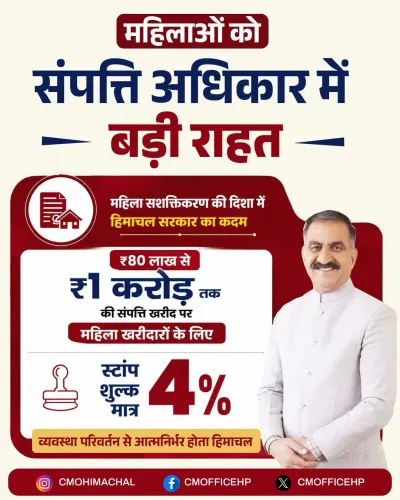
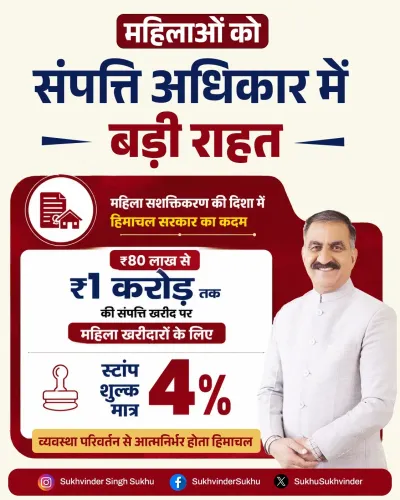
The Himachal Pradesh government has fixed the property registration fee at 4% for land purchased in a woman's name.
Participating Mahila Mandals will each receive an honorarium of ₹35,000 as a dignity grant.
The Chief Minister's Office framed both moves as support for women's aatmanirbharta (self-reliance).
Mahila Mandals are community women's groups active in savings, credit, and rural welfare across Himachal Pradesh.
Eligibility rules and disbursement timelines for both schemes are yet to be publicly detailed.
Reduced registration fees for women buyers mirror a model adopted by multiple Indian states to raise female property ownership.
Women in Himachal Pradesh are stepping forward on every front — and the state government is putting money behind that momentum. The Chief Minister's Office of Himachal Pradesh announced on Wednesday, 28 October 2026 a pair of welfare measures aimed at accelerating women's economic independence: a reduced 4% registration fee on land purchased in a woman's name, and an honorarium of ₹35,000 each for participating Mahila Mandals.
The post, shared in Hindi, reads: 'हिमाचल प्रदेश की महिलाएँ हर मोर्चे पर बढ़-चढ़कर भाग लेते हुए आत्मनिर्भरता की ओर बढ़ रही हैं' — 'Women of Himachal Pradesh are advancing towards self-reliance by participating actively on every front.' The office framed both announcements as cause for collective pride.What the 4% registration fee actually means for women buyers
Across India, stamp duty and registration charges on property have long functioned as a quiet barrier to female asset ownership. Several states have periodically lowered these levies when the buyer is a woman — a nudge that economists broadly credit with raising the share of property registered in women's names. Himachal Pradesh's move to cap the registration fee at 4% for land purchased in a woman's name follows that established playbook, with the explicit goal of putting more land titles into female hands.
Land ownership matters beyond the title deed. A woman who holds property has collateral for loans, standing in legal disputes, and a tangible stake in local governance. In a hill state where agricultural land is fragmented and migration is high, formalising women's ownership can reorder household economic power in lasting ways.
₹35,000 honorarium and the Mahila Mandal network
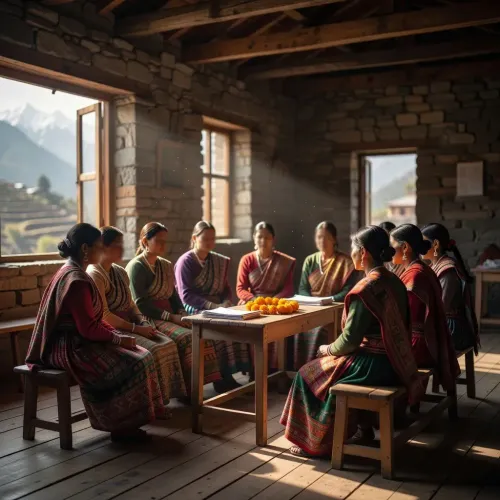
Mahila Mandals — women's community groups rooted in savings, credit, and collective action — have been a pillar of rural welfare architecture in Himachal Pradesh since the self-help group model gained national traction in the 1990s. They organise everything from thrift funds and skilling sessions to cultural programmes and local dispute resolution. The government's decision to award participating Mahila Mandals a dignity honorarium of ₹35,000 each is a signal of institutional recognition, not just financial support. The money can seed group activities, fund training, or build the savings corpus that makes a Mandal creditworthy.
Details on eligibility criteria and the disbursement timeline for both measures — the registration fee structure and the honorarium — have not yet been published, and those guidelines will determine just how wide a net each scheme casts.
Self-reliance as a state-level policy thread
Both measures slot into a broader national conversation about aatmanirbharta — self-reliance — as applied to women's economic lives. Where the Centre has pushed this agenda through credit-linked schemes and skill missions, state governments add the last-mile layer: property rights that stick, community institutions that have real money to work with, and a public affirmation that women's participation is a governance priority, not an afterthought. Himachal Pradesh, with its relatively high female literacy and strong Mahila Mandal density, has the infrastructure to convert these two announcements into measurable ground-level change — if implementation follows swiftly.
The mountain state just set a clear bar. Now the paperwork has to match the promise.
Point of View
Not just cash transfers, are the faster route to durable female economic agency. The registration fee reduction follows a well-tested model from other Indian states, lending it credibility, but the honorarium for Mahila Mandals is the more politically distinctive signal: it rewards collective organising, not just individual transactions. The real test will be implementation speed and the breadth of eligibility criteria, which can either make these headline numbers meaningful or keep them symbolic. In a hill economy where male out-migration is structural, policies that anchor women's economic standing at home carry outsized long-run significance.
NationPress
28 Oct 2026
Frequently Asked Questions
What is the new land registration fee for women in Himachal Pradesh?
The Himachal Pradesh government has set the property registration fee at 4% for land purchased in a woman's name, aiming to make female property ownership more affordable.
How much honorarium will Mahila Mandals receive in Himachal Pradesh?
Participating Mahila Mandals in Himachal Pradesh will each receive an honorarium of ₹35,000 as a recognition grant from the state government.
What are Mahila Mandals and why are they important in Himachal Pradesh?
Mahila Mandals are women's community self-help groups involved in savings, credit, skilling, and local development. In Himachal Pradesh they form a dense grassroots network that has supported rural women's economic participation since the 1990s.
Which other Indian states have reduced registration fees for women buying property?
Several Indian states — including Delhi, Haryana, Rajasthan, and Punjab at various times — have offered lower stamp duty or registration fees when property is registered in a woman's name, a policy Himachal Pradesh is now extending to its own buyers.
When will the Himachal Pradesh women's property fee and Mahila Mandal honorarium be implemented?
The Chief Minister's Office of Himachal Pradesh announced both measures on 28 October 2026 , but detailed eligibility criteria and disbursement timelines have not yet been publicly released.