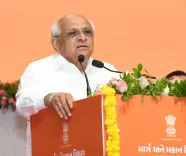
HP CMO Hails Historic Win on State Resource Rights
Synopsis
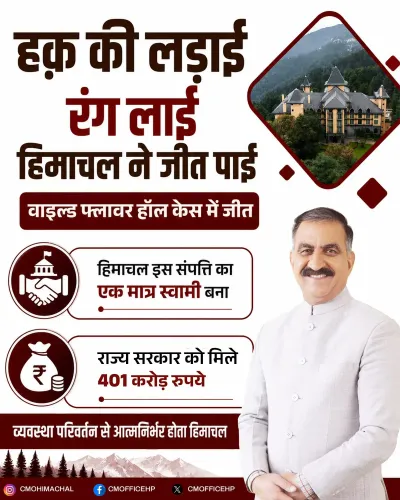
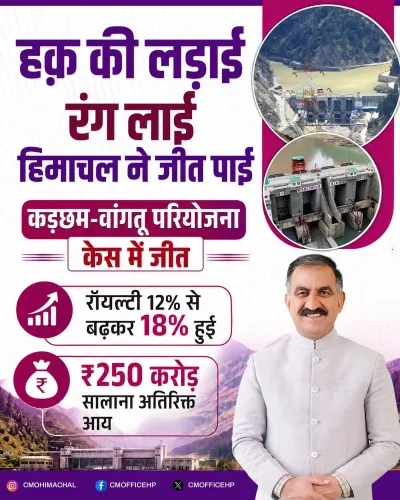
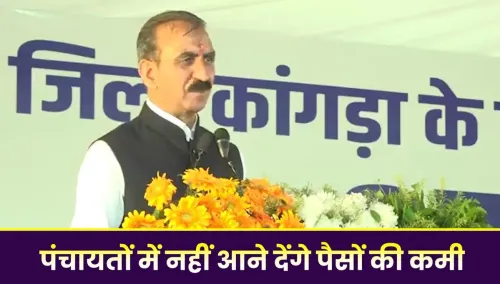
The Chief Minister's Office of Himachal Pradesh on 9 July 2026 announced a historic victory in protecting the state's rights over its natural resources, calling it a triumph of state self-respect that will secure future generations and open new avenues for development.
Key Takeaways
The Chief Minister's Office of Himachal Pradesh announced a 'historic victory' in protecting the state's rights over its natural resources on 9 July 2026 .
The official statement described the outcome as a 'triumph of the state's self-respect' ( राज्य के स्वाभिमान की विजय ).
The CMO said the achievement will secure the interests of future generations and provide a strong foundation for new development possibilities.
Himachal Pradesh has a long history of asserting greater control and enhanced royalties over hydroelectric and other natural resource projects since the 1990s .
The precise nature of the victory — judicial, legislative, or negotiated — was not specified in the post; formal clarification is awaited.
Downstream implications may include revised royalty formulae, new inter-state water agreements, and fresh revenue streams to be reflected in the state budget.
The Chief Minister's Office of Himachal Pradesh declared on Thursday, 9 July 2026 that the state has secured a historic victory in protecting its rights over natural resources, calling the achievement a triumph of state self-respect and a foundation for future development.
The official post stated: 'और संसाधनों पर प्रदेश के अधिकारों की रक्षा करते हुए मिली ऐतिहासिक जीत राज्य के स्वाभिमान की विजय है' — ('The historic victory achieved while protecting the state's rights over resources is a triumph of the state's self-respect.') The post further noted that this achievement would secure the interests of future generations while also providing a strong foundation for new possibilities of development.
Context
Himachal Pradesh is a northern hill state endowed with significant natural wealth, particularly in the form of hydroelectric potential, forest cover, and river systems. Successive state governments have, since at least the 1990s, pursued greater control and enhanced royalties from hydel projects and other resource-based arrangements with central agencies. The framing of such claims as matters of both federal equity and self-respect has been a consistent feature of the state's political discourse.
The Chief Minister's Office did not specify in the post whether the victory refers to a judicial order, a negotiated settlement, or a legislative or administrative decision. The language — 'historic victory' and 'protection of rights' — strongly implies a formal, binding outcome rather than a policy announcement.
Policy Backdrop
Himalayan states have long argued that their ecological sacrifices and resource endowments entitle them to a larger share of revenues generated within their borders. Himachal Pradesh in particular has litigated and negotiated over royalty formulae for hydroelectric projects, some of which are operated by central public sector undertakings on the state's rivers. These disputes have periodically reached the Supreme Court of India, which serves as the apex forum for centre-state and inter-state resource conflicts.
The broader pattern across Indian federalism shows resource-rich states — from mineral-bearing states in central India to hydel-rich Himalayan states — repeatedly asserting that existing revenue-sharing frameworks undervalue their natural assets. Such claims carry both immediate fiscal significance and long-term implications for how India's constitutional framework distributes the benefits of natural resource exploitation.
Stakeholders and Impact
The most direct beneficiaries of any expanded resource rights for Himachal Pradesh are its approximately 73 lakh residents, communities living near hydel project sites, and the state exchequer. Enhanced royalties or regulatory control could translate into greater public spending on infrastructure, health, and education in a state where revenue generation has historically been constrained relative to its development needs.
Central agencies, neighbouring states, and private or public sector project operators with stakes in Himachal's resource landscape would also be affected, depending on the precise nature of the ruling or agreement. The Chief Minister's Office's emphasis on 'future generations' signals that the state views this as a structural, long-term gain rather than a one-time windfall.
What's Next
Observers will watch for official clarification from the state government on the specific legal or administrative instrument behind this claimed victory — whether it is a Supreme Court judgment, an inter-state agreement, or a central government order. Follow-up developments could include revised royalty formulae, new water-sharing negotiations, or amendments to project-sharing arrangements that quantify the fiscal benefit to the state.
The state's next budget presentation will likely be the first occasion on which any fresh revenue streams arising from this outcome are formally quantified and appropriated, giving citizens and policymakers a clearer picture of the material gains behind the political milestone.
Point of View
Where resource-rich but fiscally constrained states feel the constitutional framework undercompensates them. By anchoring the announcement in intergenerational equity, the ruling establishment is also pre-empting opposition claims that short-term deals were struck at the cost of long-term interests. The absence of specifics in the post, however, leaves room for scrutiny once the underlying order or agreement enters the public domain.
NationPress
8 Oct 2026
Frequently Asked Questions
What is the historic victory announced by the Himachal Pradesh CMO?
The Chief Minister's Office of Himachal Pradesh announced on 9 July 2026 that the state has won a historic victory in protecting its rights over natural resources, though the specific legal or administrative instrument — whether a court order, settlement, or agreement — has not yet been publicly detailed.
What natural resources are at the centre of Himachal Pradesh's resource rights dispute?
Himachal Pradesh's resource rights claims have primarily centred on hydroelectric power projects, river waters, and forest resources, with the state seeking enhanced royalties and greater regulatory control from central agencies and project operators since the 1990s.
How does this affect ordinary residents of Himachal Pradesh?
If the victory translates into enhanced royalties or greater state control over resource revenues, the approximately 73 lakh residents of Himachal Pradesh could benefit through increased state spending on infrastructure, health, and education, though the fiscal quantum will become clear only in subsequent budget presentations.
Has Himachal Pradesh fought resource rights cases in the Supreme Court before?
Yes, Himachal Pradesh has periodically litigated and negotiated over resource royalties and hydel project revenues since the reorganisation of power corporations in the 1990s, with the Supreme Court of India serving as the apex forum for such centre-state and inter-state disputes.
What should we watch for next after this Himachal Pradesh resource rights announcement?
Key developments to watch include an official government clarification on the specific order or agreement behind the claimed victory, any revised royalty formulae or inter-state water-sharing negotiations that follow, and the state's next budget presentation, which may quantify fresh revenue streams arising from the outcome.