HP CM Office Seeks Higher Free Power Royalty from CPSUs
Synopsis
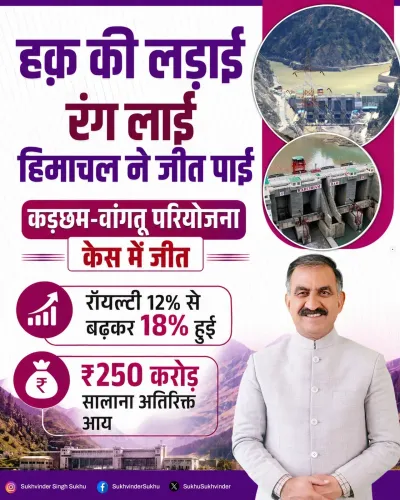
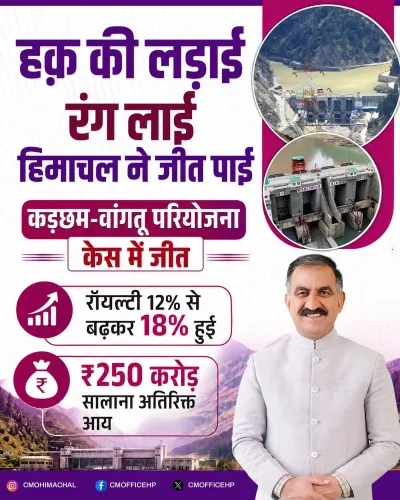
The Chief Minister's Office of Himachal Pradesh has formally requested an increase in free power royalty from Central Public Sector Undertakings for hydropower projects that have completed their initial 12-year period, over and above the existing standard rate of 12 percent.
Key Takeaways
The CMO Himachal Pradesh posted key points from a meeting on June 17, 2026 , including a formal demand for higher free power royalty from CPSU hydropower projects.
The state currently receives a standard 12 percent free power royalty from centrally operated hydropower projects, a rate fixed under India's 1998 hydro-power policy.
The demand specifically targets projects that have completed their initial 12-year commercial operation period, after which the state argues terms should be renegotiated.
Key CPSUs operating in Himachal Pradesh include NHPC and SJVN , which run several large hydropower stations across the state's river systems.
The request reflects a broader pattern of hill states seeking greater revenue from centrally owned infrastructure built on their natural resources.
The Union Ministry of Power will be the key authority to respond, with potential deliberations expected at national-level power forums.
The Chief Minister's Office of Himachal Pradesh, in a post on X on Wednesday, June 17, 2026, stated that the state has formally requested an increase in free power royalty from Central Public Sector Undertakings (CPSUs) operating hydropower projects within the state — specifically for projects that have completed their initial 12-year commercial operation period.
The post, shared by the official CMO Himachal Pradesh account, listed this as a key point from a meeting: 'केंद्रीय सार्वजनिक क्षेत्र उपक्रमों में प्रारंभिक 12 वर्षों की अवधि पूर्ण कर चुकी परियोजनाओं में सामान्य 12 प्रतिशत निःशुल्क बिजली रॉयल्टी के अतिरिक्त निःशुल्क बिजली रॉयल्टी की हिस्सेदारी बढ़ाने का अनुरोध किया' — translated: 'A request was made to increase the share of free power royalty, over and above the standard 12 percent free power royalty, for projects operated by Central Public Sector Undertakings that have completed their initial 12-year period.'
Context
Himachal Pradesh is among India's most hydropower-rich states, with major rivers including the Sutlej, Beas, and Chenab hosting a large number of centrally operated projects. Under the current framework, the state receives 12 percent of generated electricity free of cost from CPSU-run hydropower stations. This arrangement has been in place since India's hydro-power policy of 1998, which codified the free power royalty mechanism for host states. The royalty entitlement under this policy becomes applicable after the first 12 years of commercial operation of a project. Once a project crosses this threshold, the state has historically sought to renegotiate terms to reflect the matured revenue profile of the asset.Policy Backdrop
Central entities such as NHPC and SJVN operate several large hydropower stations across Himachal Pradesh. The 12 percent free power royalty forms a significant portion of the state's non-tax revenue from its natural water resources. However, hill states have long argued that once projects complete their initial tariff blocks — during which capital costs are being recovered — the host state's share should be revised upward to reflect the lower financial burden on the project operator and the ongoing environmental and social costs borne by local communities. This demand is not new to Himachal Pradesh. The state has periodically raised the issue in central forums, framing it as a matter of equitable sharing of revenue from riverine resources that lie within its geographic jurisdiction.Stakeholders and Impact
For Himachal Pradesh, an upward revision in free power royalty from mature CPSU projects would translate directly into greater electricity availability for redistribution — either for subsidised domestic supply or for sale in power markets, generating additional fiscal resources. The state government has consistently positioned this demand within the broader framework of fiscal federalism and the rights of resource-rich states. For CPSUs, any increase in free power obligation would reduce the quantum of power available for sale, affecting their revenue calculations. The Ministry of Power at the Centre would be the key decision-making authority on any revision to the existing royalty framework.What's Next
The formal request now awaits a response from the Union Ministry of Power. Any revision to the free power royalty structure would likely require policy-level deliberations, potentially at forums such as the Power Ministers' Conference or the Northern Zonal Council. The outcome of this engagement will be closely watched by other hydropower-hosting hill states, including Uttarakhand and Arunachal Pradesh, which face similar dynamics with centrally operated projects on their territory. A favourable ruling could set a precedent for wider royalty renegotiation across India's hydro-rich states.Point of View
Reflecting a structural tension between resource-rich hill states and centrally owned infrastructure operators. The timing of this formal request — placed on record via a CMO meeting note — signals that the state government is escalating the demand through official channels rather than leaving it as a routine representation. If the Centre responds positively, it could trigger similar claims from other hydropower-hosting states such as Uttarakhand and Arunachal Pradesh, making this a potentially consequential moment for how India prices the use of state-territory resources by central entities. The demand also underscores the fiscal pressure on hill states whose revenue options are constrained by geography and limited industrial bases.
NationPress
18 Sept 2026
Frequently Asked Questions
What is free power royalty in India's hydropower sector?
Free power royalty is the share of electricity that host state governments receive at no cost from hydropower projects operated by Central Public Sector Undertakings on their territory. Under India's hydro-power policy, this is currently set at 12 percent of generated power and becomes applicable after the first 12 years of commercial operation.
Why is Himachal Pradesh demanding more than 12 percent free power royalty?
Himachal Pradesh argues that once CPSU hydropower projects complete their initial 12-year tariff period — during which capital costs are being recovered — the host state's royalty share should be revised upward to reflect the project's matured financial position and the ongoing environmental and social costs borne by local communities.
Which central entities operate hydropower projects in Himachal Pradesh?
Major Central Public Sector Undertakings with hydropower operations in Himachal Pradesh include NHPC (National Hydroelectric Power Corporation) and SJVN (Satluj Jal Vidyut Nigam) , which together operate several large stations on the state's river systems.
Who will decide on Himachal Pradesh's royalty revision request?
The Union Ministry of Power is the key decision-making authority. Any revision to the free power royalty framework would likely be deliberated at national-level forums such as the Power Ministers' Conference or the Northern Zonal Council .
Does this demand affect other states beyond Himachal Pradesh?
Yes. Other hydropower-hosting hill states such as Uttarakhand and Arunachal Pradesh face similar dynamics with centrally operated projects. A favourable outcome for Himachal Pradesh could set a precedent for wider royalty renegotiation across India's hydro-rich states.