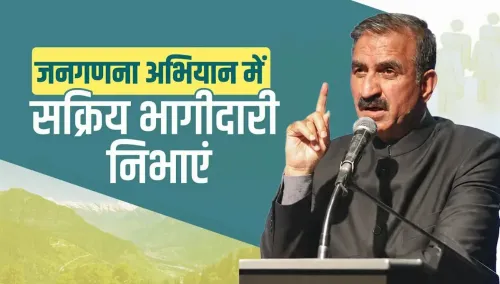
HP CM Office joins Census 2027 self-enumeration drive
Synopsis
The Chief Minister's Office of Himachal Pradesh participated in the Census 2027 self-enumeration campaign on 2 June 2026, registering details on se.census.gov.in and calling on all state residents to complete their self-enumeration by 15 June 2026, describing the census as the cornerstone of democracy and development.
Key Takeaways
The Chief Minister's Office of Himachal Pradesh publicly participated in the Census 2027 self-enumeration campaign on 2 June 2026 .
Residents are urged to register on se.census.gov.in before the 15 June 2026 deadline.
India's last completed census was in 2011 ; the 2021 exercise was postponed due to the COVID-19 pandemic .
Census data underpins welfare scheme targeting, fund allocation, and constituency delimitation across India.
Census 2027 uses a hybrid model combining digital self-enumeration with traditional field enumerator visits.
High participation in Himachal Pradesh is critical given the state's mountainous terrain and dispersed population.
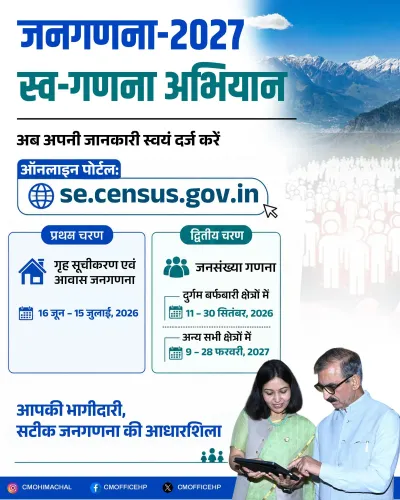
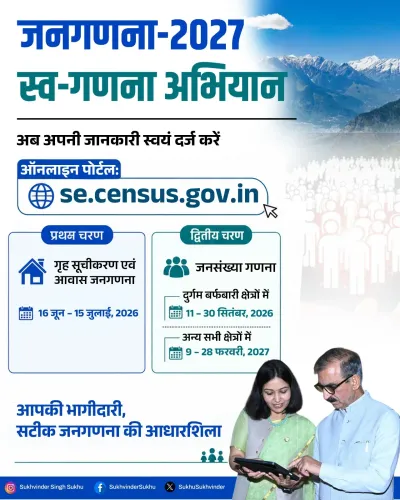
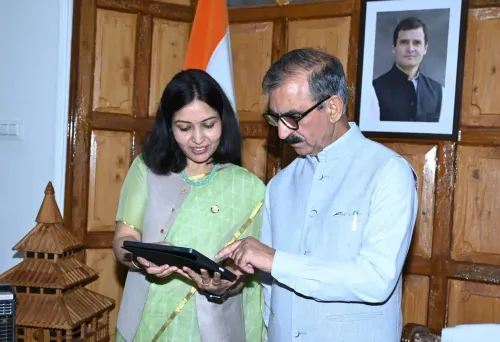
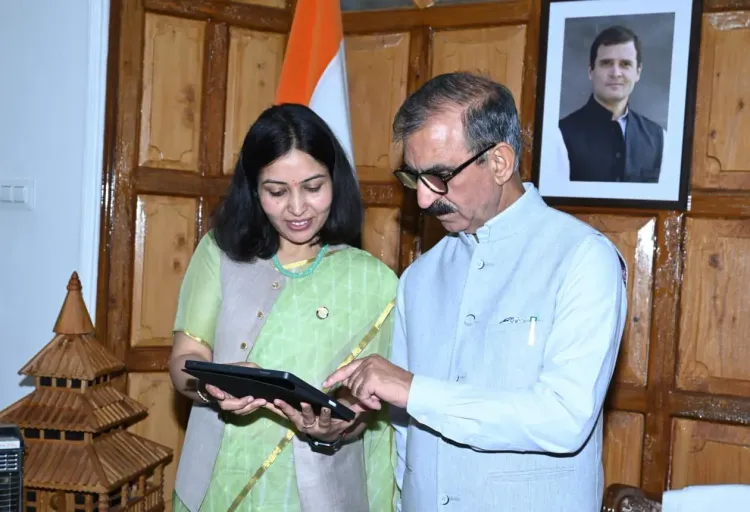
The Chief Minister's Office of Himachal Pradesh on Tuesday, 2 June 2026 announced participation in the Census 2027 self-enumeration campaign, registering details on the official portal se.census.gov.in and urging all state residents to complete their self-enumeration by 15 June 2026.
Context
The post, shared in Hindi, states: 'Aaj Janaganna-2027 ke swa-ganana abhiyan mein bhaag lekar apni jaankari online portal par darj ki' ('Today, by participating in the Census 2027 self-enumeration campaign, I registered my information on the online portal'). It further appeals to Himachal Pradesh residents to complete their self-enumeration before the 15 June 2026 deadline, describing the census as 'the cornerstone of our democracy and development' and noting that government schemes are built on its data.
The self-enumeration portal, se.census.gov.in, is the official digital gateway through which citizens can submit their household and demographic details ahead of enumerator visits. The CMO's public participation is a signal to residents that the exercise carries official weight and is not optional.
Policy Backdrop
India's last completed census was conducted in 2011, making it the longest gap between two census exercises in independent India's history. The Census 2021 exercise was postponed due to the COVID-19 pandemic and never completed, leaving planners, welfare agencies, and delimitation bodies reliant on over a decade-old data.
The Government of India subsequently announced Census 2027 as the next full enumeration cycle, incorporating a hybrid model that combines a digital self-enumeration phase with traditional field visits by enumerators. Self-enumeration forms the first stage: citizens log onto the portal, fill in household and personal data, and generate a reference number for the follow-up visit. This approach is part of a broader e-governance modernisation push that has been referenced in official statements since the mid-2010s, aimed at reducing costs and improving data timeliness.
Census data feeds directly into fund allocation formulas, constituency delimitation exercises, and targeting of welfare schemes such as food security, housing, and health programmes. The 2011 census data has been stretched well beyond its intended shelf life, and planners have flagged the distortions this creates in resource distribution.
Stakeholders and Impact
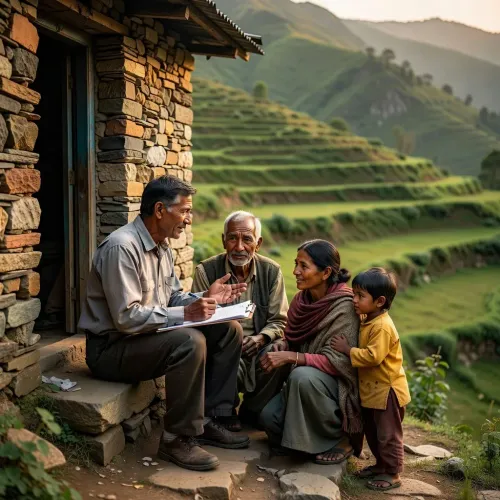
For Himachal Pradesh's roughly 75 lakh residents — spread across mountainous terrain with pockets of low digital literacy — the self-enumeration window represents both an opportunity and a logistical challenge. High participation rates from urban and semi-urban households can reduce the burden on field enumerators and improve data quality for remote areas.
Policy planners at the state and central levels depend on accurate census figures to calibrate allocations under centrally sponsored schemes. An undercounted or outdated demographic picture risks misallocation of funds for health infrastructure, midday meal programmes, and rural employment guarantees. Civil society organisations working on tribal welfare and gender equity in Himachal Pradesh have also flagged the importance of accurate enumeration for targeted interventions.
What's Next
The self-enumeration window closes on 15 June 2026, after which field enumerators are expected to visit households that have not self-registered. State governments across India are expected to track participation rates and run awareness campaigns through district administrations and gram panchayats.
Completion of the census will set the stage for a fresh delimitation exercise, updating of electoral rolls, and recalibration of welfare targeting — decisions with significant political and administrative consequences. How quickly the Registrar General and Census Commissioner processes and releases the data will determine when these downstream exercises can begin.
Point of View
Using institutional authority to nudge citizen compliance ahead of a hard deadline. With India operating on 2011 census data for over 15 years, the political stakes around a successful enumeration are high — accurate figures will reshape welfare allocations and, eventually, delimitation outcomes. For Himachal Pradesh, a hill state with dispersed settlements and seasonal migration, self-enumeration participation rates will be a test of the digital census model's reach. The CMO's visible endorsement also insulates the exercise from political scepticism at the grassroots level.
NationPress
16 Oct 2026
Frequently Asked Questions
What is the Census 2027 self-enumeration deadline for Himachal Pradesh?
The deadline to complete self-enumeration on the official portal se.census.gov.in is 15 June 2026 , as urged by the Chief Minister's Office of Himachal Pradesh.
How do I register for Census 2027 self-enumeration online?
Citizens can visit se.census.gov.in , the official government portal, to fill in their household and personal demographic details for Census 2027.
Why was India's census delayed from 2021 to 2027?
The Census 2021 exercise was postponed due to the COVID-19 pandemic and was never completed, leading the Government of India to schedule the next full enumeration as Census 2027 .
Why is the census important for welfare schemes in India?
Census data is used to determine fund allocations, target welfare programmes such as food security and housing, and conduct constituency delimitation. India has been relying on 2011 data, which is over 15 years old.
What is the self-enumeration phase of Census 2027?
Self-enumeration is the first stage of Census 2027 , where citizens register their own household data online at se.census.gov.in before field enumerators conduct follow-up visits.