HP CM Office Unveils Two-Phase Census Schedule for 2026-27

Synopsis
The Chief Minister's Office of Himachal Pradesh has announced a two-phase census for 2026-27, with house listing in June-July 2026 and separate population enumeration windows for snow-bound and other areas, aimed at refreshing welfare-planning data last updated in 2011.
Key Takeaways
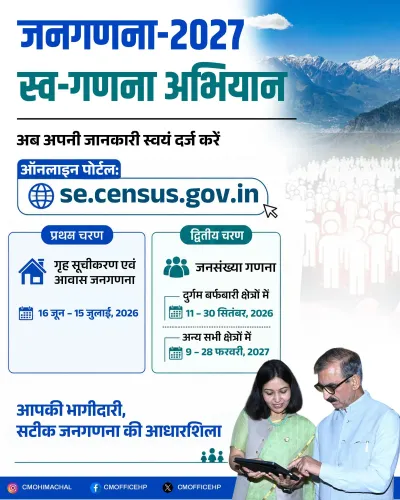
Phase 1 (house listing and housing census) will run from 16 June to 15 July 2026 across Himachal Pradesh.
In difficult snow-bound areas , population enumeration is scheduled for 11-30 September 2026 to beat winter snowfall.
For all other areas , population enumeration is set for 9-28 February 2027 .
The exercise is the first fresh census data collection since the 2011 Census , as the 2021 round was delayed by COVID-19.
Updated data will directly inform welfare scheme targeting across housing, health, and social protection in the state.
The schedule is designed around Himachal Pradesh's unique Himalayan geography, with inaccessible high-altitude districts requiring a dedicated enumeration window.
The Chief Minister's Office of Himachal Pradesh announced on Tuesday, 2 June 2026 a two-phase schedule for conducting the upcoming census in the state, with the exercise designed to accommodate the unique geographic challenges of Himachal Pradesh's snow-bound high-altitude terrain.
What Was Announced
The official post, shared in Hindi, outlined the phased calendar as part of a broader commitment to welfare-oriented policymaking. The post noted that जनकल्याणकारी नीतियां तैयार होती हैं ('welfare policies are formulated') on the basis of census data, underscoring the administrative importance of the exercise. The two-phase structure mirrors the national census framework, which separates house listing from population enumeration.
The first phase — covering house listing and housing census — is scheduled from 16 June to 15 July 2026. The second phase, the population enumeration proper, will be conducted in two separate windows depending on the region.
Geography-Driven Scheduling
Himachal Pradesh's administration has carved out a dedicated window for its most inaccessible zones. In difficult snow-bound areas (दुर्गम बर्फबारी क्षेत्र), the population count will be held from 11 to 30 September 2026, taking advantage of the brief post-monsoon window before winter snowfall cuts off connectivity. For all other areas of the state, enumeration is planned from 9 to 28 February 2027.
This approach reflects a long-established pattern in Himalayan and north-eastern states, where census planners adapt the national schedule to climatic constraints. High-altitude districts in Himachal Pradesh — including parts of Lahaul and Spiti, Kinnaur, and upper Chamba — become effectively inaccessible under heavy snowfall, making a September window the only viable option for enumerators to reach remote hamlets.
Policy Backdrop
India's decennial census has been conducted every ten years since 1881. The 2011 Census remains the most recently completed round, as the 2021 Census was postponed due to the COVID-19 pandemic and has yet to be completed. In the intervening years, central and state governments have continued to rely on 2011 data for targeting welfare schemes — from housing subsidies to food security allocations — creating growing pressure to refresh the demographic baseline.
A fresh census will directly inform the design and funding of programmes across health, education, housing, and social protection. For a state like Himachal Pradesh, accurate housing and population data are particularly critical given the dispersed settlement patterns and the disproportionate share of elderly and migrant-affected households in remote districts.
Stakeholders and Impact
The exercise will touch every resident of Himachal Pradesh, with state planning departments, local panchayats, and line departments all dependent on the resulting data for scheme targeting. Populations in snow-bound zones — historically undercounted due to access difficulties — stand to benefit most from the dedicated September enumeration window, which improves the probability of complete coverage.
Enumerators, many of whom are drawn from the state's teaching and revenue cadres, will require logistical support for the high-altitude phase, including transport and weather-appropriate equipment. The state administration's advance announcement signals early mobilisation planning for what is a large-scale, resource-intensive operation.
What's Next
The broader national census timeline remains subject to a formal notification from the Registrar General of India. Himachal Pradesh's phased schedule will need to align with any such central directive, and watchers will look for official Census Rules amendments or a gazette notification confirming the nationwide roll-out. In the interim, the state's announcement sets an administrative target and signals to district machinery that preparatory groundwork — training enumerators, updating maps, and demarcating enumeration blocks — should begin well ahead of the June 2026 first-phase window.
Point of View
More than a year ahead of the first enumeration window. The state's decision to carve out a dedicated September window for snow-bound areas is a practical acknowledgement of a chronic undercounting problem in high-altitude districts, one that has distorted welfare allocations for over a decade. Coming against the backdrop of a long-delayed national census, this announcement also reflects state-level impatience with the data vacuum left by the postponed 2021 round. If the national notification follows, Himachal Pradesh will be among the better-prepared states; if it slips further, the state's advance planning will still serve as a template for other Himalayan administrations.
NationPress
18 Oct 2026
Frequently Asked Questions
When will the census take place in Himachal Pradesh?
The census in Himachal Pradesh is planned in two phases: house listing from 16 June to 15 July 2026 , followed by population enumeration in September 2026 for snow-bound areas and February 2027 for the rest of the state.
Why is there a separate census date for snow-bound areas in Himachal Pradesh?
High-altitude districts become inaccessible in winter due to heavy snowfall, so enumerators are scheduled to visit snow-bound areas from 11-30 September 2026 — the brief post-monsoon window before roads close — to ensure complete coverage.
What is house listing and housing census in the context of the Indian census?
House listing is the first phase of India's census process, in which enumerators record details of every household, housing conditions, and amenities. This creates the frame used for the subsequent population enumeration phase.
Why has India not had a census since 2011?
The 2021 Census was postponed due to the COVID-19 pandemic and has not yet been completed, leaving 2011 as the most recent data year. States continue to rely on 2011 figures for welfare scheme targeting.
How will the Himachal Pradesh census affect welfare schemes?
Fresh census data will update the demographic and housing baseline used to design and fund programmes in health, education, housing, and social protection, correcting distortions caused by over a decade of reliance on 2011 figures.