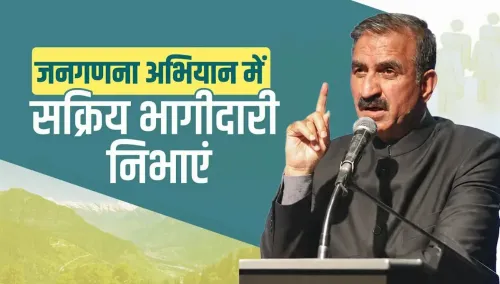
Himachal CMO opens Census-27 self-enumeration window from June 1

Synopsis
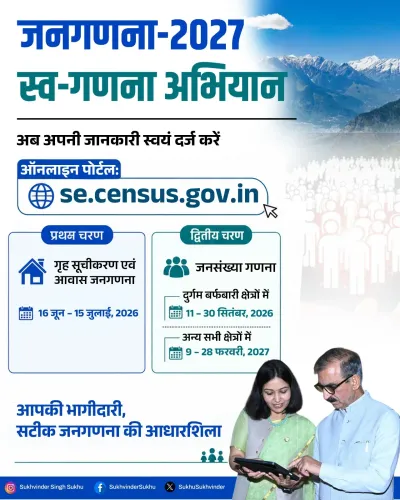
The Himachal Pradesh Chief Minister's Office has announced that Census-27 self-enumeration is open from 1 to 15 June 2026 on se.census.gov.in. The first phase, covering house listing and housing, will run from 16 June to 15 July 2026. Residents have been urged to submit accurate household details through the portal.
Key Takeaways
Self-enumeration for Census-27 is open in Himachal Pradesh from 1 to 15 June 2026 .
Citizens can submit household details on the official portal se.census.gov.in .
The first phase, covering house listing and housing , runs from 16 June to 15 July 2026 .
The census will be conducted in two phases , with population enumeration to follow.
The CMO urged residents to enter accurate information in their self-enumeration returns.
The Chief Minister's Office of Himachal Pradesh on 3 June 2026 announced that the self-enumeration facility for Census-27 will be open to residents of the state from 1 to 15 June 2026 through the official portal se.census.gov.in. The advisory urged households to record accurate information and confirmed that the census itself will be carried out in two phases, beginning with house listing and housing enumeration from 16 June to 15 July 2026.
In its post, the CMO stated that 'Himachal Pradesh mein Janganana-27 ke antargat sva-ganana 1 se 15 June, 2026 tak se.census.gov.in par uplabdh hai' ('Under Census-27, self-enumeration in Himachal Pradesh is available from 1 to 15 June 2026 on se.census.gov.in'), and appealed to 'sabhi se aagrah hai ki sahi jaankari darj karein' ('all are requested to enter correct information'). It further specified that the first phase, scheduled from 16 June to 15 July 2026, will cover house listing and housing.
Context
The announcement marks the operational rollout of India's next decennial population count in Himachal Pradesh, a hill state where dispersed habitations and difficult winter access have historically made enumeration logistically complex. By promoting the self-enumeration window early, the state administration is signalling that digital pre-registration will run in tandem with the traditional door-to-door exercise.
The Census of India is conducted by the Office of the Registrar General and Census Commissioner under the Ministry of Home Affairs. The exercise is the country's largest peacetime administrative operation and produces the demographic baseline used across ministries, state governments and local bodies.
Policy backdrop
India's census is conducted under the Census Act, 1948, which provides the legal framework for the decennial count. The last completed round was Census 2011; the cycle due in 2021 was postponed amid the COVID-19 pandemic, making Census-27 the first full enumeration in over fifteen years.
Government of India notifications issued from 2023 onward laid the groundwork for a digitally enabled census, including mobile applications for enumerators and an online self-enumeration portal. The se.census.gov.in link cited by the Himachal CMO is the citizen-facing component of that architecture, allowing households to pre-fill their schedule before an enumerator's visit.
Stakeholders and impact
For residents of Himachal Pradesh, the immediate ask is procedural: log in during the 15-day self-enumeration window and submit household details. Accurate returns feed into the housing schedule that enumerators verify during the first field phase from 16 June to 15 July 2026.
The data has downstream consequences well beyond statistics. Census figures inform the allocation of central finance commission transfers, the design of welfare schemes, the planning of health and education infrastructure, and — once notified — the delimitation of parliamentary and assembly constituencies. For a small state like Himachal, with 68 assembly seats and four Lok Sabha constituencies, granular ward-level data shapes both fiscal share and political representation.
Local administrations, panchayati raj institutions and urban local bodies are typically roped in to publicise the schedule and assist households that lack digital access. The CMO's advisory functions as the state's formal cue to district collectors and block-level officials to align with the central timetable.
What's next
After the self-enumeration window closes on 15 June 2026, the first phase of house listing and housing enumeration begins the very next day and runs through 15 July 2026. The second phase — population enumeration — will follow on a schedule to be notified by the Registrar General, and is expected to capture detailed demographic, social and economic characteristics.
The wider implication is that Census-27 will refresh India's demographic ledger after an unusually long gap, and the quality of self-enumeration uptake in states like Himachal Pradesh will be an early indicator of whether the digital-first model can deliver the coverage that paper-based rounds achieved.
Point of View
The administration is buying into the central government's digital-first census design, which aims to compress fieldwork and improve accuracy. The political stakes are non-trivial: Census-27 will eventually feed delimitation, fiscal devolution and welfare targeting debates that have been frozen since 2011. How smoothly hill states manage digital uptake will shape the credibility of the entire exercise.
NationPress
18 Oct 2026
Frequently Asked Questions
When is Census-27 self-enumeration open in Himachal Pradesh?
Self-enumeration is open from 1 to 15 June 2026, as announced by the Himachal Pradesh Chief Minister's Office. Residents can submit household details online during this 15-day window before field enumeration begins.
What is the official website for census self-enumeration?
The official portal is se.census.gov.in, as cited by the Himachal Pradesh CMO. It is the citizen-facing component of the Census-27 digital architecture managed by the Registrar General of India.
When does the first phase of Census-27 begin?
The first phase, covering house listing and housing, begins on 16 June 2026 and runs until 15 July 2026. It follows immediately after the self-enumeration window closes.
How many phases will Census-27 have?
Census-27 will be conducted in two phases. The first covers house listing and housing from 16 June to 15 July 2026, followed by a second population enumeration phase on a schedule to be notified.
Why is Census-27 important after Census 2011?
Census-27 will be India's first full decennial count since 2011, as the 2021 round was postponed due to the COVID-19 pandemic. Its data will inform welfare schemes, fiscal transfers and eventual delimitation.