CM Sukhu Urges Himachal Residents to Join Census 2027 Self-Enumeration
Synopsis
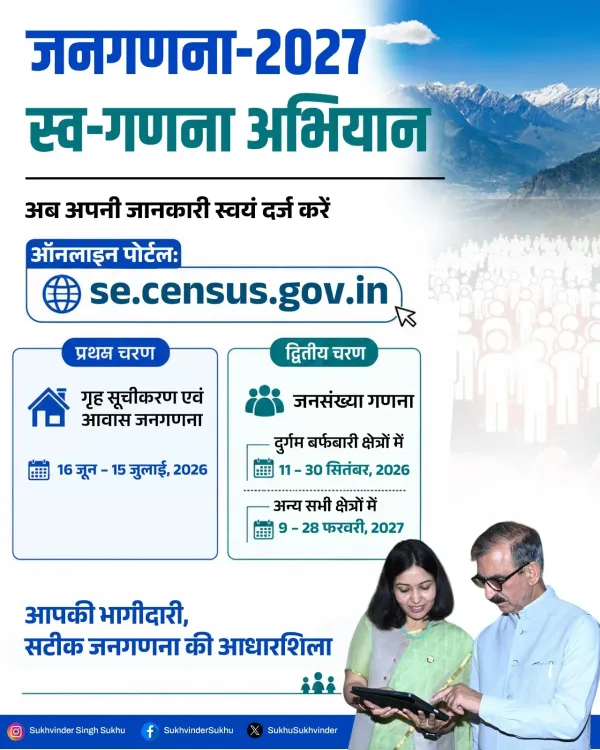
Himachal Pradesh Chief Minister Sukhvinder Singh Sukhu has urged residents to join Census 2027, flagging self-enumeration on se.census.gov.in from 1 to 15 June 2026. House-listing runs 16 June to 15 July 2026, with population enumeration in snowbound areas from 11 to 30 September 2026 and other regions from 9 to 28 February 2027.
Key Takeaways
CM Sukhvinder Singh Sukhu appealed for active participation in Census 2027 in Himachal Pradesh.
Online self-enumeration is open from 1 to 15 June 2026 on se.census.gov.in .
Phase one — house-listing and housing — runs 16 June to 15 July 2026 .
Population enumeration in snowbound areas is scheduled 11 to 30 September 2026 .
Other areas will be enumerated from 9 to 28 February 2027 .
Census data will inform schemes in education, health, roads, water supply and employment.
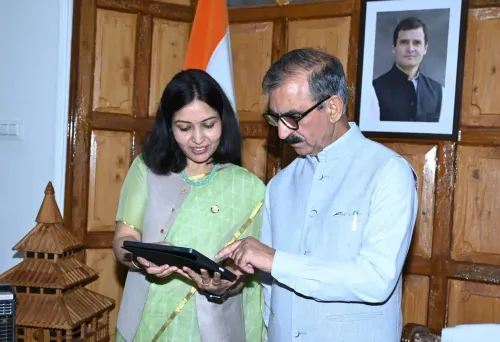
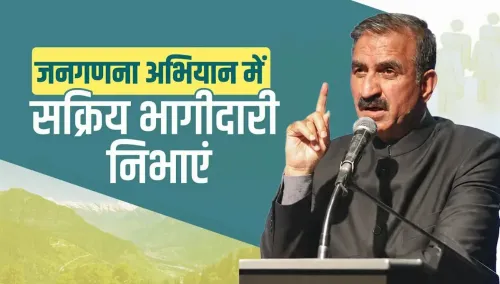
Himachal Pradesh Chief Minister Sukhvinder Singh Sukhu on Wednesday appealed to residents of the state to participate actively in Census 2027, flagging the opening of the online self-enumeration window from 1 to 15 June 2026 on the official portal se.census.gov.in. In a post on X, the Chief Minister laid out the two-phase schedule for the exercise in Himachal Pradesh and urged citizens to enter accurate information.
'The census helps us understand the current situation of the state and decides the path of future plans. These figures are important for education, health, roads, water supply, employment and other schemes,' the Chief Minister wrote, calling participation a 'national task'. He listed the first phase — gruh soochikaran evam aavaas (house-listing and housing) — as scheduled from 16 June to 15 July 2026.
Context
The second phase, the population enumeration round, has been split to account for the state's terrain. For inaccessible snowbound areas, enumeration is scheduled from 11 to 30 September 2026, ahead of the winter shutdown of high-altitude districts. For the rest of the state, the population count will run from 9 to 28 February 2027.
The Chief Minister's appeal centres on the digital self-enumeration option, a new feature designed to let households fill in their own particulars online before field enumerators arrive. The portal se.census.gov.in is being used as the entry point for residents who wish to participate digitally during the two-week window in June 2026.
Policy backdrop
India's last completed national headcount was the Census of 2011, which has served as the baseline for over a decade of central and state planning. The decennial Census of 2021 was deferred due to the Covid-19 pandemic, creating an extended gap in updated demographic and socio-economic data used for welfare targeting, delimitation and resource allocation.
The exercise is conducted by the Office of the Registrar General and Census Commissioner under the Union Ministry of Home Affairs, with state administrations responsible for ground-level coordination. The introduction of self-enumeration marks one of the most significant methodological shifts since independence, intended to expand coverage and reduce errors of omission in hard-to-reach pockets.
Stakeholders and impact
For Himachal Pradesh — a Himalayan state where several districts including Lahaul and Spiti, Kinnaur and parts of Chamba remain cut off by snow for months — the phased calendar is consequential. Accurate enumeration of remote panchayats directly affects allocations under centrally sponsored schemes for school enrolment, primary health centres, rural roads under flagship connectivity programmes and piped water supply.
The Chief Minister framed the data exercise in service-delivery terms, linking it explicitly to education, health, roads, jalapurti (water supply) and employment schemes. State planners use census figures to revise per-capita transfers, identify under-served habitations and update electoral rolls, making household-level accuracy a direct input to the next cycle of state budgets.
What's next
The immediate test will be uptake during the 1 to 15 June 2026 self-enumeration window, followed by the house-listing operation through mid-July. District administrations across Himachal Pradesh are expected to roll out awareness drives, particularly in tribal and snow-bound belts, where the September 2026 enumeration leaves a narrow operational window before snowfall.
Sukhu closed his post with an appeal to citizens to 'play an active role in this national task'. With Census 2027 set to refresh more than fifteen years of demographic data, the quality of participation in states like Himachal Pradesh will shape the evidence base for the next round of welfare and infrastructure planning.
Point of View
The first since 2011. By personally flagging the self-enumeration portal, the Chief Minister is signalling that Himachal's planning machinery is leaning on digital coverage to compensate for terrain that has historically depressed enumeration accuracy. The phased schedule, with snowbound districts counted first, is a pragmatic adaptation that other Himalayan states will likely mirror. The political subtext is unmistakable: cleaner demographic data will reshape central transfers and delimitation, making the 2026-27 cycle one of the most consequential administrative exercises of the decade.
NationPress
17 Oct 2026
Frequently Asked Questions
When does Census 2027 self-enumeration open in Himachal Pradesh?
Self-enumeration for Census 2027 is open from 1 to 15 June 2026 on the portal se.census.gov.in, as announced by Chief Minister Sukhvinder Singh Sukhu.
What are the two phases of Census 2027 in Himachal Pradesh?
Phase one is house-listing and housing from 16 June to 15 July 2026. Phase two is population enumeration, scheduled for 11 to 30 September 2026 in snowbound areas and 9 to 28 February 2027 in other regions.
Why is the population count held earlier in snowbound parts of Himachal Pradesh?
Snowbound districts such as Lahaul-Spiti and Kinnaur are largely inaccessible during winter, so enumeration is advanced to September 2026 to ensure complete coverage before the snow season.
What is the official Census 2027 self-enumeration website?
The official self-enumeration portal is se.census.gov.in, where residents can enter household details during the 1 to 15 June 2026 window.
Why does Census 2027 matter for state planning?
Census data underpins allocations for education, health, roads, water supply and employment schemes, and updates the demographic baseline that has been frozen at 2011 figures since the postponement of Census 2021.