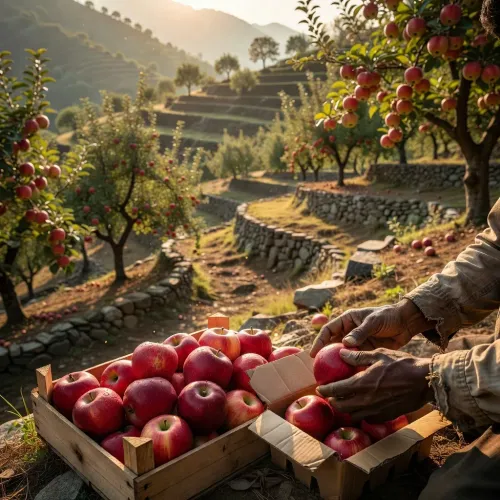
HP Govt Launches 'Pangī Apple' Branded Cartons at 50% Subsidy

Synopsis
The Himachal Pradesh CMO announced 'Pangi Apple' branded cartons in 10 kg and 20 kg sizes at a 50% subsidy, targeting ~6,300 farming families in Chamba's isolated Pangi sub-division while pursuing a chemical-free cultivation goal.
Key Takeaways
Branded cartons of 10 kg and 20 kg capacity labelled 'Pangi Apple' will be available at a 50 percent subsidy to growers.
The initiative aims to give Pangi apples a distinct commercial identity in the market.
Approximately 6,300 farming families in Pangi sub-division are expected to benefit.
The scheme is linked to making Pangi a chemical-free sub-division , adding a sustainability dimension to the branding push.
Pangi is a remote, high-altitude tribal subdivision in Chamba district, Himachal Pradesh , with limited road access for part of the year.
Deep in the tribal valleys of Chamba district, where roads are few and markets are far, Pangi's apple growers are getting a tool that could change how their fruit is seen — and sold. The Chief Minister's Office of Himachal Pradesh announced on Saturday, 24 October 2026 that branded 'Pangi Apple' cartons of 10-kilogram and 20-kilogram capacity will now be available to farmers at a 50 percent subsidy, giving the valley's produce a distinct commercial identity for the first time.
A Name on the Box — and What That Means for Pangi
Branding is not a cosmetic step in horticulture — it is the difference between a commodity and a product. The CMO's post states plainly: 'sebon ko apni vishisht pehchaan milegi' ('the apples will get their own distinct identity'). For Pangi's growers, who cultivate in one of Himachal Pradesh's most geographically isolated subdivisions, a labelled carton signals origin, quality, and traceability to buyers downstream.
Himachal Pradesh has built its rural economy substantially on apple cultivation, and branded packaging has been a recurring lever in state horticulture policy. But Pangi — a high-altitude tribal subdivision cut off for months each year — has historically struggled to access the logistics and market linkages available to growers in more connected valleys like Shimla and Kullu.
6,300 Farming Families and a Chemical-Free Goal
The announcement ties the carton initiative to a larger ambition: making Pangi a chemical-free sub-division. The CMO's post says the initiative will strengthen the livelihoods of approximately 6,300 farming families. That is a specific, consequential number — roughly the entire agrarian base of a valley that has few economic alternatives beyond horticulture and animal husbandry.
Chemical-free cultivation is increasingly a market differentiator, not just an environmental aspiration. Branded organic-origin packaging from a remote Himalayan valley carries premium-product potential in urban retail chains and export corridors — provided the supply chain can be built to support it. The subsidy on cartons addresses the first, most tangible barrier: the cost of getting the fruit to market in presentable, traceable form.
Pangi's Isolation — the Stakes Behind the Scheme
Pangi sub-division sits at high altitude in Chamba district, accessible by road only part of the year. Its tribal farming communities have long produced apples that are difficult to move to market competitively precisely because the infrastructure and branding investment that benefits growers in better-connected districts has not reached here at the same pace. A 50 percent subsidy on packaging directly lowers the per-unit cost that stands between a Pangi farmer's harvest and a retail shelf.
The broader pattern in Himachal Pradesh has been to use targeted packaging, branding, and input subsidies to pull remote horticultural communities into formal market value chains. This announcement fits that arc — but its reach into a genuinely marginalised tribal subdivision marks it as a step further along that road.
Watch for: how quickly the subsidised cartons reach Pangi's growers before the harvest window closes, and whether the chemical-free designation attracts premium buyer interest in coming seasons. The scheme's ambition is clear. Execution in one of India's most remote valleys is the harder half.
Point of View
Origin-specific packaging is an increasingly mainstream tool in agricultural policy — but applying it to Pangi, one of Himachal Pradesh's most geographically and economically marginalised subdivisions, signals a deliberate effort to widen the benefits of the state's apple economy beyond its traditional hubs. Tying the carton subsidy to a chemical-free designation is a shrewd double play: it positions Pangi produce for premium market segments while building a sustainability credential the state can promote. The key policy question is delivery — subsidised carton schemes have precedent in HP, but reaching tribal growers in a valley cut off by snow for months tests administrative last-mile capacity. If the execution matches the ambition, this becomes a replicable model for other isolated horticultural pockets across the Himalayan belt.
NationPress
24 Oct 2026
Frequently Asked Questions
What is the 'Pangi Apple' carton scheme in Himachal Pradesh?
The Himachal Pradesh government is providing branded 'Pangi Apple' cartons in 10 kg and 20 kg sizes to apple growers in Pangi sub-division at a 50 percent subsidy, aiming to give local produce a distinct market identity.
Where is Pangi sub-division located?
Pangi is a remote, high-altitude tribal sub-division in Chamba district of Himachal Pradesh, known for traditional apple cultivation and limited seasonal road connectivity.
How many farmers will benefit from the Pangi Apple carton subsidy?
According to the Chief Minister's Office announcement, approximately 6,300 farming families in Pangi are expected to benefit from the initiative.
What does chemical-free sub-division mean for Pangi?
The initiative aims to promote pesticide- and chemical-free apple cultivation across Pangi, which can open access to premium and organic market segments while improving environmental outcomes in the valley.
Why does branded packaging matter for Pangi apple growers?
Branded, origin-specific packaging helps Pangi apples stand out in wholesale and retail markets, enables traceability, and can command better prices compared to unlabelled produce sold as a generic commodity.