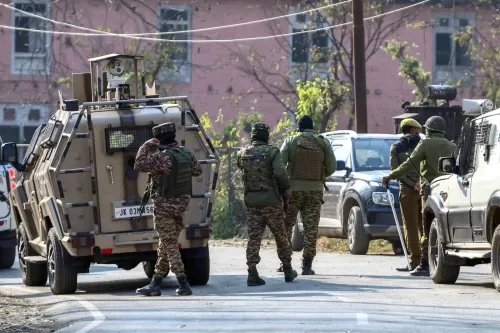
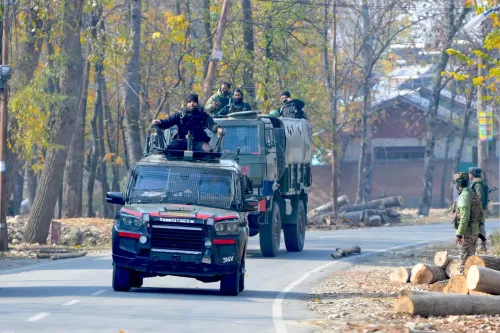
HUMINT outsmarts ISI: How Indian agencies tracked and killed Lateef Bhat
Synopsis
India's neutralisation of LeT commander Lateef Bhat was not a lucky break — it was a doctrine correction. After recognising that the ISI had deliberately gone dark digitally to evade TECHINT, Indian agencies blended human networks with technical surveillance, held five coordination meetings daily, and let local police informants pinpoint Bhat to a mosque in Kulgam. The kill exposes the ISI's own HUMINT gamble as a double-edged sword.
Key Takeaways
Lashkar-e-Taiba commander Lateef Bhat and associate Umar Nisar Dar were killed on 18 November 2026 in Kulgam , four days after the 14 November Kulgam attack.
The operation was driven by a blend of Human Intelligence (HUMINT) and Technical Intelligence (TECHINT) , countering an ISI tactic of going dark digitally.
Bhat's location was pinpointed to a mosque through local J&K Police informant networks — the decisive breakthrough.
The Indian Army , CRPF , J&K Police , and NIA held at least five coordination meetings daily from the time of the attack.
A similar HUMINT-heavy approach dismantled Hizbul Mujahideen's command structure after the killing of Burhan Wani — an outfit that has not recovered since.
Indian security agencies neutralised Lashkar-e-Taiba (LeT) commander Lateef Bhat and his associate Umar Nisar Dar on 18 November 2026 through a blended intelligence strategy that combined Human Intelligence (HUMINT) with technical surveillance — countering a deliberate ISI tactic to shift away from digitally traceable communications in Jammu and Kashmir. The operation, which culminated at a mosque in Kulgam, followed four days of intensive multi-agency coordination triggered by the 14 November Kulgam attack.
The ISI Pivot to HUMINT — and India's Counter-Move
According to an Intelligence Bureau official, the Inter-Services Intelligence (ISI) had in recent months been deliberately steering its operatives away from electronic communications, which Indian agencies had been monitoring through Technical Intelligence (TECHINT). The pivot was strategic: by relying on face-to-face networks and human couriers, ISI-backed operatives aimed to stay invisible to digital surveillance grids.
Once this shift was identified, Indian agencies recalibrated. Rather than abandoning TECHINT, they blended it with their own HUMINT networks — a combination that officials say proved decisive in the hunt for Bhat. This mirrored an earlier playbook deployed after the killing of Hizbul Mujahideen commander Burhan Wani, when heavy HUMINT use by the Jammu and Kashmir Police helped dismantle the outfit's entire command structure.
How the Operation Unfolded
The operation began with a frame-by-frame analysis of CCTV footage captured before and after the 14 November attack. Officials noted that Bhat and Dar had moved quickly out of the immediate strike zone — but the footage suggested they had not gone far. Crucially, Bhat maintained a strict communication blackout with his ISI handlers in the immediate aftermath of any attack, a practised counter-surveillance measure he had relied on previously to evade capture.
The agencies cross-referenced this behavioural pattern with a pre-compiled list of LeT hideouts in the rural belts of Kulgam and Shopian. Since Bhat was known never to return to previously used safe houses after an operation, conventional hideout surveillance would have been futile. Instead, local HUMINT networks — primarily the J&K Police's ground-level contacts — were activated to narrow the search radius.
Officials said Bhat appeared to be buying time, anticipating that security forces would concentrate on his known hideouts while he planned an escape route. That miscalculation cost him. HUMINT inputs from local sources eventually pinpointed his location to a mosque in Kulgam — the decisive turning point, according to officials.
Five Daily Briefings and Zero Siloes
From the moment of the Kulgam attack, the Indian Army, Central Reserve Police Force (CRPF), Jammu and Kashmir Police, and the National Investigation Agency (NIA) held a minimum of five coordination meetings every day. Each session fused HUMINT inputs with technical analysis before any field deployment.
Officials stress that seamless information-sharing was non-negotiable — a slip-up, they said, would have allowed Bhat to escape and resume attacks in the Valley. Central agencies focused on behavioural analysis and TECHINT; the J&K Police worked their local informant networks. The two streams converged on the mosque location on 18 November.
Local Police as the Spine of HUMINT
An official emphasised that the J&K Police are indispensable to any HUMINT-driven operation because of their organic ties to local communities. Unlike central paramilitary or intelligence agencies, local police officers can blend into civilian environments and elicit information that no digital intercept can replicate. This was equally true during the post-Burhan Wani operations, when police-led HUMINT drove the systematic dismantling of Hizbul Mujahideen's operational network — an outfit that has not revived since.
Notably, this underscores a broader doctrinal shift: in an era where adversaries have learnt to go dark digitally, the human network is not a relic but a force multiplier. With Bhat eliminated, security agencies are expected to sustain pressure on remaining LeT operatives in south Kashmir.
Point of View
It worked. India's response, blending both streams and empowering local police as the primary HUMINT spine, is a structural correction that has implications beyond a single operation. The post-Burhan Wani dismantling of Hizbul Mujahideen showed this model works at scale; the question is whether it can be sustained as ISI continues to evolve tactics. What mainstream coverage often misses is the institutional credit due to the J&K Police — it is their ground-level networks, not satellite intercepts, that keep closing these cases.
NationPress
19 Nov 2026
Frequently Asked Questions
How did Indian agencies track down Lateef Bhat after the Kulgam attack?
Indian agencies used a combination of Human Intelligence (HUMINT) from local networks and CCTV analysis to narrow Bhat's location after the 14 November Kulgam attack. J&K Police informants on the ground eventually pinpointed him to a mosque in Kulgam, where he was neutralised on 18 November.
What is HUMINT and why was it critical in this operation?
HUMINT, or Human Intelligence, refers to information gathered through human sources rather than electronic surveillance. It was critical because Bhat maintained a communication blackout with his ISI handlers after attacks, making digital tracking ineffective — local informants became the only reliable way to locate him.
Why had the ISI switched to HUMINT-based operations in Kashmir?
According to Intelligence Bureau officials, the ISI shifted toward HUMINT-driven operations deliberately to counter the Technical Intelligence (TECHINT) capabilities of Indian security forces. By reducing electronic communication, ISI-backed operatives aimed to stay invisible to India's digital surveillance infrastructure.
Which agencies were involved in the operation against Lateef Bhat?
The Indian Army, Central Reserve Police Force (CRPF), Jammu and Kashmir Police, and the National Investigation Agency (NIA) all participated, holding at least five coordination meetings daily from the time of the Kulgam attack until Bhat's elimination on 18 November.
How does this operation compare to past counterterrorism actions in Kashmir?
It closely mirrors the post-Burhan Wani operations, in which heavy reliance on HUMINT led by J&K Police dismantled Hizbul Mujahideen's entire command structure — an outfit that has never recovered. Officials say the same blended-intelligence model is now being applied against remaining Lashkar-e-Taiba operatives in south Kashmir.