Giriraj Singh flags IEA projection of $170 bn India energy investment in 2026
Synopsis
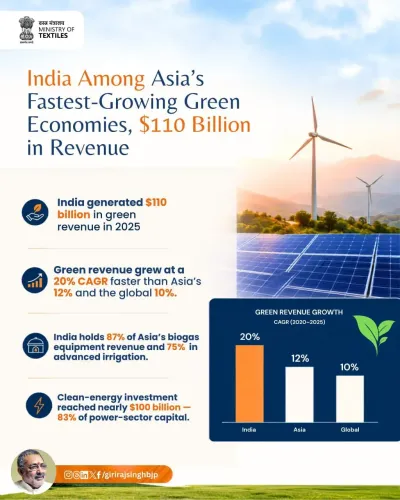
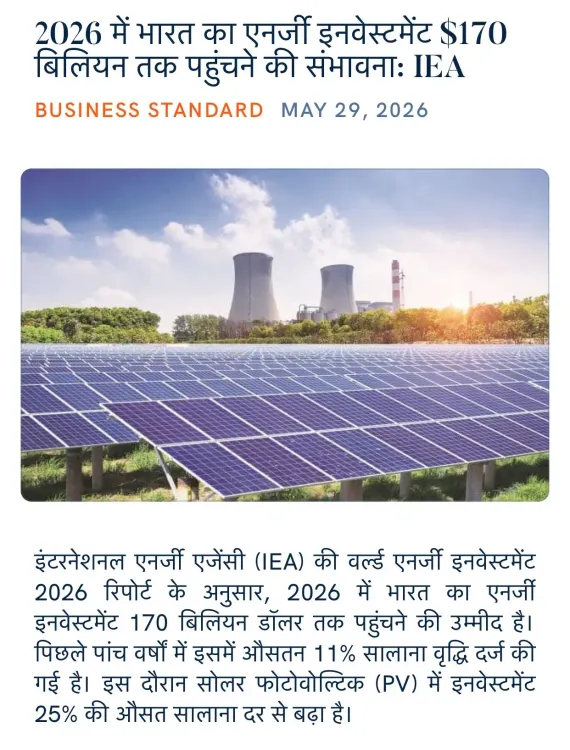
The IEA projects India's energy investment could hit $170 billion in 2026, a figure Union Textiles Minister Giriraj Singh amplified on X via the NaMo App on 29 May. The projection reflects India's accelerating push toward its 500 GW non-fossil target and a series of clean-energy policy interventions since COP26.
Key Takeaways
Union Textiles Minister Giriraj Singh shared an IEA projection on 29 May 2026 indicating India's energy investment may reach $170 billion in 2026.
India is the world's third-largest energy consumer and has committed to 500 GW non-fossil fuel capacity by 2030 and net-zero by 2070.
Key policy enablers include the National Green Hydrogen Mission (2023) and the PLI scheme for solar PV modules (2022) .
The IEA, established in 1974 , has consistently identified India as a primary driver of future global energy demand growth.
The projection is relevant to renewable energy developers, infrastructure financiers, and equipment manufacturers targeting the Indian market.
Upcoming Union Budget announcements and the next IEA World Energy Outlook will be key indicators of whether investment momentum is sustained.
Union Textiles Minister Giriraj Singh on Friday, 29 May 2026 shared a report projecting that India's energy investment could reach $170 billion in 2026, citing data from the International Energy Agency (IEA), via the NaMo App.
Context
The minister's post, shared on X, highlighted the IEA's assessment that India's annual energy investment is on course to touch $170 billion in the current year. The projection underscores the scale of capital flowing into India's energy sector — spanning generation, transmission, and clean technologies — at a time when the country is the world's third-largest energy consumer.
Singh shared the update via the NaMo App, the official platform used to circulate news and highlights of central government policies, reflecting a coordinated ministerial communication effort around positive macroeconomic signals.
Policy Backdrop
India committed at COP26 in 2021 to achieving net-zero emissions by 2070 and installing 500 GW of non-fossil fuel capacity by 2030. These targets have since anchored a series of policy interventions designed to attract both domestic and foreign investment into the energy transition.
The National Green Hydrogen Mission, launched in 2023, and the Production Linked Incentive (PLI) scheme for high-efficiency solar photovoltaic modules, introduced in 2022, are among the flagship programmes aimed at catalysing private capital. Amendments to electricity regulations and progressive liberalisation of foreign direct investment (FDI) norms in renewables have further widened the investment pipeline.
The IEA — an autonomous intergovernmental body within the OECD framework established in 1974 — has in successive assessments identified India as a primary driver of future global energy demand growth, lending external credibility to domestic policy claims.
Stakeholders and Impact
The projection carries direct relevance for renewable energy developers, infrastructure financiers, and equipment manufacturers operating in or seeking entry into the Indian market. A $170 billion annual investment figure would represent a significant acceleration in capital deployment compared to earlier years, signalling both market depth and policy stability.
For the broader economy, sustained energy investment at this scale supports job creation in construction, manufacturing, and operations across solar, wind, green hydrogen, and grid modernisation segments. State governments and public-sector utilities are also stakeholders, as transmission and distribution upgrades form a large share of overall energy capital expenditure.
The sharing of such projections by ministers across portfolios — including a Textiles Minister — reflects a deliberate strategy to build a broad narrative around India's investment attractiveness ahead of budget cycles and global investor forums.
What's Next
Attention will now turn to the IEA's forthcoming World Energy Outlook and any India-specific updates that elaborate on the investment composition — how much flows into renewables versus fossil fuels, and the public-private split. Any fresh capital allocation or incentive announcements in the upcoming Union Budget or Economic Survey will be watched as a test of whether domestic policy keeps pace with the scale of investment the IEA projects.
If the $170 billion figure is realised, it would mark a landmark threshold in India's energy financing story and strengthen the government's case that structural reforms are translating into measurable capital commitments on the ground.
Point of View
If it holds, would mark a step-change in India's energy financing and validate a decade of incremental reform in FDI norms, PLI incentives, and green-hydrogen policy. However, the cross-portfolio sharing also dilutes accountability: when positive data is broadcast widely but ownership is diffuse, scrutiny of actual on-ground delivery becomes harder. Investors and analysts will look past the headline to the composition of the investment — specifically the renewable-versus-fossil split and the proportion of committed versus announced capital.
NationPress
23 Sept 2026
Frequently Asked Questions
What is the IEA projection for India's energy investment in 2026?
The International Energy Agency has projected that India's energy investment could reach $170 billion in 2026, according to a report shared by Union Textiles Minister Giriraj Singh on 29 May 2026.
Why did Giriraj Singh share an energy report if he is the Textiles Minister?
Ministers across portfolios routinely share positive macroeconomic data via the NaMo App and social media as part of a coordinated government communication strategy, even when the subject falls outside their direct portfolio.
What is India's renewable energy target by 2030?
India has committed to installing 500 GW of non-fossil fuel capacity by 2030 , a pledge made at the COP26 climate summit in 2021 , alongside a net-zero emissions goal by 2070.
What schemes is India using to attract energy investment?
Key schemes include the National Green Hydrogen Mission (2023) , the Production Linked Incentive scheme for solar PV modules (2022) , and progressive liberalisation of FDI norms in the renewables sector.
What is the NaMo App?
The NaMo App is the official mobile application of the Prime Minister's Office, used to circulate news, policy highlights, and government reports to party workers, ministers, and the public.