India's Non-Fossil Power Capacity Crosses 300 GW
Synopsis
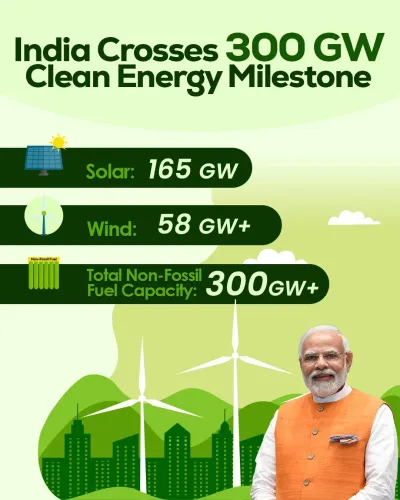
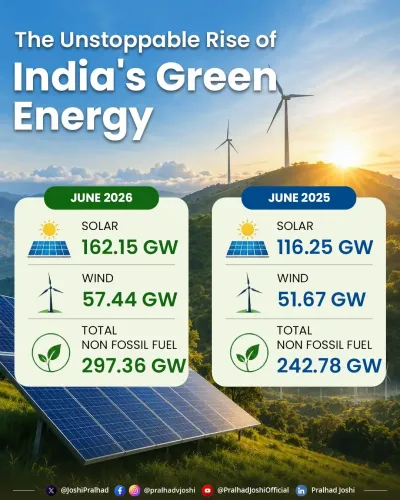
India's non-fossil fuel power capacity has crossed 300 GW, Union Minister Pralhad Joshi confirmed on August 11, 2026. The milestone represents 60 percent of India's COP26 Panchamrit pledge of 500 GW non-fossil capacity by 2030, underscoring steady progress on the country's clean energy transition.
Key Takeaways
India's non-fossil fuel power capacity has crossed the 300 GW mark as of August 2026 .
Union Minister Pralhad Joshi announced the milestone via the NaMo App on August 11, 2026 .
The 300 GW figure represents 60 percent of India's COP26 Panchamrit target of 500 GW non-fossil capacity by 2030 .
India's non-fossil expansion has been driven by solar and wind auctions under the Ministry of New and Renewable Energy .
The remaining 200 GW gap to the 2030 target will require continued policy support, grid investment, and new technology deployment.
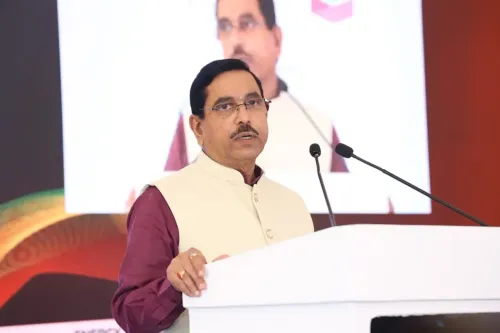
A milestone five years in the making has arrived: India's non-fossil fuel power capacity has crossed the 300 GW mark, a landmark that puts the country's 2030 climate pledge firmly within reach. Union Minister of New and Renewable Energy Pralhad Joshi flagged the achievement on Tuesday, August 11, 2026, sharing the development via the NaMo App.
What 300 GW actually means for India's 2030 pledge
At the COP26 summit in Glasgow in 2021, India made its Panchamrit commitments — five climate targets that included installing 500 GW of non-fossil fuel electricity capacity by 2030. Crossing 300 GW means India has cleared 60 percent of that target with four years still on the clock. That is not a small number — it represents solar farms, wind parks, hydropower stations, and nuclear plants collectively displacing what would otherwise be coal-fired generation.
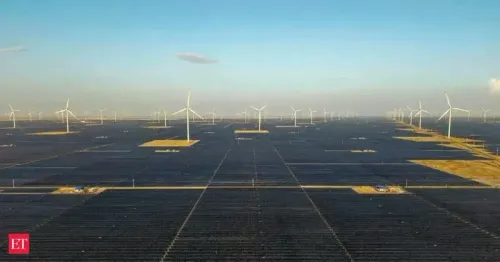
The Ministry of New and Renewable Energy, which Joshi heads alongside the Consumer Affairs portfolio, has driven this expansion through a sustained programme of competitive auctions, grid integration investment, and central government targets cascaded to state utilities. Solar has been the workhorse of the build-out, with large-scale parks in Rajasthan, Gujarat, and Karnataka anchoring capacity addition over the past decade.
The road from pledge to grid
India's renewable push was not linear. Grid absorption bottlenecks, land acquisition delays, and financing constraints slowed momentum in the early years after COP26. The fact that the 300 GW threshold has now been crossed signals that those structural challenges have been substantially navigated — at least enough to sustain large-scale capacity addition. Power distribution companies, long the weak link in the clean-energy chain due to financial stress, remain the sector to watch as higher renewable shares demand more flexible grid management.
The remaining 200 GW gap to the 500 GW goal will be harder to close than the first 300 GW — the easier, sunnier sites are already taken, and offshore wind and green hydrogen integration will require fresh policy and capital. But today's number is a concrete proof point that India's energy transition is moving at industrial scale, not just on paper.
With 2030 now less than four years away, every gigawatt added from here is a direct argument India can make at future climate negotiations: that developing nations can grow their economies and decarbonise their grids at the same time.
Point of View
Which has staked considerable credibility on delivering India's Panchamrit commitments. For Minister Joshi, it validates the Ministry of New and Renewable Energy's auction-led expansion model and provides a concrete metric ahead of future multilateral climate forums. The milestone also shifts the domestic narrative: India can now argue from a position of demonstrated delivery rather than aspiration. The harder test — closing the final 200 GW gap through offshore wind, storage, and green hydrogen — will define whether the 2030 pledge is met in full or falls short under the weight of grid and financing constraints.
NationPress
25 Sept 2026
Frequently Asked Questions
What is India's non-fossil power capacity target by 2030?
India pledged to install 500 GW of non-fossil fuel electricity capacity by 2030 as part of its Panchamrit commitments announced at the COP26 climate summit in Glasgow in 2021 .
What does non-fossil power capacity include in India?
Non-fossil power capacity in India includes solar, wind, hydropower, and nuclear energy — all sources that do not burn coal, oil, or natural gas to generate electricity.
Who is Pralhad Joshi and what ministry does he head?
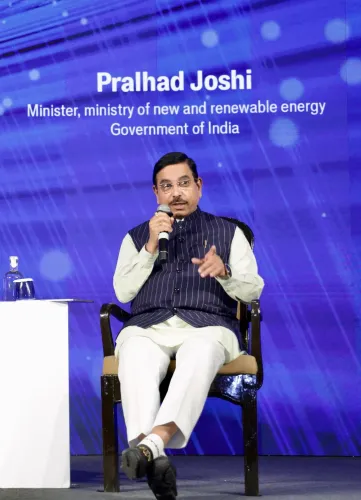
Pralhad Joshi is a senior BJP leader from Karnataka who serves as Union Minister of New and Renewable Energy and Union Minister of Consumer Affairs, Food and Public Distribution.
How much of India's 2030 clean energy target has been met?
With non-fossil capacity crossing 300 GW , India has achieved approximately 60 percent of its 500 GW target, with four years remaining until the 2030 deadline.
What is India's Panchamrit climate commitment?
The Panchamrit is India's five-point climate pledge made at COP26 in 2021 , which includes reaching 500 GW of non-fossil power capacity, sourcing 50 percent of energy from renewables, and achieving net-zero emissions by 2070 .