India must become 'laboratory of the world', not just pharmacy: Anupriya Patel at IIMA Summit
Synopsis
India supplied vaccines to 200 countries and delivered 2.2 billion doses during Covid-19 — but MoS Anupriya Patel says that’s the floor, not the ceiling. At the IIMA Healthcare Summit 2026, she called for a fundamental shift from manufacturing to original drug discovery, backed by ₹15,000 crore in government schemes and an AI ecosystem that already reaches 20 crore patients through eSanjeevani.
Key Takeaways
MoS Anupriya Patel called on India to become the ‘laboratory of the world’ at the IIMA Healthcare Summit 2026 in Ahmedabad on 22 August 2026 .
India supplied vaccines to over 200 countries and administered more than 2.2 billion doses during the Covid-19 pandemic.
The PRIP Scheme (₹ 5,000 crore ) and Biopharma SHAKTI mission (₹ 10,000 crore ) are the two flagship schemes backing pharma innovation.
AI Centres of Excellence have been set up at AIIMS New Delhi , PGIMER Chandigarh , and AIIMS Rishikesh .
Ayushman Bharat Digital Mission has created over 96 crore ABHA IDs and linked more than 1,000 crore health records . eSanjeevani AI clinical decision support has reached more than 20 crore patients .
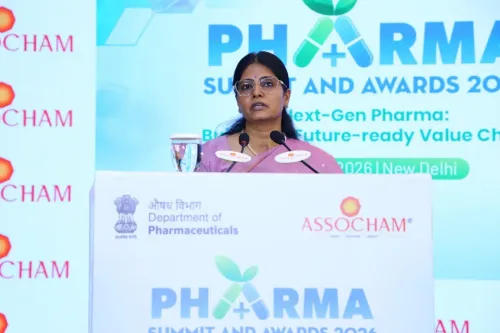
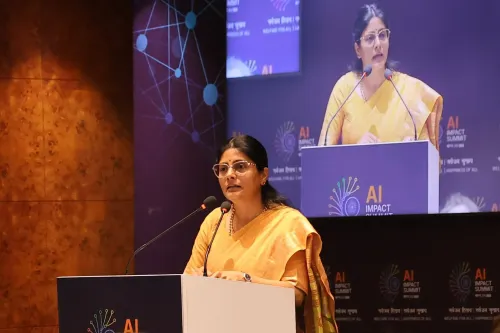
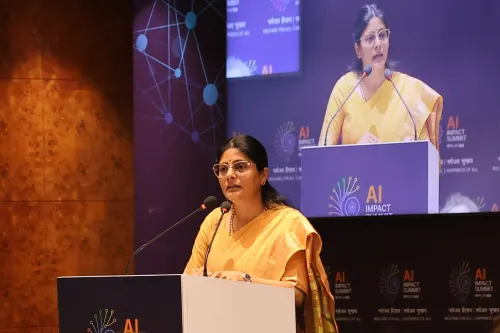
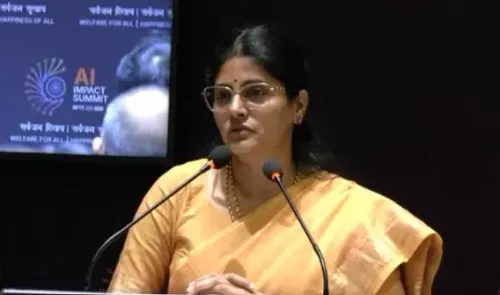
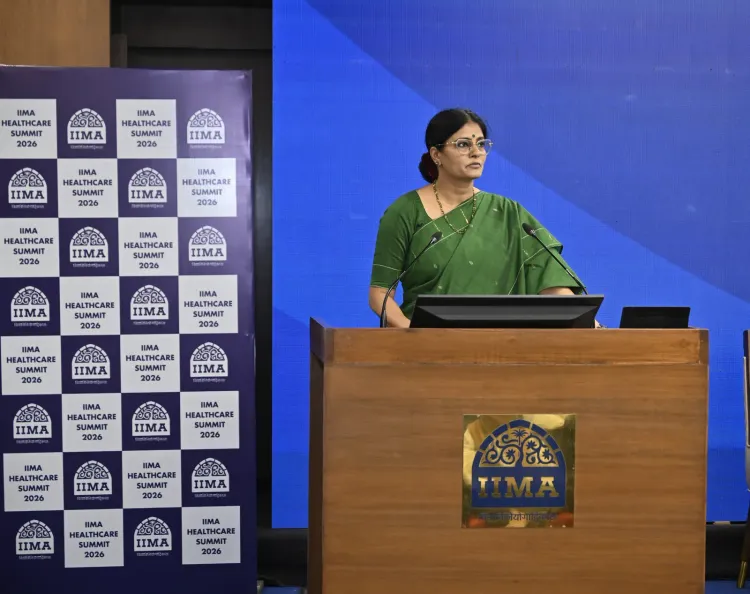
Minister of State for Health and Family Welfare and Chemicals and Fertilisers Anupriya Patel on 22 August 2026 called on India to evolve beyond its globally recognised identity as the ‘pharmacy of the world’ and position itself as the ‘laboratory of the world’ — with research, innovation, and artificial intelligence driving the country’s next healthcare leap. She made the remarks at the IIMA Healthcare Summit 2026 in Ahmedabad, hosted by the Indian Institute of Management Ahmedabad (IIMA) on the theme ‘Advancing AI in Healthcare’.
The Core Argument: From Manufacturing to Innovation
Addressing the third edition of the summit, MoS Patel argued that India’s pharmaceutical sector must move beyond producing medicines and vaccines developed abroad and pivot toward original drug discovery and innovation. She cited India’s performance during the Covid-19 pandemic as evidence of the country’s existing strength — the domestic pharmaceutical industry supplied vaccines and essential medical products to more than 200 countries, while India’s vaccination programme administered over 2.2 billion doses. The challenge now, she said, is to build on that foundation rather than rest on it.
AI in Healthcare: Opportunity and Guardrails
MoS Patel outlined several domains where AI could deliver measurable gains: accelerating drug discovery, enabling personalised treatment, improving disease surveillance, and strengthening clinical decision-making and early screening. However, she was emphatic that adoption must be safe, responsible, and human-centred. “AI must complement, not replace, human clinical judgement,” she said, also stressing the need for robust patient privacy safeguards. She called for AI applications to move beyond pilot projects and scale to population-level implementation through sustained collaboration among government, academia, healthcare institutions, startups, and industry. She noted that Centres of Excellence for AI in healthcare have already been established at AIIMS New Delhi, PGIMER Chandigarh, and AIIMS Rishikesh.
Government Schemes Backing the Push
MoS Patel highlighted two flagship initiatives underpinning this ambition. The Promotion of Research and Innovation in Pharma-MedTech Sector (PRIP) Scheme, with an outlay of ₹5,000 crore, is designed to strengthen research and industry-academia collaboration and shift the sector toward innovation-led growth. Separately, the Biopharma SHAKTI mission, announced in the Union Budget with a corpus of ₹10,000 crore, targets capabilities in biologics and biosimilars, skilled manpower development, and stronger regulatory and clinical trial infrastructure for the domestic biopharmaceutical ecosystem.
Startups, Data, and the Infrastructure Gap
Department of Pharmaceuticals Secretary Manoj Joshi said AI adoption is already expanding across pharmaceutical and healthcare sectors. Large companies are deploying AI in production, human resources, marketing, distribution, and inventory management. Startups — particularly those based in Bengaluru and Hyderabad — are using the technology specifically for drug discovery, he noted. Joshi identified access to capital, software licensing, computing capacity, and specialised talent as key constraints. The government, he said, is working to address these through the National Biopharma Mission and IndiaAI Mission, and is exploring substantial support for eligible startups on software licensing and operational costs. He also stressed the need to make healthcare and genetic data accessible to Indian innovators with appropriate safeguards.
Digital Health Ecosystem and Discover Scale
Health and Family Welfare Secretary Punya Salila Srivastava said the Centre is building a robust digital health ecosystem anchored by the Ayushman Bharat Digital Mission (ABDM), which has so far created more than 96 crore ABHA IDs and digitally linked over 1,000 crore health records across healthcare facilities and professionals. She highlighted AI-enabled applications already in use for early detection of tuberculosis and diabetic retinopathy, and AI-driven clinical decision support through eSanjeevani, which has reached more than 20 crore patients. The summit also saw the launch of India Pharma Archives — a digital initiative of the Indian Pharmaceutical Alliance in collaboration with IIM Ahmedabad Archives — to document and preserve the evolution of India’s pharmaceutical industry. A book chronicling India’s Covid-19 vaccine development journey was also released at the event.
With ₹15,000 crore committed across the PRIP and Biopharma SHAKTI schemes and a digital health backbone already at scale, the government’s next test will be translating policy ambition into verifiable innovation outcomes — and demonstrating that India’s laboratory ambitions can match its pharmacy record.
Point of View
Not innovation depth — and that distinction matters. The ₹15,000 crore committed across PRIP and Biopharma SHAKTI is significant, but India’s drug discovery pipeline remains thin relative to its generic manufacturing muscle. The ABDM’s 1,000-crore linked health records are a genuine asset for AI training, yet data access for domestic innovators remains constrained by regulatory caution. The real shift will come not from schemes announced at summits, but from whether startups in Bengaluru and Hyderabad can get timely access to capital, compute, and anonymised patient data — three things the government has acknowledged as gaps but not yet systematically closed.
NationPress
6 Oct 2026
Frequently Asked Questions
What did MoS Anupriya Patel say at the IIMA Healthcare Summit 2026?
MoS Anupriya Patel called on India to transition from being the ‘pharmacy of the world’ to becoming the ‘laboratory of the world’, with research, innovation, and AI at the centre of healthcare ambitions. She made the remarks at the third edition of the IIMA Healthcare Summit in Ahmedabad on 22 August 2026.
What is the PRIP Scheme and how much has been allocated?
The Promotion of Research and Innovation in Pharma-MedTech Sector (PRIP) Scheme carries an outlay of ₹5,000 crore and is aimed at strengthening research and industry-academia collaboration, supporting a shift from manufacturing-led to innovation-led growth in the pharmaceutical sector.
What is the Biopharma SHAKTI mission?
The Biopharma SHAKTI mission, announced in the Union Budget with a corpus of ₹10,000 crore, is designed to build capabilities in biologics and biosimilars, develop skilled manpower, and strengthen regulatory and clinical trial infrastructure for India’s domestic biopharmaceutical ecosystem.
How is AI already being used in India’s healthcare system?
AI is being used for early detection of tuberculosis and diabetic retinopathy, and for clinical decision support through eSanjeevani, which has served more than 20 crore patients. Startups in Bengaluru and Hyderabad are also applying AI to drug discovery, according to Department of Pharmaceuticals Secretary Manoj Joshi.
What is the Ayushman Bharat Digital Mission and how large is it?
The Ayushman Bharat Digital Mission (ABDM) is a government initiative creating an interoperable, open-standards-based digital health ecosystem. It has generated more than 96 crore ABHA IDs and digitally linked over 1,000 crore health records across healthcare facilities and professionals across India.