India's fiscal deficit hits ₹7.10 lakh crore in April–August, 41.9% of FY27 target
Synopsis
India's fiscal deficit hit ₹7.10 lakh crore in just five months of FY27 — already 41.9% of the full-year target, a wider pace than last year's 38.1%. With non-tax revenue momentum slowing and state devolution down ₹60,243 crore year-on-year, the government is leaning on a ₹7.86 lakh crore second-half borrowing programme, including green bonds, to keep its 4.3%-of-GDP deficit target intact.
Key Takeaways
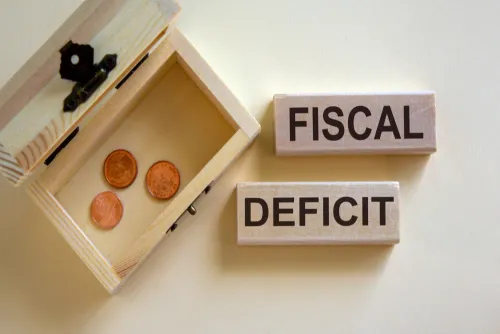
India's fiscal deficit stood at ₹7.10 lakh crore in April–August 2026 , or 41.9% of the full-year Budget Estimate.
The full-year deficit target is ₹16.96 lakh crore , pegged at 4.3% of GDP by Finance Minister Nirmala Sitharaman .
Total receipts reached ₹13,67,709 crore ( 37.5% of BE), while total expenditure stood at ₹20,77,958 crore ( 38.9% of BE).
State tax devolution totalled ₹5,90,391 crore — ₹60,243 crore lower than the same period last year.
The Centre will borrow ₹7.86 lakh crore in the second half of FY27 via 23 weekly auctions , including ₹15,000 crore in Sovereign Green Bonds.
India's fiscal deficit reached ₹7.10 lakh crore in the first five months of FY27 (April–August 2026), equivalent to 41.9% of the Centre's full-year Budget Estimate, according to official data released on Wednesday, 30 September 2026. The figure compares with 38.1% at the same stage last year, indicating a slightly wider gap against the annual target in the current cycle.
The Centre has pegged the full-year fiscal deficit at ₹16.96 lakh crore for FY27, equivalent to 4.3% of GDP — a target set by Finance Minister Nirmala Sitharaman in the Union Budget earlier this year.
Receipts and Revenue: Where the Numbers Stand
Total receipts up to August 2026 stood at ₹13,67,709 crore, or 37.5% of the corresponding Budget Estimate for FY27. Of this, ₹8,37,921 crore came from net tax revenue, ₹4,54,549 crore from non-tax revenue, and ₹75,239 crore from non-debt capital receipts.
Net tax revenue reached 29.2% of the full-year estimate through August, a marginal improvement from 28.6% during the corresponding period last year. Non-tax revenue, however, clocked 68.2% of the annual target — lower than the 75.5% seen in the same period a year ago, according to the data released by the Ministry of Finance.
Expenditure: Capital Spending Holds Firm
Total expenditure by the Centre stood at ₹20,77,958 crore, or 38.9% of the corresponding FY27 Budget Estimate. Of this, ₹15,68,009 crore was on revenue account and ₹5,09,949 crore on capital account. Within revenue expenditure, ₹5,14,810 crore went towards interest payments and ₹1,87,037 crore towards major subsidies.
The capital account figure is a closely watched metric, as it reflects the government's commitment to productive investment in infrastructure over consumption-linked spending.
State Devolution Down ₹60,243 Crore Year-on-Year
The Centre transferred ₹5,90,391 crore to state governments as devolution of share of taxes during the April–August period — ₹60,243 crore lower than the same period in the previous year. The shortfall could constrain state-level capital spending in the near term, particularly in infrastructure-heavy states.
Second-Half Borrowing Programme
Separately, the Central government has announced it will borrow ₹7.86 lakh crore in the second half of FY27, including Sovereign Green Bonds worth ₹15,000 crore. The borrowing will be executed through 23 weekly auctions, according to a Finance Ministry statement. This signals that the government intends to maintain its spending trajectory even as it keeps an eye on the deficit target.
With five months of data in, fiscal consolidation appears broadly on track, though the gap versus last year's pace and the softening non-tax revenue intake warrant close monitoring through the remainder of FY27.
Point of View
Combined with a meaningful dip in non-tax revenue momentum (68.2% vs 75.5% a year ago), suggests the cushion is thinner. The ₹60,243 crore shortfall in state devolution is the less-noticed figure worth watching: it compresses state fiscal space precisely when infrastructure execution needs to accelerate. The ₹7.86 lakh crore second-half borrowing plan keeps the annual deficit math intact on paper, but bond markets will watch whether elevated supply meets sufficient demand without pushing up yields — which would, in turn, raise the government's own interest payment burden in FY28.
NationPress
30 Sept 2026
Frequently Asked Questions
What is India's fiscal deficit for April–August 2026?
India's fiscal deficit stood at ₹7.10 lakh crore in the first five months of FY27 (April–August 2026), amounting to 41.9% of the government's full-year Budget Estimate of ₹16.96 lakh crore. This compares with 38.1% at the same point last year.
What is the government's full-year fiscal deficit target for FY27?
Finance Minister Nirmala Sitharaman set the FY27 fiscal deficit target at ₹16.96 lakh crore, equivalent to 4.3% of GDP, in the Union Budget presented earlier in 2026. The government aims to maintain fiscal consolidation while sustaining capital expenditure.
How much will the Centre borrow in the second half of FY27?
The Central government has announced a second-half borrowing programme of ₹7.86 lakh crore, to be executed through 23 weekly auctions. This includes Sovereign Green Bonds worth ₹15,000 crore.
Why is state tax devolution lower than last year?
The Centre transferred ₹5,90,391 crore to state governments as devolution of share of taxes in April–August 2026, which is ₹60,243 crore lower than the corresponding period last year. The reasons for the shortfall have not been explicitly detailed in the Finance Ministry statement.
How does India's revenue performance compare with last year?
Net tax revenue reached 29.2% of the full-year estimate through August 2026, slightly better than 28.6% in the same period last year. Non-tax revenue, however, came in at 68.2% of the annual target, lower than 75.5% recorded a year ago.