Dr. Jitendra Singh: India hits 1,000-km quantum mark in 3 years
Synopsis
Union Minister Dr. Jitendra Singh announced at PRAGATI Q-FOUNDRY 2026 in New Delhi that India has achieved 1,000 km of quantum secure communication in three years — half the National Quantum Mission's eight-year target — crediting enabling policy for accelerating private-sector participation in frontier quantum technologies.
Key Takeaways
India achieved 1,000 km of quantum secure communication in three years , against a 2,000-km target set for an eight-year National Quantum Mission period.
The National Quantum Mission was approved by the Union Cabinet in April 2023 with a budget of approximately Rs 6,003 crore .
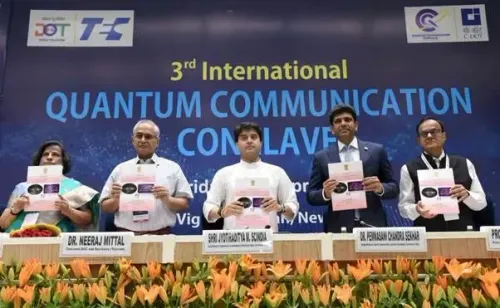
PRAGATI Q-FOUNDRY 2026 , held at Ambedkar International Centre, New Delhi , brought together government, scientific institutions, startups, industry, investors, states and strategic users.
Singh positioned the mission's enabling policy environment as the key factor unlocking private-sector confidence to invest in quantum technologies.
India's stated goal is to move from being a consumer of foreign-developed quantum technologies to a global creator and exporter of them.
The foundry model represents a shift from siloed public-sector research toward whole-of-ecosystem collaboration in frontier technology.
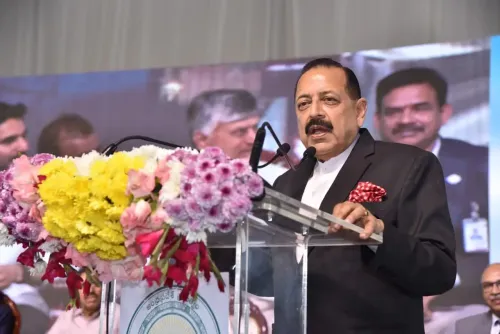
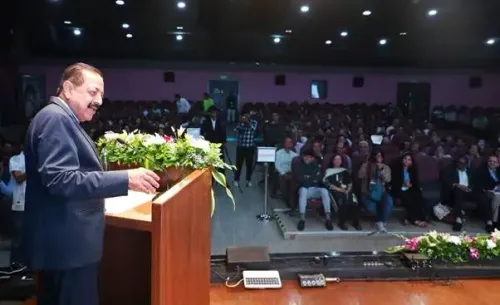
India's quantum ambitions just hit a milestone that was supposed to take twice as long. Addressing the 'PRAGATI Q-FOUNDRY 2026' meet at Ambedkar International Centre, New Delhi, on Wednesday, 30 September 2026, Union Science and Technology Minister Dr. Jitendra Singh declared that India has already achieved 1,000 km of quantum secure communication — half the eight-year target — in just three years under the National Quantum Mission.
Half the target. A third of the time.
The headline number from the minister's address is stark: the National Quantum Mission, approved by the Union Cabinet in April 2023 with a budget of approximately Rs 6,003 crore, set a target of 2,000 km of quantum secure communication over an eight-year period. India has, according to Dr. Singh, already crossed the 1,000-km mark in three years. The minister framed it as evidence not just of technical capability but of institutional momentum — the kind of compressed timeline that changes what investors and startups think is possible.
Dr. Singh told the gathering that India's problem was never talent or technical readiness. 'India had the scientific talent, technological capability and industry readiness,' he said, 'but the enabling environment provided by policymakers is now giving stakeholders the confidence to build and scale up in quantum technologies.' In other words: the science was ready; the policy ecosystem had to catch up. His argument is that under the Modi government, it finally has.
What PRAGATI Q-FOUNDRY 2026 represents
The event itself signals a structural shift in how India approaches frontier technology. PRAGATI Q-FOUNDRY 2026 brought together government agencies, scientific institutions, startups, industry, investors, state governments and strategic users — all under one roof — to align on indigenous quantum capability-building. Dr. Singh described it as 'a new approach' that replaces the older model of siloed public-sector research with a whole-of-ecosystem collaboration.
The minister was direct about the strategic framing: 'India would no longer remain a consumer of quantum technologies developed elsewhere and is building capabilities, infrastructure, talent and enterprises to develop these technologies at home and take them to the world.' That line — from consumer to creator — echoes the broader Atmanirbhar Bharat doctrine applied to frontier tech, the same logic that has driven India's semiconductor and AI policy pushes.
What the quantum race looks like from here
Quantum secure communication — the specific milestone cited — uses quantum key distribution to make interception of data physically detectable, a capability with obvious relevance for defence, banking, and critical infrastructure. Reaching 1,000 km of such a network is a genuine infrastructure threshold, placing India in a small group of countries with operational long-distance quantum communication links.
The watch items now are the push toward the full 2,000-km target, progress on quantum computing prototypes — another Mission deliverable — and whether the foundry model demonstrated at this event translates into announced private-sector partnerships or state-level quantum hubs. The Mission's remaining five years carry both the targets and the credibility test.
Three years in, the scoreboard reads better than the plan said it should. The next question is whether the second half of the mission can match the pace of the first.
Point of View
000-km quantum communication milestone, cited by Dr. Singh at a high-profile industry-government meet, is designed to do double duty: validate the National Quantum Mission's compressed timeline and signal to private investors that state-backed quantum infrastructure is real and moving fast. The PRAGATI Q-FOUNDRY format — explicitly multi-stakeholder — mirrors the model used successfully in India's semiconductor push and suggests the government is betting that ecosystem convening, not just public funding, is the accelerant. The 'consumer-to-creator' framing is a deliberate geopolitical signal, placing quantum alongside semiconductors and AI in India's technology sovereignty narrative. Whether the second half of the Mission — quantum computing prototypes, expanded communication networks, commercial spin-offs — can match the first half's pace will determine whether this milestone becomes a launchpad or a high-water mark.
NationPress
30 Sept 2026
Frequently Asked Questions
What is India's National Quantum Mission?
The National Quantum Mission is India's flagship eight-year programme, approved by the Union Cabinet in April 2023 with a budget of approximately Rs 6,003 crore, aimed at developing indigenous capabilities in quantum computing, communication and sensing.
What is PRAGATI Q-FOUNDRY 2026?
PRAGATI Q-FOUNDRY 2026 is a collaborative quantum technology meet held at Ambedkar International Centre, New Delhi, bringing together government bodies, scientific institutions, startups, industry, investors, state governments and strategic users to align on building indigenous quantum capabilities.
How much quantum secure communication has India achieved under NQM?
According to Union Minister Dr. Jitendra Singh, India has achieved 1,000 km of quantum secure communication in approximately three years — half of the 2,000-km target set for the full eight-year Mission period.
What is quantum secure communication and why does it matter?
Quantum secure communication uses quantum key distribution to make data interception physically detectable, providing tamper-evident encryption critical for defence, banking and national critical infrastructure.
How does India's quantum push connect to Atmanirbhar Bharat?
India's quantum technology drive is part of the broader Atmanirbhar Bharat strategy to reduce reliance on imported frontier technologies, alongside parallel initiatives in semiconductors and artificial intelligence, aiming to build domestic infrastructure, talent and exportable enterprises.