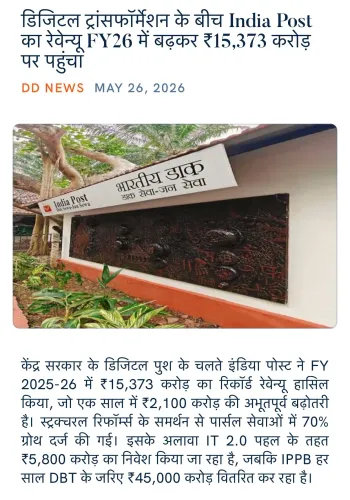
Giriraj Singh: India Post Revenue Up 25%, Parcels Surge 71%

Synopsis
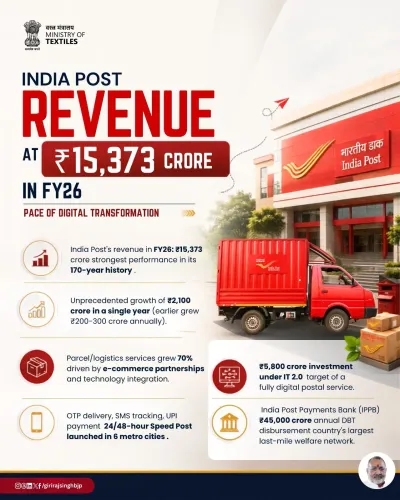
Union Textiles Minister Giriraj Singh cited a 25% rise in India Post revenue and a 71% surge in parcel business on November 3, 2026, crediting PM Modi's drive to modernise the national postal network and tap e-commerce-driven logistics demand.
Key Takeaways
India Post revenue has grown by 25% , according to figures cited by Union Textiles Minister Giriraj Singh on November 3, 2026 .
Parcel business at India Post has surged 71% , reflecting the growing use of the postal network for e-commerce logistics.
The growth is attributed to the Modi government's programme of modernisation and expansion of postal services.
India Post Payments Bank , launched in 2018 , extended the department's role beyond mail into financial inclusion.
India Post's last-mile reach into rural and underserved areas positions it as a key logistics partner for domestic e-commerce growth.
The Department of Posts next annual report will be a critical indicator of whether this growth trajectory is sustained.
India's postal network — long written off as a relic of the telegraph age — is posting numbers that demand attention. Union Textiles Minister Giriraj Singh on Tuesday, November 3, 2026 cited a 25% rise in India Post's revenue and a 71% surge in parcel business, calling them proof of a structural turnaround under the Modi government.
Singh wrote in Hindi: 'इंडिया पोस्ट के राजस्व में 25% की वृद्धि और पार्सल कारोबार में 71% की बढ़ोतरी इस बदलते स्वरूप और बढ़ती कार्यक्षमता को दर्शाती है' — ('A 25% rise in India Post revenue and a 71% increase in parcel business reflect this changing character and growing efficiency'). The minister attributed the gains to Prime Minister Narendra Modi's push to modernise and expand postal services across the country.
From letters to last-mile logistics: what is driving the numbers
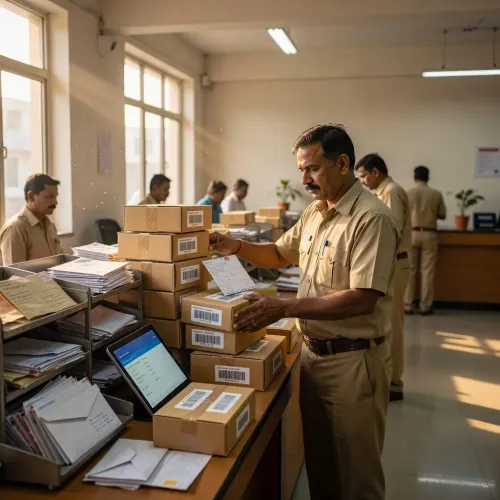
India Post, the national postal operator under the Department of Posts, has historically been anchored in traditional mail and small-savings products. The parcel spike tracks almost exactly with the explosion of domestic e-commerce — millions of orders are flowing into pin codes that private couriers still find uneconomical to serve. The postal network's unmatched last-mile reach, spanning rural India's remotest corners, has quietly made it a logistics partner of growing commercial relevance.
The government laid an institutional foundation for this pivot in 2018 with the launch of India Post Payments Bank, which extended financial services through the existing network of post offices and postmen. That move signalled a broader intent: transform a cost-heavy legacy department into a multi-service platform generating its own revenue momentum.
Why a 71% parcel jump matters beyond the headline
A 71% growth in parcel volume is not just a departmental win — it is a data point about where Indian commerce is heading. Small businesses and artisans in underserved towns increasingly depend on reliable parcel delivery to reach customers in metros and abroad. If India Post can sustain this trajectory, it reduces the country's logistics gap between urban and rural markets. That, in turn, feeds directly into government priorities around rural income and the formalisation of small trade.
Successive governments have attempted computerisation and service upgrades at post offices, but outcomes were often patchy. The revenue figures now being highlighted suggest the investment cycle may finally be compounding — a rarer outcome than the announcements that precede it.
The real test will come when the Department of Posts releases its next full annual report and any fresh budgetary allocations are announced — those numbers will show whether this growth is a trend or a single strong season.
Point of View
Since the specific growth figures come from the minister's post and remain unverified by independent data, the political dimension of the announcement deserves equal weight alongside the operational claim. The real policy story will crystallise when the Department of Posts releases its next audited annual report.
NationPress
3 Nov 2026
Frequently Asked Questions
What is the latest India Post revenue growth figure?
Union Textiles Minister Giriraj Singh cited a 25% increase in India Post revenue in a post on November 3, 2026, attributing it to the Modi government's modernisation efforts. The figure has not been independently verified.
Why has India Post parcel business grown so fast?
The 71% rise in India Post parcel business is driven largely by the boom in domestic e-commerce, with the postal network's unmatched last-mile reach making it the logistics provider of choice for deliveries to rural and underserved areas private couriers often skip.
What is India Post Payments Bank and when was it launched?
India Post Payments Bank was launched in 2018 to extend banking and financial services to rural India through the existing network of post offices and postmen, broadening the department's role beyond mail and savings.
What has the Modi government done to modernise postal services?
The government has pursued technology-driven upgrades including post office computerisation, parcel and payments service expansion, and the establishment of India Post Payments Bank to transform the postal network into a multi-service platform.
What should we watch next regarding India Post's performance?
The release of the Department of Posts' next annual report and any fresh budgetary allocations for postal infrastructure will be the key indicators of whether the reported revenue and parcel growth represents a sustained trend.