Sakura Science Programme 2026: India sends 56 students to Japan for science exchange
Synopsis
Fifty-six government-school students — all NMMS scholarship holders from 15 states — have left for Japan under the Sakura Science Programme 2026, with girls outnumbering boys 32 to 24. Since India joined in 2016, 674 students have made this trip; the 2026 cohort is the clearest signal yet that the programme is scaling access beyond elite institutions.
Key Takeaways
The Union Education Ministry flagged off 56 students and 4 supervisors for the Sakura Science Programme 2026 in Japan on 24 May 2026 .
The cohort includes 24 boys and 32 girls from government schools across 15 states and Union Territories .
All participants hold scholarships under the National Means cum Merit Scholarship (NMMS) scheme.
The programme runs from 24 to 30 May 2026 ; India is joined by participants from Ghana , Nigeria , and South Africa .
A cumulative 674 Indian students and 96 supervisors have visited Japan under the programme since India joined in April 2016 .
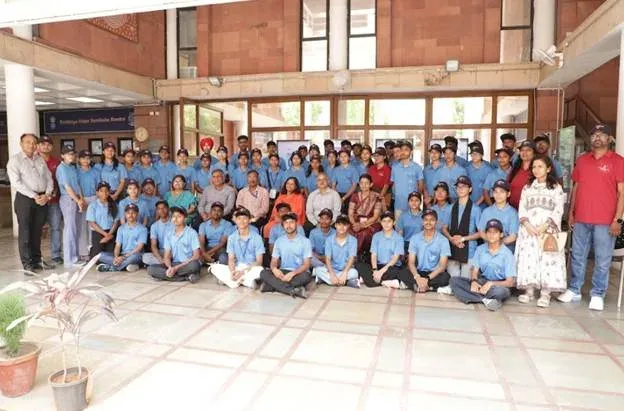
The Union Education Ministry on Saturday, 24 May 2026, flagged off a cohort of 56 school students from India to participate in the Sakura Science Programme 2026 in Japan, in a ceremony held at the National Council of Educational Research and Training (NCERT) campus in New Delhi. The students, accompanied by four supervisors, will spend one week in Japan from 24 to 30 May, exploring the country's advanced science and technology ecosystem.
Who Is Going and Where They Are From
The group comprises 24 boys and 32 girls drawn from government schools across 15 states and Union Territories, including Assam, Gujarat, Karnataka, Maharashtra, Tamil Nadu, West Bengal, Rajasthan, Odisha, Jharkhand, Telangana, Madhya Pradesh, Punjab, Haryana, Goa, and Dadra and Nagar Haveli and Daman and Diu. All participants are recipients of scholarships under the National Means cum Merit Scholarship (NMMS) scheme of the Union government.
India will be joined at the programme by participants from Ghana, Nigeria, and South Africa, making it a multi-nation science exchange initiative.
The Flag-Off Ceremony
The send-off event at NCERT was attended by senior officials including Archana Sharma Awasthi, Additional Secretary of the Department of School Education and Literacy (DoSEL); Dinesh Prasad Saklani, Director of NCERT; and A. Srija, Economic Advisor at DoSEL. The ceremony underscored the government's commitment to providing merit-based students from public schools access to global scientific exposure.
About the Sakura Science Programme
The Sakura Science Programme, formally known as the Japan Asia Youth Exchange Program in Science, has been implemented by the Japan Science and Technology Agency (JST) since 2014. India joined the programme in April 2016. According to official figures, a cumulative total of 674 students and 96 supervisors from India have visited Japan under the programme to date, with the most recent prior batch having travelled in August 2025.
Under the programme's framework, selected students are invited to Japan for one week to experience its science and technology infrastructure alongside its cultural heritage — an approach aligned with the National Education Policy (NEP) 2020, which emphasises holistic, experiential, and cross-disciplinary learning.
Broader Significance for Indian Education
This cohort represents a deliberate effort to widen access: all 56 students hail from government schools and hold NMMS scholarships, meaning the programme specifically targets academically meritorious students from non-privileged backgrounds. The NEP 2020's emphasis on experiential learning and global exposure makes international science exchanges like this a policy priority, not merely a ceremonial gesture. Notably, with 32 girls outnumbering boys in the group, the batch also reflects a push toward gender parity in STEM participation at the school level.
As the 2026 cohort departs, the programme's cumulative reach — now covering students from across India's geographic and socioeconomic spectrum — positions it as one of the more substantive bilateral science diplomacy initiatives between India and Japan at the school level.
Point of View
Which tend to cluster around private or Kendriya Vidyalaya institutions. With 32 of 56 seats going to girls, the 2026 cohort also quietly advances a gender equity agenda that rarely gets explicit attention in science diplomacy. The real question is whether the experience translates into measurable outcomes — increased STEM enrolment, research interest, or mentorship pipelines — or remains a one-week highlight on a student's resume. India has participated since 2016, yet there is no publicly available longitudinal data on what happens to Sakura alumni. That gap in accountability is worth closing.
NationPress
7 Oct 2026
Frequently Asked Questions
What is the Sakura Science Programme 2026?
The Sakura Science Programme 2026 is a one-week exchange visit to Japan for school students from India and other countries, running from 24 to 30 May 2026. It is part of the Japan Asia Youth Exchange Program in Science, implemented by Japan's Science and Technology Agency (JST) since 2014.
Who are the 56 students selected for the programme?
All 56 students are recipients of the National Means cum Merit Scholarship (NMMS) and study in government schools across 15 states and Union Territories. The group comprises 24 boys and 32 girls, representing states including Assam, Gujarat, Karnataka, Maharashtra, Tamil Nadu, and West Bengal, among others.
When did India first join the Sakura Science Programme?
India began participating in the Sakura Science Programme in April 2016. Since then, a cumulative total of 674 students and 96 supervisors from India have visited Japan under the initiative, with the most recent prior batch having travelled in August 2025.
Which other countries are participating in the 2026 edition alongside India?
Ghana, Nigeria, and South Africa are participating alongside India in the Sakura Science Programme 2026, making it a multi-nation youth science exchange.
How does this programme connect to India's National Education Policy 2020?
The NEP 2020 emphasises holistic, experiential, and cross-disciplinary learning, and specifically envisions educational visits to places of scientific and cultural significance as part of standard pedagogy. International exchanges like the Sakura Science Programme are positioned as practical expressions of these NEP goals.