India Aims for 100 GW Nuclear Power Capacity by 2047
Synopsis
India is setting an ambitious target to boost its nuclear power capacity to 100 GW by 2047. This move is part of a strategy to enhance energy security and reduce fossil fuel dependence, marking a significant milestone in the nation's energy transition.
Key Takeaways
India targets 100 GW nuclear capacity by 2047.
Currently operates 24 reactors with 8,780 MWe capacity.
Government plans for 22 GW by early 2030s.
Dual strategy includes large and small reactor development.
PFBR in Tamil Nadu marks a significant milestone.
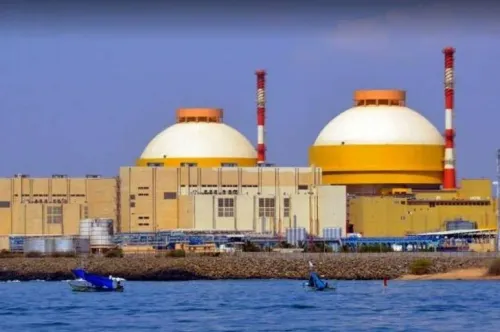
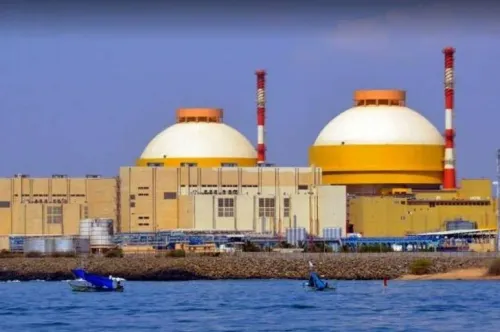
New Delhi, April 11 (NationPress) India has established an ambitious goal to enhance its nuclear energy capacity to a minimum of 100 GW by the year 2047, which will coincide with the centenary of its independence. This initiative is aimed at bolstering long-term energy security while decreasing reliance on fossil fuels, according to a recent report.
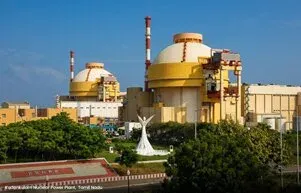
As highlighted by Khaleej Times, the nation currently operates 24 nuclear reactors with a total capacity of 8,780 MWe (Megawatt electric), while construction is underway for eight additional reactors with a combined capacity of 6,028 MWe.
Government forecasts suggest that the installed nuclear capacity will increase to approximately 22 GW by the early 2030s before experiencing a significant expansion to achieve the 100 GW target.
To realize this ambitious eleven-fold growth, India is implementing a dual strategy that includes the construction of large reactors—such as indigenous 700 MWe pressurized heavy water reactors (PHWRs) and imported large-capacity units at greenfield sites—alongside smaller modular systems like 200 MWe Bharat Small Modular Reactors (BSMRs) and 55 MWe SMR-55 units, as stated in the report.
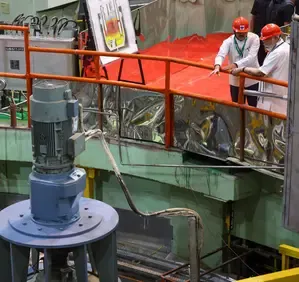
A significant milestone was reached on April 6, 2026, when the 500 MWe Prototype Fast Breeder Reactor (PFBR) located in Kalpakkam, Tamil Nadu, achieved its first criticality, marking the initiation of a controlled nuclear fission chain reaction.
This development represents a crucial advance in enhancing India’s indigenous nuclear technology and ensuring long-term fuel sustainability.
India’s nuclear agenda is structured around a three-stage strategy intended to optimize limited uranium resources while capitalizing on its extensive thorium reserves.
The first stage leverages PHWRs fueled by natural uranium to generate plutonium. The second stage involves fast breeder reactors that use plutonium as fuel and produce more fissile material than they consume. The final stage aims to harness thorium-based reactors, generating uranium-233 to support sustained nuclear power generation.
As detailed in the report, the PFBR employs uranium-plutonium mixed oxide (MOX) fuel and liquid sodium as a coolant, allowing it to produce more fuel than it consumes and setting the stage for future thorium utilization.
The 500 MWe reactor has the capacity to provide electricity to approximately half a million households.
Point of View
India's commitment to scaling its nuclear power capacity is a strategic move towards energy independence and sustainability. By investing in both large and small reactor technologies, the country is positioning itself at the forefront of clean energy innovation, ensuring a stable energy supply for future generations.
NationPress
26 Sept 2026
Frequently Asked Questions
What is India's target for nuclear power capacity by 2047?
India aims to increase its nuclear power capacity to at least 100 GW by 2047.
How many nuclear reactors does India currently operate?
India currently operates 24 nuclear reactors with a combined capacity of 8,780 MWe.
What strategy is India using to achieve its nuclear capacity goals?
India is pursuing a dual strategy, developing large reactors and smaller modular systems to significantly increase its nuclear capacity.
What is the significance of the Prototype Fast Breeder Reactor (PFBR)?
The PFBR is a crucial step in advancing India's nuclear technology, marking the start of a controlled nuclear fission chain reaction.
How does India's nuclear program utilize thorium resources?
India's nuclear program is designed to maximize limited uranium resources while leveraging its vast thorium reserves through a three-stage strategy.