INS Taragiri Launch: A New Era for India's Naval Power

Synopsis
The Indian Navy's commissioning of the INS Taragiri heralds a significant milestone in strengthening India's maritime security. Defence Minister Rajnath Singh emphasizes the warship's role in boosting national defense and self-reliance in ship-building.
Key Takeaways
INS Taragiri enhances India's naval strength and security.
75% of the warship is indigenously produced .
Significant for coastal surveillance and humanitarian missions.
Defence manufacturing is a national mission under the Modi administration.
Strong naval presence is essential for securing trade routes.
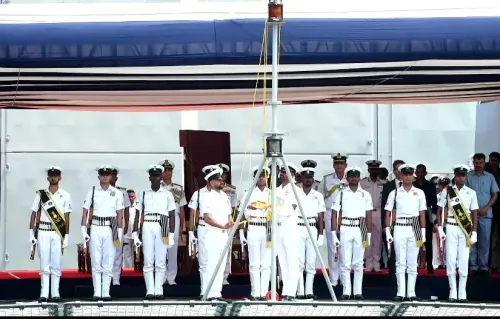
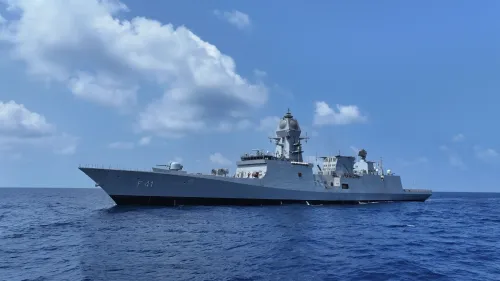
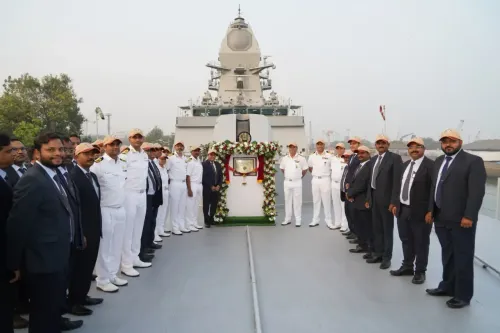
Visakhapatnam, April 3 (NationPress) The Indian Navy celebrated the commissioning of its stealth frigate INS Taragiri during an impressive ceremony on Friday, graced by Defence Minister Rajnath Singh. This event signifies a pivotal advancement in India's maritime security and sovereignty.
Post-commissioning, Rajnath Singh praised this milestone as a testament to India’s evolving defence capabilities and its aspirations towards becoming a self-sufficient naval force.
He emphasized that the commissioning of INS Taragiri conveys a message of peace and prosperity throughout the region, elaborating on how the warship will bolster stability, with its name inspired by one of the majestic Himalayan ranges.
The Defence Minister noted that this warship significantly enhances India’s naval strength, safeguarding maritime boundaries and deterring adversaries.
“The 7,000-tonne vessel, armed with BrahMos and other advanced missiles, is capable of monitoring enemy movements while ensuring coastal surveillance along India’s extensive maritime borders. It will also participate in humanitarian missions,” he explained to the audience.
Highlighting the indigenous nature of the stealth frigate, he revealed that approximately 75 percent of its components are produced domestically, underscoring India’s burgeoning ship-building capabilities. He stated that the nation is progressing rapidly towards self-reliance in ship construction and allied industries.
Rajnath Singh characterized defence manufacturing as a national priority under the Modi administration, asserting that the launch of INS Taragiri exemplifies India's increasing indigenous capabilities and growing Atmanirbharta in this sector.
He emphasized the necessity of a formidable naval force, given that India boasts an extensive coastline of 11,000 kilometers and is bordered by oceans on three sides.
“With 95 percent of our trade conducted via maritime routes, our energy security is also dependent on these pathways. Hence, a strong navy is essential—it's not merely an option,” the Defence Minister remarked.
He further pointed out that whether in the Persian Gulf or the Malacca Straits, the navy remains prepared to offer various forms of assistance, even amid humanitarian crises.
“The commissioning of INS Taragiri will invigorate India's naval capabilities. In this digital era, maritime security must be envisioned through a futuristic lens,” he stated, extending his congratulations to the Navy and the citizens of India.
He also touched upon the increasing importance of oceans in the 21st century, highlighting that maritime strength remains a critical asset for national security.
“Historically, oceans facilitated civilizational exchanges. However, in contemporary times, factors such as security, sovereignty, and strategic interests hinge on maritime considerations, which now serve as foundations for connectivity and economic growth. Nations with robust naval forces command respect and are better positioned to safeguard their strategic interests,” he concluded.
Point of View
Showcasing the nation's commitment to enhancing its maritime security and self-reliance in ship-building. This event, attended by Defence Minister Rajnath Singh, reflects a robust stance towards fostering a strong naval presence in a rapidly changing geopolitical landscape.
NationPress
7 Oct 2026
Frequently Asked Questions
What is the significance of INS Taragiri?
INS Taragiri's commissioning marks a pivotal enhancement in India’s naval strength, symbolizing the country's commitment to maritime security and self-reliance in defence manufacturing.
Who attended the commissioning ceremony?
The ceremony was attended by Defence Minister Rajnath Singh, among other dignitaries.
What percentage of INS Taragiri is indigenously produced?
Approximately 75 percent of INS Taragiri is produced within India, highlighting the country's growing capabilities in ship-building.
How does INS Taragiri contribute to India's maritime security?
INS Taragiri enhances naval capabilities through advanced surveillance, coastal protection, and humanitarian mission support.
Why is a strong navy essential for India?
With a coastline of 11,000 kilometers, a strong navy is crucial for securing trade routes, energy security, and national sovereignty.