How is ISI Using Homegrown Terror to Overwhelm Indian Agencies?

Synopsis
Explore the alarming tactics employed by ISI to instigate chaos in India through homegrown terror networks. Discover how these strategies threaten national security and the measures being taken to counteract this growing menace.
Key Takeaways
ISI is expanding its operational networks within India.
Homegrown terrorism is becoming a primary focus for Pakistan.
Increased drone activity is being utilized for smuggling operations.
Targeting of prominent individuals is part of a larger strategy.
Indian agencies are adapting their responses to counter these threats.
New Delhi, Feb 2 (NationPress) Indian agencies have uncovered numerous schemes orchestrated by ISI-supported terrorists, designed to execute attacks within India. Recent insights reveal that Pakistan has established several networks inside the country, aiming to disrupt tranquility.
An official from the Intelligence Bureau indicated that the ISI has not limited itself to just one type of network. The Pakistani intelligence agency is not only forming terror modules for attacks but has also created spy rings, along with a significant honey-trapping network. These proxies are targeting individuals in Jammu and Kashmir, whom they perceive as anti-Pakistan.
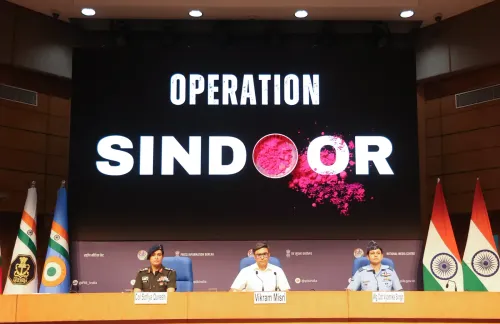
Additionally, there are also returning hit squads, which have compiled lists of notable individuals to be targeted. Officials assert that this indicates the extensive operational reach the ISI intends to have within India. After the Pahalgam attack, India retaliated with Operation Sindoor, resulting in increased security along the borders, leading to a decrease in infiltrations.
With no terrorists penetrating the borders, Pakistan has revived pre-existing modules in Jammu and Kashmir. Those who had previously infiltrated are now on alert and have been directed to act in Jammu and Kashmir.
Another official noted that there is an uptick in drone activity in border regions. These drones are utilized to smuggle drugs and arms into Punjab, with the aim of reigniting the Khalistan movement. The ISI has tasked its proxy, Lashkar-e-Taiba, to conduct a sustained campaign in Jammu and Kashmir, targeting prominent figures and branding them as anti-Pakistan and anti-Kashmir, with the goal of tarnishing their reputations and inciting local opposition against them.
Recently, the Lashkar-e-Taiba threatened well-known counter-terrorism expert Junaid Qureshi due to his critical stance towards the ISI. Interestingly, Qureshi's father, Hashim Qureshi, was one of the hijackers of Air India flight IC-405 in 1971, though Junaid does not share his father's views.
The Gujarat ATS apprehended a young man from Uttar Pradesh for advocating the ideologies of terror groups like Jaish-e-Mohammed and Al Qaeda. Following the guidance of his handlers, he was disseminating their ideologies and had compiled a hit list of seven individuals with plans to eliminate them to instigate fear in Gujarat.
Intelligence Bureau officials have identified a clear pattern. The ISI aims to keep Indian agencies preoccupied, pushing its agenda on a large scale to confuse them, ultimately waiting for a chance to execute a major strike. Moreover, the goal is to recruit as many youth as possible, with the ISI willing to financially incentivize individuals to advance their objectives.
Another official explained that in the forthcoming months, Pakistan will persist in promoting a similar agenda, not just to confuse agencies, but also to increase recruitment among youth. Pakistan seeks to ensure that terrorism in India is predominantly homegrown, alleviating the need for infiltration and allowing them plausible deniability during a terror incident. The push for a homegrown network is intensifying as India has revised its doctrine to classify any act of terror as an act of war, rather than mere cross-border terrorism.
Point of View
It's imperative to recognize the escalating threat posed by ISI-backed terror networks. The strategic shift towards homegrown terrorism necessitates a comprehensive response from Indian agencies to safeguard national security and maintain peace.
NationPress
1 Sept 2026
Frequently Asked Questions
What are the tactics used by ISI to disrupt India?
The ISI employs multiple tactics including establishing terror modules, spy rings, and honey-trapping networks, targeting individuals in Jammu and Kashmir.
Why has Pakistan focused on homegrown terrorism?
Pakistan aims to develop homegrown terrorism to eliminate the need for infiltration, allowing them plausible deniability during attacks.
What steps is India taking to counter these threats?
India has heightened security measures at borders and conducted operations like Operation Sindoor to combat ISI's strategies.