Jaishankar Begins Brussels Visit, Meets EU's Kallas
Synopsis
External Affairs Minister Dr. S. Jaishankar arrived in Brussels on 15 July 2026 for meetings with EU High Representative Kaja Kallas, focusing on West Asian stability, maritime commerce safety and advancing the India-EU Strategic Partnership for supply chain resilience.
Key Takeaways
Jaishankar began his visit to Brussels on 15 July 2026 .
He met EU HRVP Kaja Kallas and held discussions on West Asia peace and stability.
Safe and unimpeded maritime commerce was a key agenda item, reflecting India's energy and trade route interests.
Both sides discussed advancing the India-EU Strategic Partnership with a focus on supply chain resilience .
The India-EU Strategic Partnership dates to 2004 ; the Trade and Technology Council was added in 2022 .
A full India-EU summit is expected in late 2026 , for which this meeting lays the groundwork.
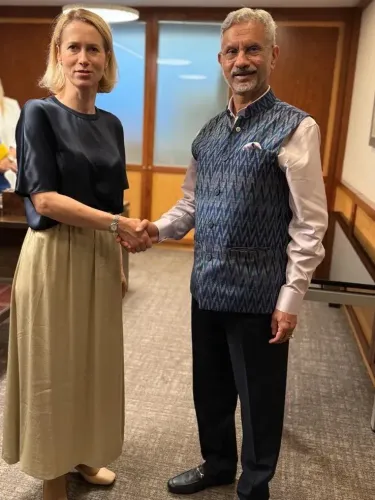
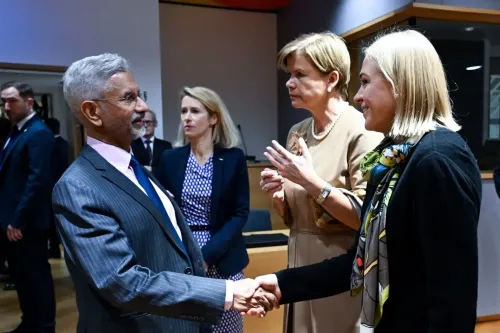
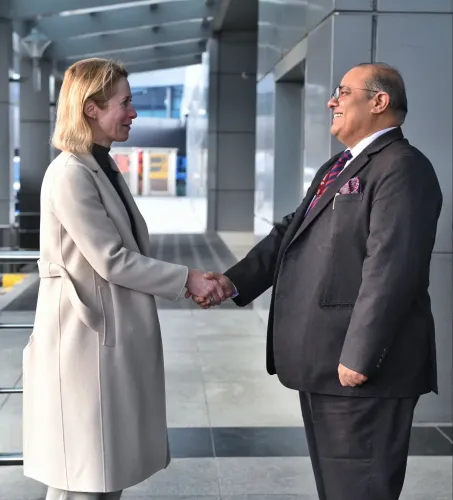
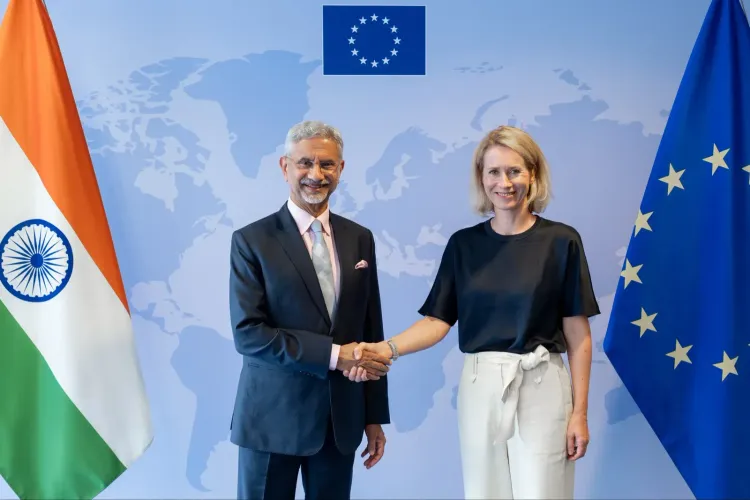
Union External Affairs Minister Dr. S. Jaishankar arrived in Brussels on Wednesday, 15 July 2026, kicking off a bilateral visit with a meeting with European Union High Representative for Foreign Affairs and Security Policy Kaja Kallas. The discussions spanned West Asian stability, maritime commerce, and the broader India-EU Strategic Partnership.
Context
Dr. Jaishankar described the meeting as covering 'useful discussions on West Asia and the need to ensure peace and stability,' along with an exchange of views on 'the importance of safe and unimpeded maritime commerce.' The visit marks one of the more substantive India-EU ministerial engagements of 2026, coming ahead of a widely anticipated India-EU summit later in the year.
The Brussels leg places India's top diplomat at the heart of EU foreign-policy decision-making, signalling New Delhi's intent to keep the strategic dialogue with Europe active at the highest levels even as global attention remains fixed on flashpoints in West Asia and ongoing disruptions to international shipping lanes.
Policy Backdrop
The India-EU Strategic Partnership, established at The Hague in 2004, has grown into a multi-layered framework covering trade, security, technology and connectivity. A significant upgrade came in 2022 with the launch of the India-EU Trade and Technology Council (TTC), designed to address supply-chain resilience, semiconductors and clean energy — precisely the themes Dr. Jaishankar flagged in his post on advancing the partnership to 'ensure supply chain resilience.'
India's maritime interests in the region are substantial. New Delhi relies heavily on West Asian energy routes and hosts one of the world's largest diaspora communities in the Gulf. Any instability affecting Red Sea or Arabian Sea corridors has direct consequences for Indian exporters and energy importers alike, making safe maritime commerce a standing priority in India's external engagements.
Stakeholders and Impact
Indian exporters and maritime traders stand to benefit most directly from any progress on supply-chain resilience frameworks that emerge from India-EU dialogue. The Trade and Technology Council workstreams on semiconductors and clean energy also carry implications for Indian manufacturers seeking to diversify sourcing away from single-country dependencies — a lesson reinforced by disruptions during the COVID-19 pandemic and the fallout from the Ukraine conflict.
For the European Union, deeper engagement with India represents a strategic hedge as Brussels seeks to reduce its own economic vulnerabilities and build partnerships with large democratic economies in the Indo-Pacific. The meeting between Dr. Jaishankar and HRVP Kallas reflects this mutual interest in institutionalising cooperation beyond transactional trade ties.
What's Next
The next India-EU summit, expected in late 2026, will be a key moment to assess whether the ministerial-level groundwork laid in Brussels translates into concrete deliverables on trade, technology and maritime security. Follow-up action on the Trade and Technology Council workstreams — particularly on supply chains and connectivity — will be closely watched by industry and policy circles in both New Delhi and Brussels.
As India continues to position itself as an indispensable partner in a rules-based global order, engagements like this Brussels visit underscore New Delhi's strategy of weaving a dense web of high-level partnerships that can anchor its economic and security interests across multiple geographies.
Point of View
New Delhi is signalling that it sees European engagement as inseparable from its Indo-Pacific and Gulf security calculus. The emphasis on supply-chain resilience also keeps India aligned with the EU's own strategic-autonomy agenda, creating a platform of shared interest that could accelerate the stalled India-EU Free Trade Agreement talks. Watch whether the late-2026 summit produces binding TTC deliverables — that will be the real test of whether this diplomatic tempo converts into structural economic integration.
NationPress
15 Jul 2026
Frequently Asked Questions
Why did Jaishankar visit Brussels in July 2026?
Dr. Jaishankar visited Brussels on 15 July 2026 to meet EU High Representative Kaja Kallas for discussions on West Asian stability, maritime commerce and advancing the India-EU Strategic Partnership on supply chain resilience.
Who is Kaja Kallas and why did Jaishankar meet her?
Kaja Kallas is the European Union High Representative for Foreign Affairs and Security Policy, making her the EU's top diplomat. Dr. Jaishankar met her to hold bilateral talks on shared foreign-policy priorities including West Asia and maritime trade.
What is the India-EU Strategic Partnership?
The India-EU Strategic Partnership is a bilateral framework established at The Hague in 2004 covering trade, security, technology and connectivity. It was significantly upgraded in 2022 with the launch of the Trade and Technology Council.
What did India and the EU discuss about maritime commerce?
Dr. Jaishankar and HRVP Kallas exchanged views on the importance of safe and unimpeded maritime commerce, a priority driven by India's dependence on West Asian energy routes and international shipping lanes that have faced disruption in recent years.
When is the next India-EU summit?
The next full India-EU summit is expected in late 2026 and will be a key moment to assess progress on trade, technology and maritime security commitments discussed at the ministerial level in Brussels.