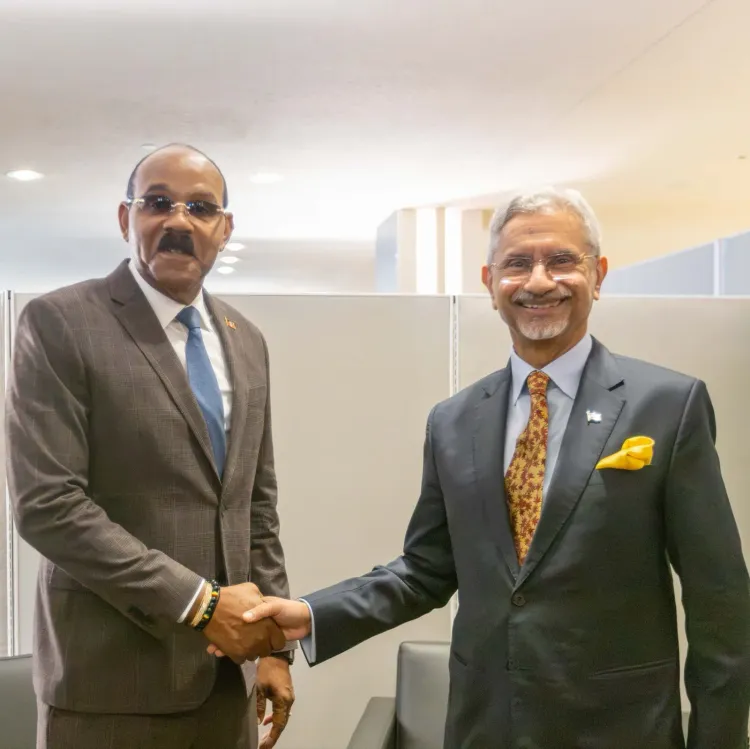
Jaishankar meets Antigua PM Browne at UNGA81
Synopsis
External Affairs Minister Dr. S. Jaishankar met Antigua and Barbuda Prime Minister Gaston Browne on Day 4 of UNGA81, reinforcing India's development partnership, capacity-building programmes, climate cooperation, and strong commitment to the success of CHOGM.
Key Takeaways
Day 4 of UNGA81 opened for India with a bilateral between EAM Dr.
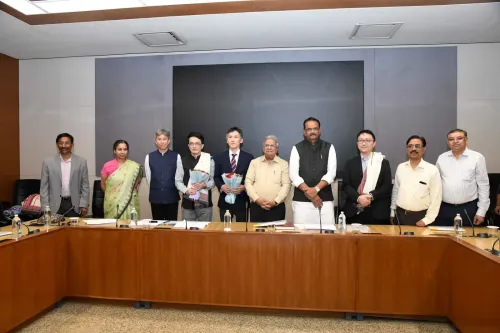
Jaishankar and PM Gaston Browne of Antigua and Barbuda in New York .
India confirmed that its development partnership and capacity-building cooperation with Antigua and Barbuda are progressing.
Climate change cooperation was explicitly cited as a pillar of the bilateral relationship.
Jaishankar stated India is 'strongly committed to the success of CHOGM ' — the biennial Commonwealth Heads of Government Meeting.
India has historically supported Caribbean nations through the ITEC programme , offering technical training and lines of credit.
The meeting reflects India's deliberate diplomatic outreach to small island developing states at multilateral forums.
On the sidelines of the 81st United Nations General Assembly in New York, Union External Affairs Minister Dr. S. Jaishankar opened Day 4 of the high-diplomacy sprint with a bilateral meeting with Prime Minister Gaston Browne of Antigua and Barbuda — a pairing that signals how seriously New Delhi is courting small island states on climate and development.
From ITEC classrooms to climate corridors
India's relationship with Antigua and Barbuda runs deeper than the handshake photo suggests. For decades, New Delhi has extended capacity-building support to Caribbean nations through the Indian Technical and Economic Cooperation (ITEC) programme — training officials, funding infrastructure, and offering lines of credit. Jaishankar confirmed that development partnership and capacity building are 'going forward,' signalling continuity rather than reset.
Climate change sits at the heart of why this relationship matters to Bridgetown and its neighbours. Small island developing states face existential stakes — rising seas, intensifying hurricanes, eroding coastlines. India's climate cooperation with the Caribbean is part of a broader posture New Delhi has cultivated across the Global South, positioning itself as a partner that shares vulnerability rather than merely lecturing from a position of comfort.
India's CHOGM commitment — and what it means
The clearest signal in Jaishankar's post is the explicit pledge: 'India is strongly committed to the success of CHOGM.' The Commonwealth Heads of Government Meeting (CHOGM), held biennially, is a platform where 54 Commonwealth nations — including Antigua and Barbuda — shape shared agendas on trade, climate, and governance. India's vocal support for CHOGM's success, stated directly to a sitting Caribbean prime minister, is diplomatic language with weight: it tells smaller member states that New Delhi intends to be a constructive, invested actor inside the Commonwealth architecture.
Prime Minister Gaston Browne, in power since 2014, has been a consistent voice for climate finance and debt relief for small island economies. A meeting with the Indian External Affairs Minister at UNGA — the world's most watched multilateral stage — gives that advocacy an important amplifier.
UNGA81 as India's diplomatic sprint
This bilateral is one node in what is evidently a packed UNGA schedule for Jaishankar. The General Assembly's high-level week is when foreign ministers and heads of government concentrate in Midtown Manhattan, making it the single most efficient venue for back-to-back diplomacy. Choosing to begin Day 4 with a Caribbean leader — rather than a major power — is itself a statement: India's global engagement is wide, not just weighted toward the usual heavyweights.
Watch for any follow-up project announcements under the India-Antigua and Barbuda development partnership, and for India's positioning at the next CHOGM as a measure of how today's conversation translates into action.
Point of View
Not just big-power optics. By publicly reaffirming CHOGM support in the same breath as climate and development cooperation, Jaishankar is reinforcing India's pitch to the Global South: that it is a reliable partner with skin in the game on climate vulnerability, not merely a bystander. This posture — sustained over decades through ITEC and lines of credit — is now being amplified on the world's largest diplomatic stage, and that amplification itself has strategic value ahead of the next CHOGM.
NationPress
24 Sept 2026
Frequently Asked Questions
Why did Jaishankar meet Antigua and Barbuda PM at UNGA81?
EAM Dr. S. Jaishankar met PM Gaston Browne on the sidelines of the 81st UN General Assembly in New York to advance India's development partnership, capacity-building programmes, and climate cooperation with Antigua and Barbuda, and to affirm support for CHOGM.
What is CHOGM and why is India committed to it?
CHOGM — the Commonwealth Heads of Government Meeting — is a biennial summit of 54 Commonwealth nations. India, as a major Commonwealth member, sees it as a key multilateral platform for trade, climate, and governance, and Jaishankar publicly stated India is 'strongly committed' to its success.
What is India's development partnership with Antigua and Barbuda?
India supports Caribbean nations including Antigua and Barbuda through the ITEC (Indian Technical and Economic Cooperation) programme, which provides capacity-building, technical training, and lines of credit for development projects.
What role does climate change play in India-Antigua and Barbuda ties?
Climate change cooperation is a central pillar of the bilateral relationship. As a small island developing state, Antigua and Barbuda faces existential climate risks, and India frames its cooperation as part of its broader partnership with vulnerable Global South nations.
Who is Gaston Browne and what is his significance?
Gaston Browne has been Prime Minister of Antigua and Barbuda since 2014. He is a prominent advocate for climate finance and debt relief for small island economies, and his engagement with India at UNGA gives that advocacy an influential partner.