Jal Shakti Minister CR Paatil Highlights Women Empowered via FTK Kits
Synopsis
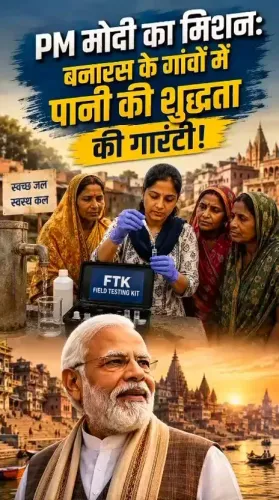
Union Jal Shakti Minister C. R. Paatil has highlighted the government's initiative to equip rural women with Field Test Kits for on-site drinking water quality monitoring, framing it as a flagship achievement under Prime Minister Narendra Modi's leadership on the occasion of #12YearsOfSeva.
Key Takeaways
Union Jal Shakti Minister C.
Paatil posted on 13 June 2026 about women being given Field Test Kits (FTKs) for water quality monitoring.
The initiative is part of the Jal Jeevan Mission , launched in 2019 , which targets functional tap water connections for all rural households.
FTKs allow community members to test drinking water for parameters such as pH, turbidity, and chemical contaminants on-site.
Community-based water quality surveillance using test kits has policy lineage going back to NRDWP guidelines from 2009 .
The post was tagged #12YearsOfSeva , situating the initiative within the BJP-led government's broader governance record.
Village panchayats and women's self-help groups are the key local institutions through which FTK distribution is operationalised.
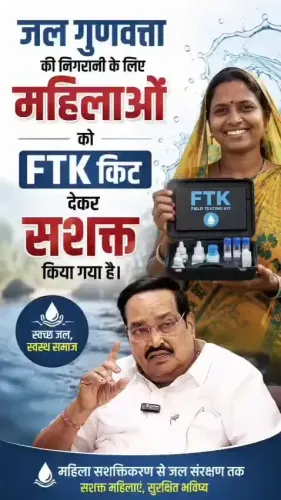
Union Jal Shakti Minister C. R. Paatil on Saturday, 13 June 2026 highlighted the government's initiative to empower women with Field Test Kits (FTKs) for drinking water quality monitoring, crediting the programme to the leadership of Prime Minister Narendra Modi.
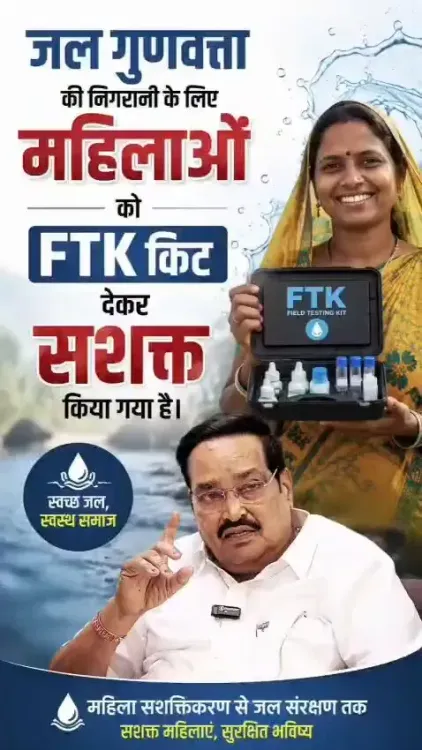
Posting on X, Minister Paatil wrote: 'माननीय प्रधानमंत्री श्री @narendramodi सर के नेतृत्व में जल गुणवत्ता की निगरानी के लिए महिलाओं को FTK किट देकर सशक्त बनाया गया है' — translating to: 'Under the leadership of honourable Prime Minister Shri Narendra Modi, women have been empowered by providing FTK kits for water quality monitoring.' The post was tagged #12YearsOfSeva, marking a milestone in the BJP-led government's tenure.
Context
Field Test Kits are portable, low-cost devices that allow community members to conduct rapid on-site checks of key drinking water parameters, including pH levels, turbidity, and chemical contaminants. Distributing these kits to women at the village level is intended to decentralise water quality surveillance beyond formal laboratory networks. The initiative positions rural women as frontline monitors of public health infrastructure.
The broader policy framework traces back to National Rural Drinking Water Programme (NRDWP) guidelines from 2009, which included provisions for community-based water quality surveillance. The current government has scaled this approach significantly under the Jal Jeevan Mission.
Policy Backdrop
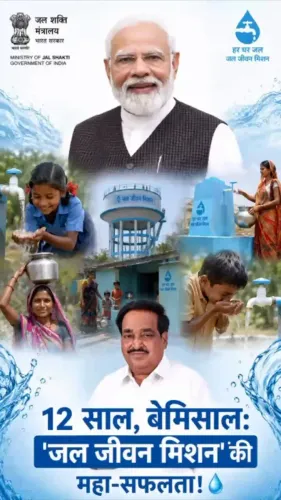
The Jal Jeevan Mission, launched in 2019 under Prime Minister Modi, aims to provide functional tap water connections to every rural household in India. Water quality monitoring is a core component of the mission, with FTKs forming a decentralised, community-level layer of oversight alongside state laboratory networks. The mission's architecture explicitly integrates women's participation to strengthen grassroots accountability.
This approach reflects a wider pattern of gender mainstreaming in central government schemes, visible also in the Swachh Bharat Mission and earlier sanitation programmes. Women's self-help groups have been a preferred vehicle for rolling out community surveillance roles, combining social mobilisation with technical function.
Stakeholders and Impact
The primary beneficiaries of FTK distribution are rural women and the communities they serve, who gain a direct mechanism to flag water quality failures without waiting for centralised testing. Village panchayats are also key stakeholders, as local governance bodies responsible for coordinating with district water authorities when test results indicate contamination.
By placing testing capability in the hands of women, the policy aims to reduce dependence on overburdened state laboratories and improve response times when water sources are found to be unsafe. The approach also carries a capacity-building dimension, training women in basic water science and public health protocols.
What's Next
Attention will now turn to the release of annual Jal Jeevan Mission water quality dashboards, which track kit distribution, tests conducted, and contamination incidents reported at the district level. Parliamentary questions on the scale of FTK rollout and the number of women trained are expected to provide further granularity on programme reach. The #12YearsOfSeva framing signals that the ruling party intends to continue highlighting such grassroots welfare metrics as a political communication strategy ahead of future electoral cycles.
Point of View
Designed to aggregate welfare achievements ahead of future electoral cycles. The FTK initiative is substantively significant — decentralised water quality monitoring addresses a genuine gap in rural public health infrastructure — but the post offers no new data on scale or outcomes, making it as much a branding exercise as a policy announcement. The gender-mainstreaming angle is consistent with a broader pattern across BJP-era flagship schemes, from Swachh Bharat to Ujjwala, where women are positioned as both beneficiaries and delivery agents. The real test will be whether forthcoming Jal Jeevan Mission dashboards show measurable improvements in contamination detection rates in districts with high FTK penetration.
NationPress
24 Sept 2026
Frequently Asked Questions
What is an FTK kit used for in India's water sector?
An FTK, or Field Test Kit, is a portable device used to test drinking water quality on-site for parameters such as pH, turbidity, fluoride, nitrate, and other contaminants, without needing a laboratory.
What is the Jal Jeevan Mission?
The Jal Jeevan Mission is a flagship central government scheme launched in 2019 under Prime Minister Narendra Modi, aimed at providing functional household tap connections to every rural home in India, with water quality monitoring as a core component.
Why are women given water testing kits under government schemes?
Women are given FTK kits to act as frontline water quality monitors in their villages, enabling rapid detection of contamination and reducing dependence on centralised state laboratories, while also building women's capacity in public health.
Who is C. R. Paatil and what ministry does he head?
C. R. Paatil is a senior BJP leader and former Gujarat BJP state president who currently serves as Union Minister of Jal Shakti, the ministry responsible for drinking water, sanitation, and river management in India.
What is #12YearsOfSeva?
#12YearsOfSeva is a hashtag used by BJP leaders and the central government to mark and communicate achievements across welfare and governance schemes completed during the twelve years of the Modi-led government.