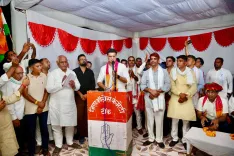
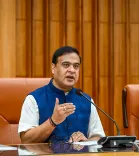
Jal Shakti Minister Paatil at Manjula Sarovar inauguration in Gujarat
Synopsis
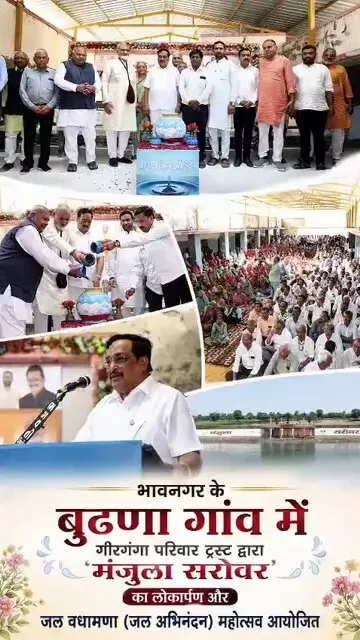
Union Jal Shakti Minister C. R. Paatil shared highlights from the Manjula Sarovar inauguration and water augmentation programme organised by the Girganga Parivar Trust in Gujarat's Gir region on 18 July 2026, spotlighting the trust-partnership model for community water conservation.
Key Takeaways
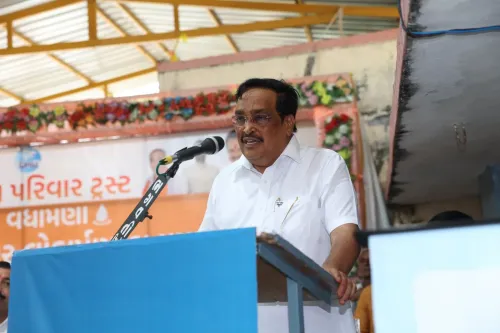
Manjula Sarovar was formally inaugurated at a lokarpan ceremony organised by the Girganga Parivar Trust in the Gir region of Gujarat on 18 July 2026 .
Union Jal Shakti Minister C.
Paatil attended and shared visuals from the event, highlighting community-led water augmentation.
The project benefits farmers and rural communities in Saurashtra , a semi-arid zone prone to seasonal water scarcity.
The initiative aligns with central schemes including the Jal Jeevan Mission , Jal Shakti Abhiyan , and Atal Bhujal Yojana , all launched between 2018 and 2019 .
The trust-partnership model mirrors Gujarat 's long-standing emphasis on check dams and community reservoirs, which the Union government is seeking to scale nationally.
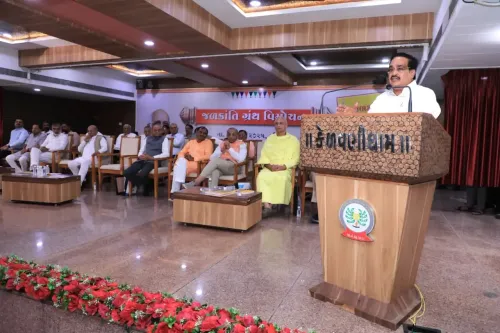
Union Jal Shakti Minister C. R. Paatil shared highlights on Saturday, 18 July 2026 from the Manjula Sarovar Lokarpan evam Jalvardhan Karyakram (Manjula Sarovar Inauguration and Water Augmentation Programme), organised by the Girganga Parivar Trust in Gujarat. The event marked the formal opening of Manjula Sarovar, a community reservoir developed to bolster water storage and groundwater recharge in the Gir region of Saurashtra.
Context
Paatil posted a glimpse of the programme on X, describing it as 'Girganga Parivar Trust dwara aayojit Manjula Sarovar Lokarpan evam Jalvardhan Karyakram ki ek jhalak' — 'a glimpse of the Manjula Sarovar inauguration and water augmentation programme organised by the Girganga Parivar Trust.' The Girganga Parivar Trust is a Gujarat-based organisation active in the Gir region, with a track record of mobilising community participation for lake development and water conservation drives.
The lokarpan (public dedication) ceremony signals that the reservoir has been handed over for community use, a symbolic step that underscores the trust-led model of water infrastructure development that has gained traction across Saurashtra.
Policy Backdrop
The event sits within a broader national framework anchored by the Jal Shakti Ministry. The Jal Jeevan Mission, launched in 2019, targets piped water supply and groundwater recharge across rural India, while the Jal Shakti Abhiyan — also initiated in 2019 — runs as a nationwide campaign for water conservation and rainwater harvesting. The Atal Bhujal Yojana, approved in 2018, specifically addresses groundwater management in priority blocks, including parts of Gujarat.
Gujarat has long served as a reference model for decentralised water conservation. BJP-led administrations in the state have emphasised check dams, recharge wells, and community reservoirs since the early 2000s, and the current Union government has sought to scale that approach nationally through the schemes above.
Stakeholders and Impact
The primary beneficiaries of the Manjula Sarovar project are farmers and rural communities in the Saurashtra belt, a semi-arid zone where seasonal water scarcity routinely affects agriculture and drinking water availability. Community-led sarovar projects of this kind supplement state irrigation infrastructure and can meaningfully raise the local water table when coupled with recharge structures.
The involvement of the Girganga Parivar Trust reflects the central government's broader strategy of partnering with local trusts and civil-society organisations to augment traditional water bodies — a model that reduces dependence on purely government-funded delivery and builds local ownership of conservation assets.
What's Next
Attention will turn to state-level progress reports on the Atal Bhujal Yojana and whether the Union Budget cycle brings new guidelines or dedicated funding for community-led sarovar projects modelled on initiatives like Manjula Sarovar. As the Jal Shakti Ministry continues to push demand-side management alongside supply-side infrastructure, events such as this one in the Gir region are likely to be cited as proof-of-concept for scaling trust-partnership models to other water-stressed districts across India.
Point of View
Not a stopgap. Gujarat's community-reservoir model has been politically and administratively central to the BJP's water narrative since the early 2000s, and elevating it at the ministerial level reinforces that lineage. With the Atal Bhujal Yojana mid-term reviews approaching, such events help build the optics of on-ground delivery in a state that remains the party's organisational heartland. The broader implication is that community-led sarovar projects could gain formal policy recognition — and possibly dedicated budget lines — in the next Union Budget cycle.
NationPress
18 Jul 2026
Frequently Asked Questions
What is Manjula Sarovar and where is it located?
Manjula Sarovar is a community reservoir inaugurated by the Girganga Parivar Trust in the Gir region of Saurashtra, Gujarat, aimed at improving local water storage and groundwater recharge.
Who is C. R. Paatil and what is his role?
C. R. Paatil is the Union Minister of Jal Shakti, a senior BJP leader and former Gujarat state president responsible for national water resource and conservation policy.
What is the Girganga Parivar Trust?
The Girganga Parivar Trust is a Gujarat-based organisation active in the Gir region that organises water conservation and lake development programmes, often in partnership with government initiatives.
How does the Manjula Sarovar project connect to central government water schemes?
The project complements central schemes such as the Jal Jeevan Mission, Jal Shakti Abhiyan, and Atal Bhujal Yojana, all of which target water supply, conservation, and groundwater management in rural and semi-arid India.
Why is Gujarat significant for water conservation policy in India?
Gujarat has been a reference model for decentralised water conservation since the early 2000s, with an emphasis on check dams, recharge wells, and community reservoirs that the Union government is now seeking to replicate nationally.