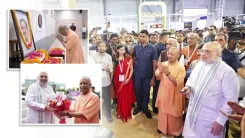
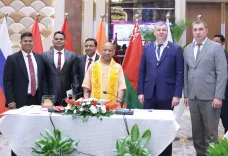
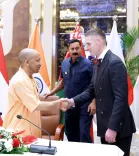
Jal Shakti Minister Paatil closes 9th India International Water Week
Synopsis
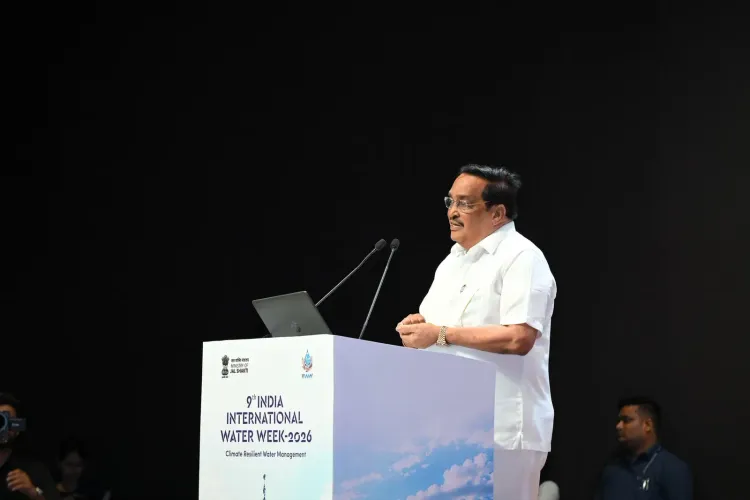
Union Jal Shakti Minister C. R. Paatil closed the 9th India International Water Week at Bharat Mandapam on 25 September 2026, with over 7,224 delegates present, stressing that water security demands public participation and technology — not policy alone.
Key Takeaways
The 9th India International Water Week concluded on 25 September 2026 at Bharat Mandapam, New Delhi .
The four-day event drew 7,224-plus delegates, 227 exhibitors and 119 research papers from across the world.
Minister Paatil said solutions to water challenges require jan bhagidari (public participation), science and technology — not just policy.
He credited PM Narendra Modi for linking water conservation to community ownership, referencing schemes like the Jal Jeevan Mission (launched August 2019).
The ministry's goal is to ensure safe, adequate and sustainable water for every family by converting summit learnings into ground-level delivery.
State-level adoption of technologies showcased at the event and upcoming JJM coverage reports are the next indicators to watch.
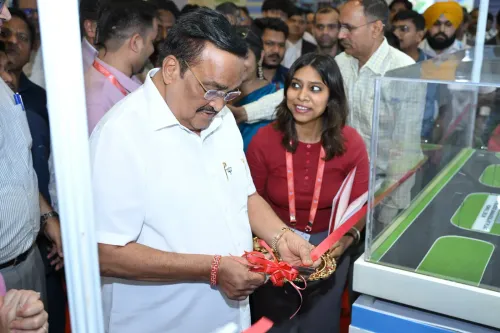
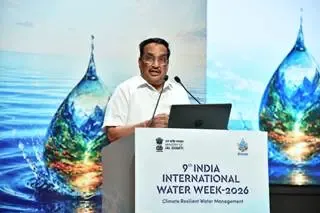
More than 7,224 delegates, 227 exhibitors and 119 research papers — and a single, pointed message: water security cannot be engineered from government offices alone. Union Jal Shakti Minister C. R. Paatil addressed the closing ceremony of the 9th India International Water Week at Bharat Mandapam, New Delhi, on Friday, 25 September 2026, drawing a four-day global conversation on water challenges to a close with a call for deeper community ownership of solutions.
Posting on X after the event, Paatil wrote: 'जल की चुनौतियों का समाधान केवल नीतियों से नहीं, बल्कि जनभागीदारी, विज्ञान और तकनीक के बेहतर उपयोग तथा आपसी सहयोग से निकलेगा' — 'The solution to water challenges will come not from policies alone, but from public participation, better use of science and technology, and mutual cooperation.' The numbers behind the event underscore its scale: the ninth edition drew participants from across the world to share technologies, field experiences and successful water-management models.
Bharat Mandapam as a global water-knowledge exchange
Bharat Mandapam, New Delhi's landmark convention complex, served as the venue where domestic policymakers sat alongside international delegates for four days. The gathering was designed explicitly as a two-way street — India presenting its own advances while absorbing global best practices — reflecting the Ministry of Jal Shakti's broader goal of building a unified, evidence-based water-security framework.
The India International Water Week has grown into a recurring flagship of the ministry precisely because water governance in India has shifted, over successive administrations, from purely supply-side infrastructure toward a blend of community participation, real-time data monitoring and technology adoption. That shift is now institutionalised through schemes like the Jal Jeevan Mission (JJM), launched in August 2019 to deliver piped tap-water connections to every rural household, and the Atal Bhujal Yojana, which targets groundwater recharge through community-led management.
PM Modi's jan bhagidari frame — and what Paatil carried forward
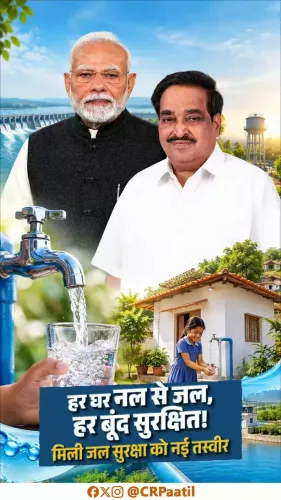
Paatil explicitly credited Prime Minister Narendra Modi for anchoring India's water conservation strategy in jan bhagidari — public participation — giving it what he called 'a new direction.' That framing is more than rhetoric: the Jal Jeevan Mission operationalised it through Village Water and Sanitation Committees, placing local communities in charge of maintaining infrastructure after installation. The Namami Gange programme, approved in 2014 as an integrated conservation mission for the Ganga river basin, similarly stressed stakeholder involvement alongside engineering works.
For Paatil, the Water Week's closing message was forward-looking: translate the conversations, technologies and success stories shared at Bharat Mandapam into on-the-ground delivery so that 'every family receives safe, adequate and sustainable water services.' The minister was clear that the dialogue does not end with the event — it marks the point where shared responsibility for a water-secure future must intensify.
From conference floor to village tap — what comes next
The real test of any knowledge-sharing summit lies in state-level adoption. Rural households, state water departments and agricultural users — the stakeholders who live the water challenge daily — will ultimately determine whether the technologies and practices showcased at the ninth Water Week travel beyond the convention hall. The Ministry of Jal Shakti periodically releases JJM coverage reports that track household tap-connection progress, and those numbers will be the next concrete indicator of whether the summit's energy converts into delivery.
The conversation at Bharat Mandapam is over. The harder work — pipe by pipe, well by well, village by village — is just beginning.
Point of View
Tying the Modi government's community-participation brand directly to a domain — water scarcity — that affects electoral outcomes in rural India. The scale of the event (7,224-plus delegates) gives the ministry a global credential it can leverage in multilateral climate negotiations where water security is increasingly central. The real policy test, however, remains the gap between showcase and scale: how quickly state governments translate conference learnings into verifiable tap-connection and aquifer-recharge numbers.
NationPress
25 Sept 2026
Frequently Asked Questions
What is the India International Water Week?
The India International Water Week is a recurring international conference organised by India's Ministry of Jal Shakti to bring together policymakers, researchers and practitioners to share water technologies, best practices and policy experiences. The ninth edition was held at Bharat Mandapam, New Delhi, in September 2026.
How many delegates attended the 9th India International Water Week?
According to Minister C. R. Paatil's post, the 9th India International Water Week was attended by more than 7,224 delegates, alongside 227 exhibitors and 119 research papers.
What is jan bhagidari in the context of water conservation?
Jan bhagidari means public or community participation. In water governance, it refers to involving local communities — especially in rural areas — in planning, implementing and maintaining water infrastructure, as seen in the Jal Jeevan Mission's Village Water and Sanitation Committees.
What is the Jal Jeevan Mission?
The Jal Jeevan Mission is a central government scheme launched in August 2019 under Prime Minister Narendra Modi to provide functional household piped tap-water connections to every rural household in India, with a strong emphasis on community participation and local management.
Where is Bharat Mandapam located?
Bharat Mandapam is a large convention and exhibition centre located in New Delhi, India. It has served as the venue for several major national and international events organised by the central government.