Jal Shakti Minister Paatil: Varanasi's 57-Ha Land Swap Unlocks Urban Push

Synopsis
Union Jal Shakti Minister C. R. Paatil announced that Varanasi Nagar Nigam has completed a landmark 57-hectare land swap with the Defence Estate and Indian Railways, unlocking centrally located parcels for multi-level parking, wider roads, and public projects to ease the city's chronic congestion.
Key Takeaways
57 hectares (approximately 227 bighas) of land in central Varanasi has been swapped between the Varanasi Nagar Nigam, the Defence Estate, and Indian Railways.
Key parcels include land under the Phulwaria Flyover , the Cantonment zone , and the Goods Shed area .
The freed land is earmarked for multi-level parking facilities , wider roads, and new public infrastructure projects.
The deal is described as a solution to Varanasi's longstanding problem of unavailable open land for new urban infrastructure.
Varanasi has been under sustained central government development focus since 2014 , including its inclusion in the Smart Cities Mission in 2015 .
The land-swap model bypasses formal acquisition, avoiding lengthy legal and financial delays common in heritage cities.
The ancient city of Varanasi has long carried a modern paradox: a government determined to transform it, and almost no empty land to build on. That bottleneck, Union Jal Shakti Minister C. R. Paatil announced on Friday, 31 July 2026, has now been broken — through a landmark three-way land swap involving the Varanasi Nagar Nigam, the Defence Estate, and Indian Railways.
The 57-Hectare Deal at the Heart of the City
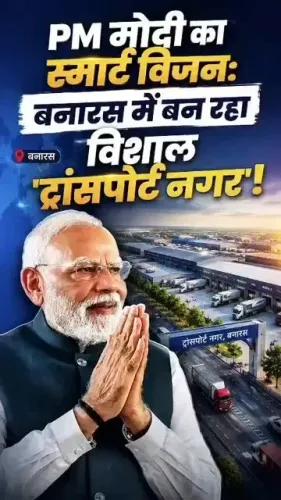
The swap covers 57 hectares — roughly 227 bighas — of land located in the thick of the city. Minister Paatil described the arrangement as 'historical' (ऐतिहासिक लैंड डील), with parcels including the area beneath the Phulwaria Flyover, the Cantonment zone, and the Goods Shed area. These are not peripheral plots; they sit where Varanasi's congestion is most punishing and where new infrastructure would deliver the most immediate relief.
Under the deal, land is exchanged between the municipal body and two central government entities — the Defence Estate, which manages military land holdings across India, and Indian Railways, which controls large parcels in virtually every major Indian city. By swapping rather than acquiring, the Nagar Nigam sidesteps the years-long legal and financial maze of formal land acquisition.
What Gets Built: Parking Towers, Wider Roads, Public Projects
The freed land is earmarked for multi-level parking facilities to unclog streets that choke daily, wider arterial roads, and new public-use projects. Varanasi's narrow lanes — a feature of its ancient urban grain — have made surface parking a chronic crisis, particularly around the ghats, the cantonment market, and the railway station precincts. A vertical parking solution on centrally located land could meaningfully shift that equation.
Minister Paatil framed the announcement squarely within Prime Minister Narendra Modi's development agenda for his parliamentary constituency, noting that the deal was executed 'under the leadership of the honourable Prime Minister.' Varanasi has been the centrepiece of a sustained urban renewal push since 2014, including its selection under the Smart Cities Mission in 2015.
A Template for Heritage Cities Hemmed In by History
The Varanasi swap is part of a broader playbook emerging for India's densely packed pilgrimage and heritage cities — places where land acquisition is politically fraught, legally slow, and financially ruinous. Similar inter-agency land arrangements have been used in other historic centres to bypass those bottlenecks. The difference here is scale: 57 hectares in a single transaction is significant for a city where usable open land is measured in fragments.
Paatil closed his post with the invocation 'Har Har Mahadev' — the salutation to Lord Shiva that is inseparable from Kashi's identity — signalling that this is as much a cultural moment for the city as an administrative one.
The projects now move to detailed planning and execution. Whether multi-level parking towers rise on the Phulwaria and Cantonment parcels on schedule will be the real test of whether this deal delivers as loudly as it was announced — and whether Kashi's new speed, as Paatil put it, holds.
Point of View
The government avoids the legal exposure and delay that have stalled projects elsewhere, setting a potential template for other congested heritage cities. The announcement by a Union Cabinet minister rather than a local official signals that the Centre is keen to own the optics of Varanasi's urban transformation directly. The real measure will be the speed at which shovels hit ground on the parking and road projects — delivery timelines in such announcements have historically lagged the fanfare.
NationPress
31 Jul 2026
Frequently Asked Questions
What is the Varanasi land swap deal announced by C. R. Paatil?
The Varanasi Nagar Nigam has completed a three-way land exchange with the Defence Estate and Indian Railways, swapping 57 hectares of centrally located land in Varanasi to use for multi-level parking, wider roads, and public infrastructure projects.
Where exactly is the swapped land located in Varanasi?
The parcels include land beneath the Phulwaria Flyover, the Cantonment zone, and the Goods Shed area — all situated in the heart of the city.
What will be built on the newly acquired land in Varanasi?
The land is earmarked for multi-level parking facilities to reduce traffic congestion, wider arterial roads, and new public-use projects as part of Varanasi's urban renewal drive.
Why was a land swap used instead of regular land acquisition in Varanasi?
Formal land acquisition in a densely built heritage city like Varanasi is legally complex and time-consuming. A land swap between government agencies bypasses those hurdles and delivers usable parcels faster.
Is Varanasi part of India's Smart Cities Mission?
Yes. Varanasi was selected under the Smart Cities Mission in 2015, and urban mobility and public infrastructure improvements have been a consistent focus of the programme there.