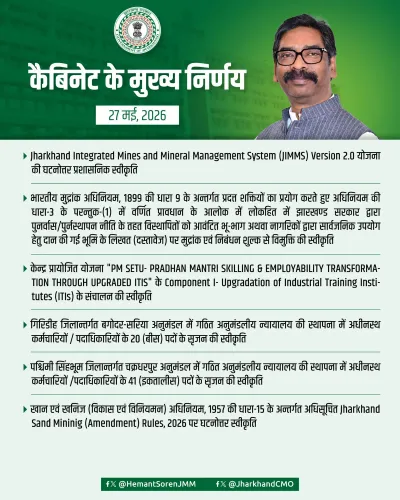
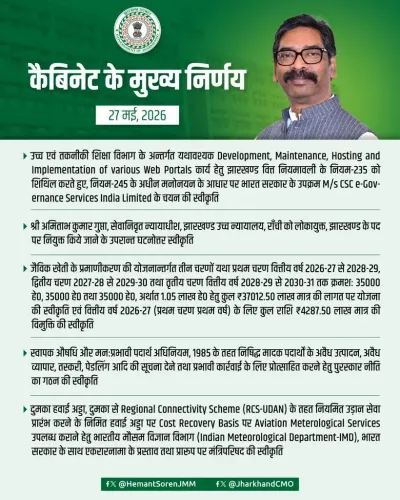
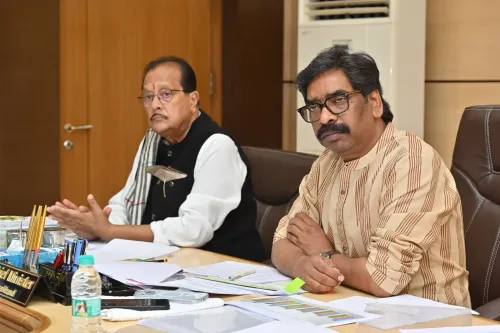
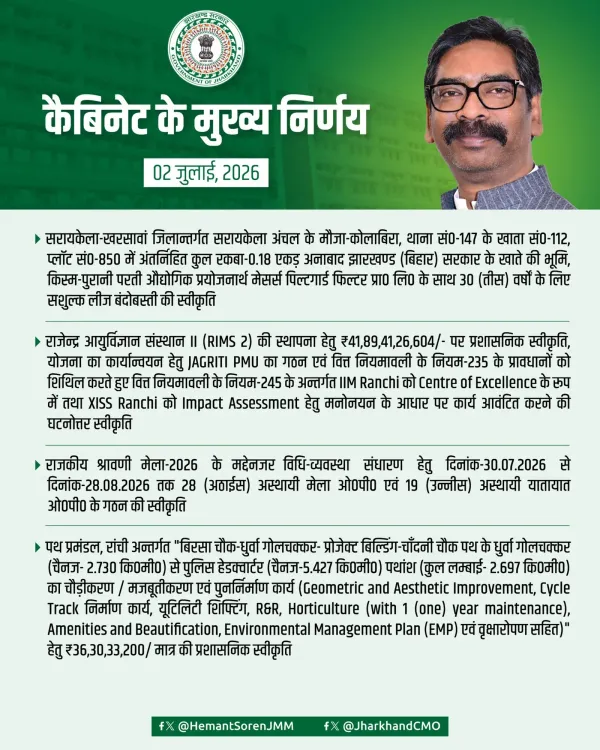
Jharkhand Cabinet meets, key decisions announced
Synopsis
The Chief Minister's Office of Jharkhand shared key decisions taken at a state cabinet meeting on 2 July 2026, signalling fresh executive action on governance priorities in one of India's most mineral-rich states.
Key Takeaways
The Chief Minister's Office of Jharkhand announced key cabinet decisions on 2 July 2026 .
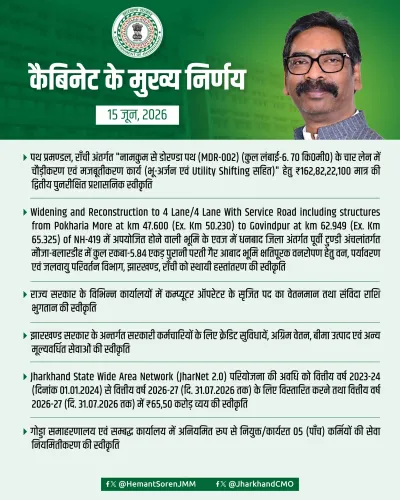
The announcement was made via the official JharkhandCMO account on X, accompanied by four images of official documents.
Jharkhand is one of India's most mineral-rich states, with cabinet decisions frequently impacting mining, tribal welfare, and rural infrastructure.
Tribal communities form approximately 26 per cent of Jharkhand's population and are key stakeholders in state executive decisions.
Detailed official circulars and gazette notifications are expected to follow, outlining the specifics of each approved decision.
The Chief Minister's Office of Jharkhand announced on 2 July 2026 that the state cabinet had convened and taken several key decisions, sharing details of the meeting outcomes through its official account on X.
Context
The post, captioned 'Cabinet ke mukhya nirnay…' ('Key cabinet decisions…'), was accompanied by four images indicating an official release of cabinet resolutions. The Jharkhand cabinet, as the collective executive body of the state, is empowered to approve policies, schemes, and administrative measures across all subjects in the State and Concurrent Lists of the Constitution of India.
Jharkhand, carved out of Bihar on 15 November 2000, holds strategic importance as one of India's most mineral-rich states, with governance decisions frequently touching on mining royalties, tribal welfare, and rural infrastructure.
Policy Backdrop
State cabinet meetings in India are a routine but consequential mechanism through which elected governments exercise executive authority. In Jharkhand, cabinet decisions have historically spanned a wide range — from revision of mining lease terms and forest rights implementation to welfare schemes targeting the state's significant Scheduled Tribe population, which constitutes roughly 26 per cent of residents.
The state government has in recent years placed emphasis on schemes addressing livelihood, land rights, and social security for tribal and rural communities. Cabinet approvals serve as the formal gateway for such initiatives to move into implementation.
Stakeholders and Impact
The primary stakeholders of any Jharkhand cabinet decision are the state's approximately 3.8 crore residents, with tribal communities, farmers, and residents of rural districts standing to be most directly affected by welfare and infrastructure measures. Industrial and mining interests are also closely attentive to executive decisions given the state's resource base.
Official follow-up releases from the Jharkhand Chief Minister's Office and the state's Department of Information and Public Relations are expected to detail the specific agenda items approved, any associated budget allocations, and the timelines for implementation.
What's Next
Detailed official circulars and gazette notifications outlining each approved decision are anticipated in the coming days. Departments concerned will be required to operationalise the cabinet's directives, with implementation progress likely to be tracked through the state's administrative machinery.
The announcements will be watched closely by civil society groups working on tribal rights, infrastructure contractors, and policy observers monitoring the state government's development priorities ahead of future electoral cycles.
Point of View
And the timing — mid-year in a fiscal cycle — often signals course corrections or scheme launches intended to accelerate implementation before the budget review season. For a state where tribal rights, mining revenues, and rural welfare are perennial flashpoints, each cabinet cycle carries outsized political significance. The use of official social media to amplify decisions reflects a broader pattern of state governments leveraging digital channels to project executive activity directly to citizens. Observers will parse the detailed resolutions for signals on the administration's priorities heading into the second half of the financial year.
NationPress
2 Jul 2026
Frequently Asked Questions
What decisions did the Jharkhand cabinet take on 2 July 2026?
The Chief Minister's Office of Jharkhand announced that the state cabinet took several key decisions on 2 July 2026, sharing images of the resolutions on X. The specific details of each decision are expected to be released through official government circulars and gazette notifications.
Who announced the Jharkhand cabinet decisions?
The announcement was made by the official Chief Minister's Office of Jharkhand through its verified account on X, which serves as the primary digital communication channel for the state's executive leadership.
How often does the Jharkhand cabinet meet?
The Jharkhand cabinet meets periodically as required by governance needs. There is no fixed statutory frequency, but meetings are typically convened to approve schemes, policies, budget proposals, and administrative decisions before implementation.
Why are Jharkhand cabinet decisions important for tribal communities?
Jharkhand has one of India's largest tribal populations, constituting roughly 26 per cent of its residents. Cabinet decisions frequently cover land rights, forest rights, welfare schemes, and livelihood programmes that directly affect these communities.
Where can I find the full list of Jharkhand cabinet decisions?
Full details of cabinet decisions are typically published through the Jharkhand government's official press releases, the state Department of Information and Public Relations, and official gazette notifications following the meeting.