Jharkhand Cabinet Clears 49 Proposals, Including Heli-Ambulance and AI Classes
Synopsis
The Jharkhand cabinet cleared 49 proposals on 22 July 2026, approving a helicopter ambulance service for patients in remote areas and AI-based tele classes for 1,000 high and Plus Two schools — marking a significant push to close healthcare and education gaps in the state's underserved regions.
Key Takeaways
The Jharkhand cabinet approved 49 proposals in a single meeting on 22 July 2026 .
A helicopter ambulance service was cleared to provide emergency medical transport to patients in remote and hard-to-reach areas.
AI-based tele classes were approved for 1,000 government high and Plus Two schools across the state.
The approvals target Jharkhand's tribal and forested belts , where conventional road-based service delivery is limited.
Subsequent government orders will detail budgets, district coverage, and rollout timelines for both schemes.
The twin approvals align with national priorities on digital governance and public health equity .
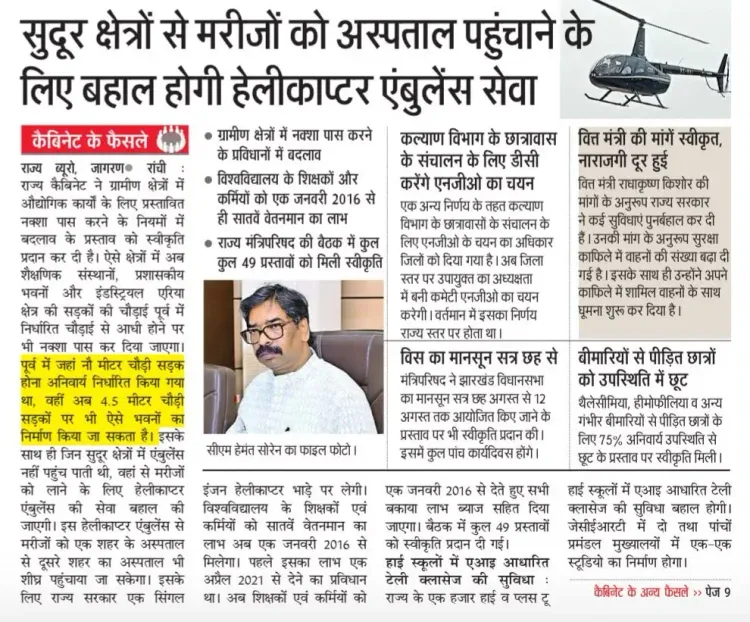
The Chief Minister's Office of Jharkhand announced on Wednesday, 22 July 2026 that the state cabinet meeting approved 49 proposals, including a helicopter ambulance service for patients in remote areas and AI-based tele classes for 1,000 high and Plus Two schools across the state.
Context
The cabinet post, shared by the official Jharkhand CMO handle, stated: 'सुदूरवर्ती क्षेत्रों के मरीजों के लिए हेलीकॉप्टर एम्बुलेंस' — 'helicopter ambulance for patients in remote areas' — alongside AI-enabled tele classes in schools, as part of a broader package of 49 proposals cleared in a single sitting. The announcement signals the state government's intent to deploy technology-driven solutions for both healthcare and education in underserved regions.
Jharkhand, carved out of Bihar in 2000, has long grappled with the twin challenges of difficult terrain and dispersed tribal settlements that make conventional service delivery costly and slow. The cabinet's twin approvals directly address these structural gaps.
Policy Backdrop
The helicopter ambulance approval builds on a pattern of state-level air-ambulance initiatives seen across India, where hilly and forested geographies make road-based emergency response inadequate. For Jharkhand, a state where a significant share of the population lives in forest-adjacent or plateau villages, air evacuation can be the difference between life and death in trauma or obstetric emergencies.
On the education front, the AI-based tele-class scheme targets 1,000 government high schools and higher secondary schools. The initiative aligns with the broader national push under digital governance frameworks to bring quality instruction to schools that lack specialist teachers in subjects such as science, mathematics, and English. Similar tele-education pilots have been attempted in states like Andhra Pradesh and Odisha, with mixed but instructive results that later iterations — including AI-assisted delivery — aim to improve upon.
Jharkhand's cabinet has periodically used omnibus approval sessions to push through welfare-oriented schemes, allowing the government to signal policy momentum across multiple sectors simultaneously. The 49-proposal package follows this administrative tradition.
Stakeholders and Impact
The primary beneficiaries of the helicopter ambulance service are residents of Jharkhand's remote and tribal belts — districts such as West Singhbhum, Lohardaga, Gumla, Simdega, and parts of the Santhal Parganas — where the nearest referral hospital can be hours away by road. Timely air evacuation in critical cases could substantially reduce preventable deaths.
For the tele-class programme, the direct stakeholders are students and teachers in 1,000 government schools. AI-assisted remote instruction can help bridge teacher shortages in rural postings, though the quality of outcomes will depend on reliable electricity, internet connectivity, and device availability — infrastructure gaps that the state will need to address in parallel.
What's Next
The cabinet approval is the first formal step; subsequent government orders will need to specify rollout timelines, district-wise coverage, operational budgets, and procurement or empanelment processes for the helicopter ambulance fleet. For the tele-class scheme, clarity on the technology vendor, curriculum integration, and teacher training protocols will determine how quickly classrooms in remote Jharkhand see the benefit. Civil society groups and opposition legislators are likely to seek these details in the coming weeks.
If implemented effectively, the two flagship approvals could set a replicable model for other states with similar demographic and geographic profiles — making Jharkhand's cabinet session of July 2026 a reference point in India's evolving approach to tech-enabled public service delivery.
Point of View
But the real test lies in execution: past state-level air-ambulance and tele-education schemes across India have often stalled at the procurement and infrastructure stage. For a state with a large tribal population and difficult terrain, these approvals carry genuine transformative potential, but only if followed by granular implementation orders with accountability mechanisms. The move also fits a broader pattern of state governments using technology-delivery frameworks to respond to equity critiques without large-scale physical infrastructure investment.
NationPress
21 Oct 2026
Frequently Asked Questions
What did the Jharkhand cabinet approve on 22 July 2026?
The Jharkhand cabinet approved 49 proposals in its meeting on 22 July 2026 , with key decisions including a helicopter ambulance service for patients in remote areas and AI-based tele classes for 1,000 government high and Plus Two schools.
How will the Jharkhand helicopter ambulance service work?
The helicopter ambulance is designed to provide emergency air evacuation for patients in remote and hard-to-access areas of Jharkhand where road transport is inadequate. Specific operational details, including districts covered and fleet size, are expected to be outlined in subsequent government orders.
Which schools will get AI tele classes in Jharkhand?
The AI-based tele-class scheme covers 1,000 government high schools and higher secondary (Plus Two) schools in Jharkhand. The programme aims to deliver quality instruction in subjects where specialist teachers are scarce in rural postings.
Why does Jharkhand need a helicopter ambulance service?
Jharkhand has a large tribal population spread across forested and plateau terrain where the nearest referral hospital can be hours away by road. A helicopter ambulance service can significantly cut response times in trauma, obstetric, and other medical emergencies.
What are the next steps after the Jharkhand cabinet approvals?
Following cabinet clearance, the government must issue detailed orders specifying rollout timelines, district-wise coverage, procurement processes, and budgets for both the helicopter ambulance and tele-class programmes before implementation can begin.