Jitendra Singh Inaugurates Cosmoserve Space Debris Facility in Hyderabad
Synopsis
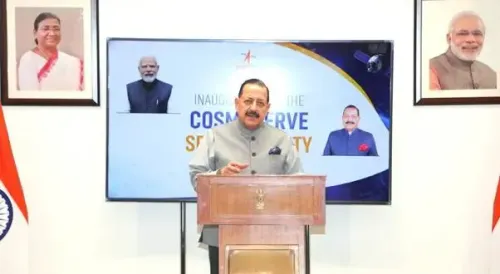
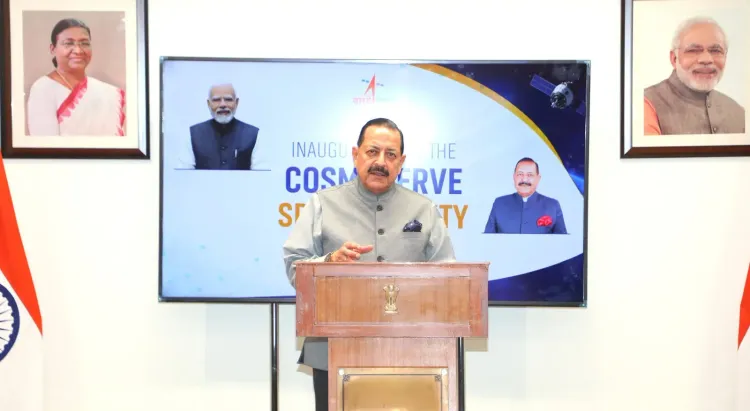
Union Minister Dr. Jitendra Singh inaugurated Cosmoserve Space's Base 1 in Hyderabad — India's first active space debris removal startup — reaffirming the country's 'Debris-Free Space by 2030' goal and citing a space economy grown to nearly USD 9 billion since Modi's 2020 sector reforms.
Key Takeaways
Cosmoserve Space's Base 1 facility was inaugurated in Hyderabad by Union Minister Dr.
Jitendra Singh on 5 November 2026 .
Cosmoserve is described as India's first and among the world's first startups working on Active Space Debris Removal and in-orbit servicing.
India has set a formal target of 'Debris-Free Space by 2030' , among the most explicit national commitments to orbital sustainability globally.
The startup is led by Dr.
Chiranjeevi Phanindra and is positioned as a global-benchmarking venture rather than a domestic one alone.
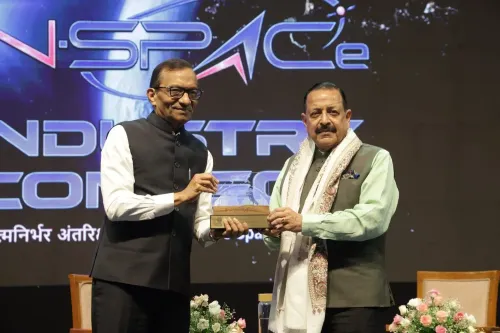
India's space economy has grown to nearly USD 9 billion since the 2020 IN-SPACe reforms and is projected to reach USD 40–45 billion within a decade.
The facility's location in Hyderabad underscores the city's growing centrality to India's private space ecosystem.
India's first startup dedicated to Active Space Debris Removal now has a home — and a minister to cut the ribbon. Union Science and Technology Minister Dr. Jitendra Singh inaugurated Cosmoserve Space's Base 1 facility in Hyderabad on Thursday, 5 November 2026, marking a milestone for a niche that could define the next chapter of responsible spacefaring.
What Cosmoserve is building — and why it matters
Cosmoserve Space, led by young entrepreneur Dr. Chiranjeevi Phanindra, is focused on two of the most technically demanding frontiers in modern space operations: active debris removal and in-orbit servicing. The startup is positioning itself not just as India's first in this niche, but among the world's first ventures to operationalise such capabilities at a commercial scale. Dr. Singh described the team as embodying the spirit of 'Vishwamandhu Bharat' — a vision of India as a benevolent force for the world — extending its commitment to safe and sustainable space beyond national boundaries.
The stakes are real. Earth's orbital environment is increasingly congested, with thousands of defunct satellites and fragments posing collision risks to active missions. India's stated ambition — a target of 'Debris-Free Space by 2030' — sets a bold, time-bound goal that few governments have committed to publicly. Cosmoserve's Base 1 facility in Hyderabad is now the physical anchor for that ambition.
The reform wave that made room for startups like Cosmoserve
The launch of IN-SPACe (Indian National Space Promotion and Authorisation Centre) in 2020 was the structural unlock that made ventures like Cosmoserve possible. Prime Minister Narendra Modi's government opened the sector to private participation after decades of near-exclusive ISRO dominance, creating a regulatory body to promote, authorise and hand-hold private players through missions that were once the sole preserve of the state. Dr. Singh credited those reforms directly, calling them 'transformative' in unlocking India's 'immense potential.'
The numbers that have followed are striking. India's space economy has grown to nearly USD 9 billion in roughly five to six years since those reforms, and projections place it at USD 40–45 billion within less than a decade — a fourfold-plus leap that would cement India's place among the top-tier space economies globally.
Hyderabad's role as India's space startup capital
That Base 1 sits in Hyderabad is no accident. The city has emerged as a focal point for India's new-generation space cluster, home to multiple private launch and satellite technology companies drawn by infrastructure, talent density, and policy support from both central and state governments. Cosmoserve's choice of Hyderabad for its anchor facility reinforces the city's claim as the ground-level home of India's space privatisation story.
Dr. Singh framed the broader message pointedly: Indian startups are no longer just consumers of global space technology — they are building 'integrated space missions' and setting global benchmarks. For a country that sent a rover to the Moon's south pole and landed a mission near Mars on a shoestring budget, the ambition to clean up Earth's orbital neighbourhood on a commercial footing is a logical — if audacious — next step.
The world's orbital commons needs a clean-up crew. India just opened its first dedicated shop for the job.
Point of View
And debris removal offers a uniquely high-visibility, globally resonant proof point. By framing the initiative under 'Vishwamandhu Bharat,' Dr. Singh is consciously elevating a niche startup story into a soft-power and diplomatic narrative, positioning India as a steward of the global commons rather than merely a space-race competitor. The 'Debris-Free Space by 2030' target, however aspirational, also functions as a policy anchor that will now invite international scrutiny — and could attract collaboration or funding from agencies that share the goal. Watch for whether this facility becomes a node in multilateral debris-mitigation frameworks, which would be the real test of how far India's space diplomacy can extend.
NationPress
5 Nov 2026
Frequently Asked Questions
What is Cosmoserve Space and what does it do?
Cosmoserve Space is described as India's first startup — and among the world's first — focused on Active Space Debris Removal and in-orbit servicing. Its Base 1 facility is located in Hyderabad.
What is India's 'Debris-Free Space by 2030' goal?
It is India's stated national target to work toward eliminating orbital debris by 2030, framed as a contribution to global space sustainability rather than a purely domestic objective.
What are India's 2020 space sector reforms?
In 2020, the Government of India established IN-SPACe (Indian National Space Promotion and Authorisation Centre) to open the space sector to private companies alongside ISRO, marking a major structural liberalisation.
How large is India's space economy in 2026?
According to Dr. Jitendra Singh's statement, India's space economy has grown to nearly USD 9 billion and is projected to reach USD 40–45 billion within less than a decade.
Who is Dr. Chiranjeevi Phanindra?
Dr. Chiranjeevi Phanindra is the head of the Cosmoserve Space startup, described by Union Minister Dr. Jitendra Singh as a young entrepreneur leading India's first active space debris removal venture.