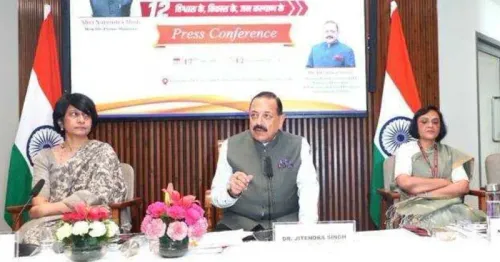
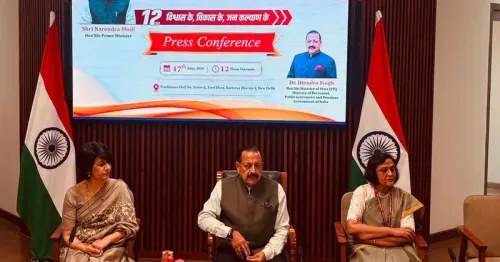
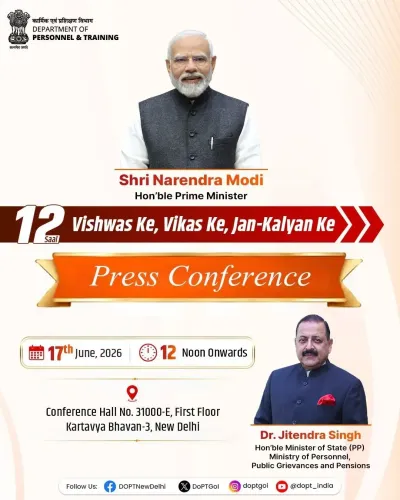
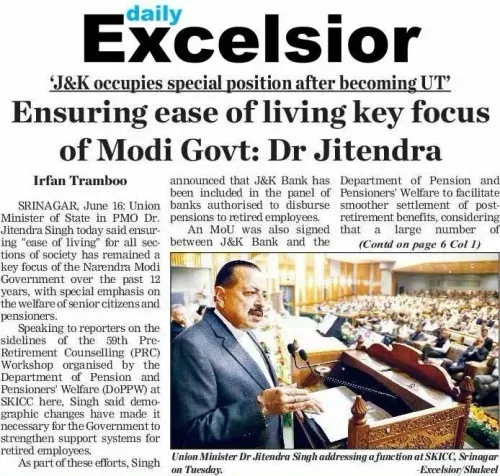
Dr. Jitendra Singh marks 12 years of Modi govt reforms
Synopsis
Union Minister Dr. Jitendra Singh marks 12 years of Modi government on June 2, 2026, listing key administrative reforms including self-attestation, interview abolition, digital life certificates, Mission Karmayogi, Rozgar Mela, and relaxed pension rules for separated daughters.
Key Takeaways
Self-attestation of documents replaced mandatory gazetted officer attestation, reducing procedural burden on citizens applying for central government services.
Interviews abolished for many recruitment posts to curb malpractices, alongside Rozgar Mela drives launched in 2022 to fill vacancies transparently.
Family pension rules relaxed for divorced and separated daughters, and maternity leave extended to cases of still birth under DoPPW.
Digital Life Certificate (Jeevan Pramaan) , introduced in November 2014 , allows elderly pensioners to submit annual proof of life digitally without visiting offices.
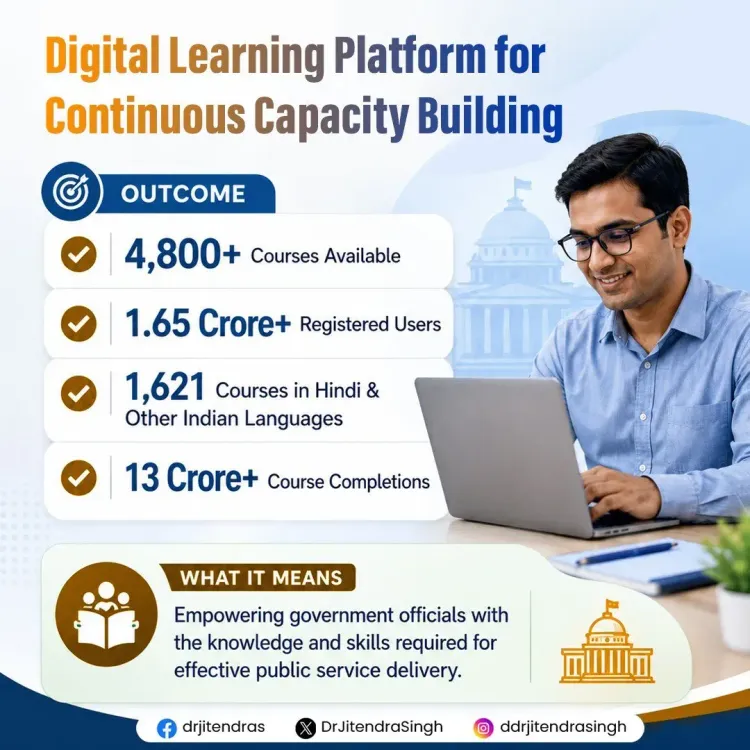
Mission Karmayogi and the iGOT platform , launched in December 2020 , provide digital capacity-building for civil servants across ministries.
Svamitva scheme and Gatishakti platform extend digitisation to rural property mapping and integrated infrastructure planning respectively.
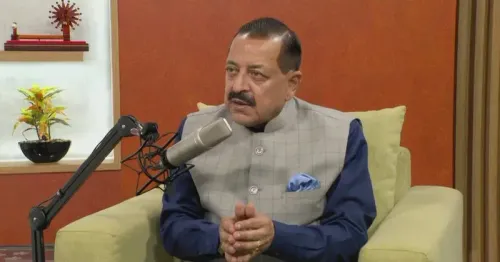
Union Science and Technology Minister Dr. Jitendra Singh on Tuesday, June 2, 2026, posted a detailed account on X marking 12 years of governance under Prime Minister Narendra Modi, highlighting a series of administrative, pension, and digital reforms carried out since 2014 through the Department of Personnel and Training (DoPT), the Department of Administrative Reforms and Public Grievances (DARPG), and the Department of Pension and Pensioners' Welfare (DoPPW).
Context
The post enumerates reforms spanning over a decade, describing PM Modi's governance approach as a 'Reform Express' — moving 'with speed and sensitivity to seek ease of living for common citizen.' Among the changes cited: self-attestation of documents replacing the mandatory attestation by gazetted officers, and the abolition of interviews for recruitment to check malpractices. The minister also noted that nearly 2,000 obsolete rules have been done away with, a figure cited in the post though the precise count has not been independently verified.
On the social welfare side, the post highlights relaxed family pension rules for divorced and separated daughters and the extension of maternity leave to cases of still birth — both significant expansions of entitlements for government employees and their families.
Policy Backdrop
The Jeevan Pramaan digital life certificate scheme, introduced in November 2014, replaced the need for pensioners to appear in person for annual verification, addressing a long-standing grievance of elderly citizens. Self-attestation for central government services was similarly permitted from late 2014 onward, reducing the procedural burden on ordinary applicants.
Mission Karmayogi, formally launched by the Union Cabinet in December 2020, established the National Programme for Civil Services Capacity Building, with the iGOT (Integrated Government Online Training) platform as its digital learning backbone. The Rozgar Mela recruitment drives, initiated in 2022, have sought to fill central government vacancies transparently, with interviews dispensed for many Group B and Group C posts since 2014.
The Svamitva scheme — Survey of Villages and Mapping with Improvised Technology in Village Areas — launched in 2020, has focused on creating verifiable rural property records, extending the digitisation drive beyond urban administration. The e-HRMS 2.0 and Gatishakti platforms further reflect the government's emphasis on integrated digital infrastructure for service delivery.
Stakeholders and Impact
The reforms collectively affect a wide cross-section of citizens: government employees benefit from streamlined HR processes and capacity-building through iGOT; pensioners and senior citizens gain from the digital life certificate and relaxed family pension rules; and job aspirants are impacted by the Rozgar Mela model and the removal of interviews for lower-grade posts. Rural citizens, particularly in villages covered under Svamitva, have received formal property documentation that can serve as collateral for credit.
The Grievance AI-CHATBOT, referenced in the post as an innovative initiative under DARPG, is positioned as a technology-driven tool to streamline citizen redressal, though its full deployment status across ministries is subject to ongoing rollout. The broader pattern reflects a central government push to reduce rent-seeking opportunities and procedural friction at every level of public administration.
What's Next
Further phases of e-HRMS 2.0 integration across ministries are expected to deepen the digital HR ecosystem for central government employees. The pension relaxation provisions for divorced and separated daughters may also see further rule notifications as implementation guidelines are refined.
Dr. Jitendra Singh's enumeration of reforms at the 12-year mark signals that the government intends to use this milestone as a platform to consolidate and communicate its administrative record ahead of continued policy activity — with the 'Reform Express' framing suggesting further measures are anticipated.
Point of View
DARPG, and DoPPW as engines of administrative simplification rather than routine bureaucratic departments. The framing of PM Modi's record as a 'Reform Express' is a deliberate political positioning, linking disparate policy threads — from pension welfare to AI-driven grievance redressal — into a single narrative of momentum. The inclusion of welfare-oriented measures like maternity leave for still births and pension rights for separated daughters alongside tech platforms like iGOT and e-HRMS 2.0 reflects a strategy of demonstrating both social sensitivity and modernisation credentials simultaneously. Analysts will note that this messaging pattern typically precedes further policy announcements, using milestone communication to set the stage for the next phase of reform.
NationPress
16 Oct 2026
Frequently Asked Questions
What is self-attestation of documents in India?
Self-attestation allows citizens to certify their own document copies as true rather than requiring a gazetted officer's signature, a reform introduced for central government services from late 2014 onward to reduce procedural delays.
Why were interviews abolished for government recruitment in India?
Interviews were abolished for many Group B and Group C central government posts to eliminate opportunities for favouritism and malpractice in recruitment, a reform pursued by the Modi government through DoPT since 2014.
What is Mission Karmayogi and how does iGOT work?
Mission Karmayogi is the National Programme for Civil Services Capacity Building, launched in December 2020, with iGOT (Integrated Government Online Training) as its digital platform providing online courses and skill modules for government employees.
What is the Digital Life Certificate for pensioners in India?
The Digital Life Certificate, also known as Jeevan Pramaan, was introduced in November 2014 and allows elderly pensioners to submit their annual proof of life digitally through biometric authentication, removing the need to visit a bank or government office.
What are the new family pension rules for divorced daughters in India?
The government relaxed family pension rules to extend eligibility to divorced and separated daughters of government employees, addressing a gap that previously left such dependants without pension cover in cases of marital breakdown.