Pralhad Joshi Champions Agrivoltaics as India's Dual Harvest
Synopsis
Union Minister Pralhad Joshi coined 'Annadata bhi, Urjadata bhi' at the AgriVoltaicsWorldConference2026, framing agrivoltaics — co-locating solar panels with crops — as India's answer to the food-versus-energy land trade-off, building on the foundation laid by the PM-KUSUM scheme since 2019.
Key Takeaways
Pralhad Joshi called agrivoltaics India's 'unique strength' at the AgriVoltaicsWorldConference2026 on 21 October 2026 .
His phrase 'Annadata bhi, Urjadata bhi' positions farmers as both food-givers and energy-providers under agrivoltaic systems.
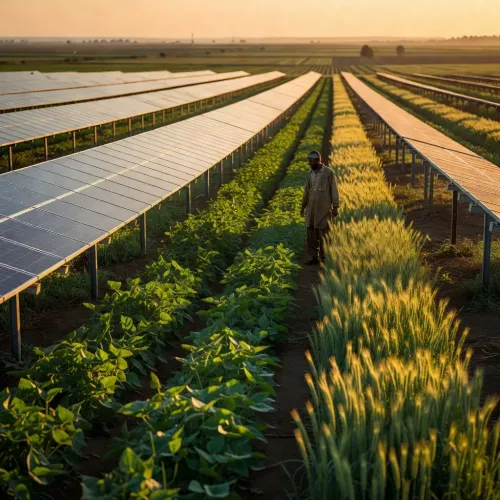
Agrivoltaics places solar panels above or between crops, enabling simultaneous food production and electricity generation on the same land.
The PM-KUSUM scheme (launched 2019) under the Ministry of New and Renewable Energy established India's policy basis for solar-agriculture integration.
Further scheme guidelines or pilot projects on agrivoltaics from the Ministry are the key developments to watch next.
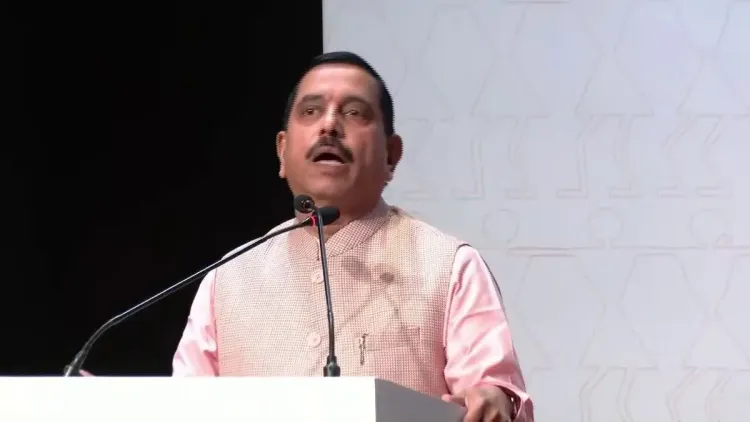
One field, two harvests — food and electricity, grown side by side. Union Minister Pralhad Joshi on Wednesday, 21 October 2026, captured that idea in five Hindi words at the #AgriVoltaicsWorldConference2026, calling agrivoltaics the nation's unique strength: 'Annadata bhi, Urjadata bhi' — 'Food-giver as well as Energy-giver.'
'Annadata bhi, Urjadata bhi' — what Joshi's phrase actually means
The slogan is a play on two words deeply embedded in Indian agrarian culture. Annadata — literally 'giver of grain' — is the term of reverence India uses for its farmers. Urjadata means energy provider. By fusing them, Joshi positioned the Indian farmer not merely as a beneficiary of renewable energy policy, but as its co-producer.
Agrivoltaics — the practice of co-locating solar panels above or between crops on the same parcel of land — is precisely that fusion made physical. The shade from panels can reduce water evaporation, moderate soil temperature, and in some crop configurations even improve yields, while the land simultaneously generates clean electricity.
Where PM-KUSUM laid the foundation
India's policy footing for this approach stretches back to the PM-KUSUM scheme launched in 2019 under the Ministry of New and Renewable Energy — the same ministry Joshi now heads. PM-KUSUM was designed to solarise irrigation pumps and allow farmers to sell surplus power to the grid, planting the idea that agricultural land could be a dual-use energy asset. Agrivoltaics takes that logic a step further: instead of replacing a pump, it reimagines the field itself as both farm and power plant.
For a country racing toward its renewable energy capacity targets while simultaneously protecting food security, the calculus is compelling. India cannot afford to sacrifice farmland for solar parks, nor can it leave rural electricity demand unmet. Agrivoltaics, at least in principle, dissolves that trade-off.
What the Minister's spotlight signals for policy
Joshi's visible presence at an international agrivoltaics conference — and his choice to frame it in the language of farmer identity rather than megawatts — suggests the Ministry is building political and public groundwork for scaled agrivoltaic pilots. Concrete scheme guidelines or updated PM-KUSUM provisions specifically enabling agrivoltaic installations would be the natural next step to watch from New Delhi.
The stakes are real: millions of Indian farmers sit on land that receives among the highest solar irradiance on earth. If policy can unlock dual-income streams from that land — a crop harvest and a power tariff — it changes the economics of farming at scale. Annadata bhi, Urjadata bhi is not just a slogan. It may well become a scheme headline.
Point of View
And agrivoltaics offers exactly that. His appearance at an international conference signals India is ready to position itself as a thought-leader in dual land-use solar, not just a capacity installer. The real policy test will be whether the rhetorical momentum translates into updated PM-KUSUM guidelines that farmers and developers can actually act on.
NationPress
21 Oct 2026
Frequently Asked Questions
What is agrivoltaics and how does it work in India?
Agrivoltaics involves installing solar panels above or between crops on the same farmland, allowing simultaneous food production and electricity generation. In India, it builds on the PM-KUSUM scheme framework that has encouraged solar-agriculture integration since 2019.
What does 'Annadata bhi, Urjadata bhi' mean?
'Annadata bhi, Urjadata bhi' is a Hindi phrase used by Minister Pralhad Joshi meaning 'food-giver as well as energy-giver,' framing farmers as dual producers of crops and clean electricity under agrivoltaic systems.
What is the PM-KUSUM scheme?
PM-KUSUM is a central government scheme launched in 2019 under the Ministry of New and Renewable Energy to solarise agricultural water pumps and enable farmers to sell surplus solar power to the grid, laying the policy foundation for solar-agriculture integration.
Who is Pralhad Joshi and what ministry does he head?
Pralhad Joshi is a senior BJP leader from Karnataka who serves as Union Minister of Consumer Affairs, Food and Public Distribution, and Minister of New and Renewable Energy in the central government.
Why is agrivoltaics important for India's energy and food goals?
India needs to expand renewable energy capacity without sacrificing farmland for food security. Agrivoltaics allows the same land to serve both purposes, potentially giving farmers an additional income stream from power tariffs alongside their crop harvest.