PM Modi backs agrivoltaics to boost farmer incomes ahead of AgriVoltaics World Conference
Synopsis
With India hosting the seventh AgriVoltaics World Conference in New Delhi from 21–23 October, PM Modi's personal amplification of the technology signals more than a social media moment — it hints at a forthcoming policy push under PM-KUSUM to place dual-use solar-agriculture land at the centre of the rural income agenda, targeting the 86 per cent of Indian farmers who are small and marginal landholders.
Key Takeaways
PM Narendra Modi on 21 October 2026 shared an article by Ministers Pralhad Joshi and Shivraj Singh Chouhan promoting agrivoltaics via a post on X .
India is hosting the seventh AgriVoltaics World Conference in New Delhi from 21–23 October 2026 under the theme 'Powering the Global South' .
Agrivoltaics — or AgriPV — allows farmers to generate clean electricity while continuing cultivation on the same land.
Nearly 86 per cent of India's farmers are small and marginal landholders who stand to gain from dual income streams.
The Centre is planning additional measures under the next phase of the PM-KUSUM scheme to create a dedicated space for agrivoltaics.
Successful deployment requires crop selection, irrigation management, and coordination across agriculture, energy, and state-level bodies.
Prime Minister Narendra Modi on Wednesday, 21 October 2026, shared an article authored by Union Ministers Pralhad Joshi and Shivraj Singh Chouhan that underscored the transformative potential of agrivoltaics — the practice of generating solar power on agricultural land while continuing cultivation — to diversify and strengthen farmers' incomes across India.
In a post on social media platform X, Modi described the technology as 'an important avenue for advancing rural prosperity,' highlighting its capacity to provide farmers with an additional revenue stream, reduce energy costs, and support crop productivity.
India Hosts AgriVoltaics World Conference 2026
The Prime Minister's endorsement comes as New Delhi prepares to host the seventh AgriVoltaics World Conference from 21 to 23 October 2026 under the theme 'Powering the Global South'. The event positions India as a leading voice in the global clean-energy-agriculture nexus and draws participants from across the developing world.
What Agrivoltaics Offers Indian Farmers
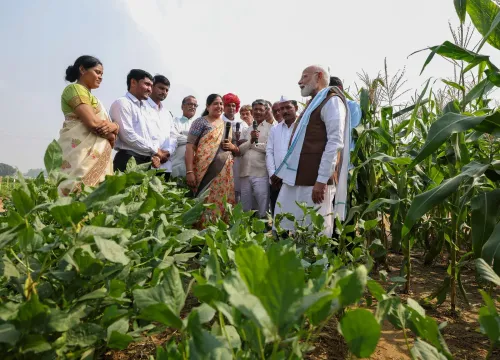
In their article, Ministers Joshi and Chouhan laid out the core value proposition of agrivoltaics, also referred to as AgriPV: farmers can generate clean electricity while continuing to cultivate the same land, helping diversify incomes and build resilience against agricultural uncertainties.
The ministers noted that nearly 86 per cent of India's farmers are small and marginal landholders — a demographic particularly vulnerable to income shocks — and argued that agrivoltaics could allow them to benefit simultaneously from agricultural production and the clean-energy transition.
According to the ministers, the model can generate additional income from electricity sales, reduce dependence on diesel and purchased power, and create favourable microclimatic conditions that shield crops from heat stress, drought, excessive solar radiation, and hail — concerns that have grown more acute with erratic monsoons and rising temperatures.
Government Plans Under PM-KUSUM Scheme
The Centre is reportedly planning additional measures under the next phase of the PM-KUSUM scheme to accelerate solar power generation through a dedicated space for agrivoltaics, building on progress already made in solarising agricultural irrigation. The scheme has previously focused on solar pumps and grid-connected power for farmers; the agrivoltaics push would mark a significant expansion of its scope.
Wider adoption, the ministers said, could also stimulate rural employment through installation, maintenance, and agricultural services linked to solar infrastructure — adding a jobs dimension to what is primarily positioned as an income-diversification initiative.
Conditions for Successful Deployment
The ministers stressed that successful deployment of agrivoltaics would require careful crop selection, adequate irrigation and nutrient management, and system designs that preserve sufficient sunlight for cultivation. They also flagged the need for coordination among agriculture and energy departments, state governments, research institutions, and local bodies — an acknowledgement of the multi-stakeholder complexity that has historically slowed large-scale agricultural technology adoption in India.
This comes amid growing global interest in dual-use land models, with countries including Germany, Japan, and France already running commercial-scale agrivoltaic installations. India's push, if executed at scale, could be among the largest in the Global South. As the three-day conference gets under way in New Delhi, all eyes will be on whether the government translates its stated ambition into the policy specifics — land-use norms, tariff structures, and financing — that farmers and developers need to act.
Point of View
Not a scheme — the hard work of translating agrivoltaic enthusiasm into farmer-level uptake still lies ahead. India has 86 per cent small and marginal farmers who lack the capital and technical knowledge to navigate a dual solar-agriculture system without robust state support. The PM-KUSUM framework is promising, but its track record on last-mile delivery has been uneven. Without clear land-use norms, standardised tariff structures, and accessible financing, agrivoltaics risks becoming another high-profile announcement that clusters around conference halls rather than paddy fields.
NationPress
21 Oct 2026
Frequently Asked Questions
What is agrivoltaics and why is India promoting it?
Agrivoltaics, also called AgriPV, is the practice of installing solar panels on agricultural land so that farmers can generate clean electricity while continuing to cultivate crops underneath. India is promoting it to diversify farmer incomes, reduce dependence on diesel power, and advance the clean-energy transition — particularly for the nearly 86 per cent of farmers who are small and marginal landholders.
What is the AgriVoltaics World Conference 2026?
The seventh AgriVoltaics World Conference is being hosted by India in New Delhi from 21 to 23 October 2026 under the theme 'Powering the Global South.' It is a global gathering focused on combining solar energy generation with agricultural activity, and India's hosting underlines its ambitions as a leader in this space.
How does agrivoltaics benefit farmers financially?
According to Union Ministers Pralhad Joshi and Shivraj Singh Chouhan, agrivoltaics can generate additional income from electricity sales, reduce electricity and diesel costs, and create microclimatic conditions that protect crops from heat stress, drought, and hail — strengthening overall farm resilience and income stability.
What role does the PM-KUSUM scheme play in agrivoltaics?
The Centre is reportedly planning further measures under the next phase of the PM-KUSUM scheme to create a dedicated space for agrivoltaics, building on its existing work in solarising agricultural irrigation. This would mark a significant expansion of the scheme's scope beyond solar pumps and grid-connected power.
What are the key challenges to scaling up agrivoltaics in India?
Successful deployment requires suitable crop selection, adequate irrigation and nutrient management, and solar system designs that preserve sufficient sunlight for crops. It also demands coordination among agriculture departments, energy ministries, state governments, research institutions, and local bodies — a multi-stakeholder challenge that has historically slowed large-scale agricultural technology adoption in India.