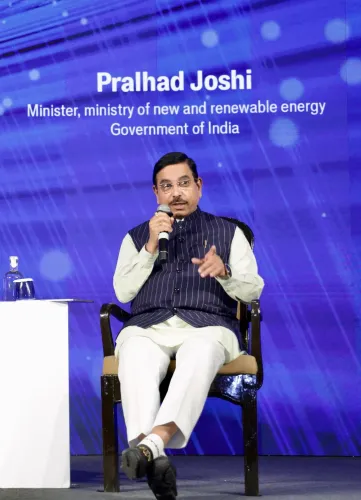
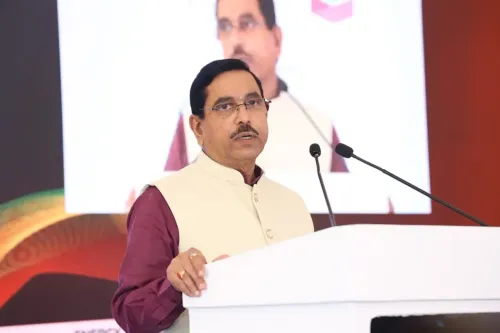
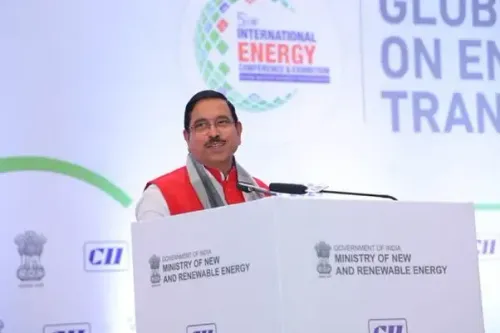
Joshi: India adds 30,581 MW renewable energy in H1 2026
Synopsis
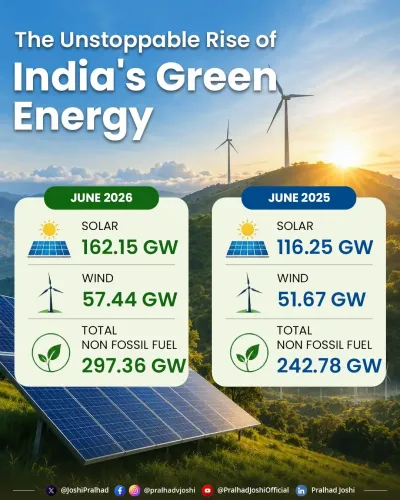
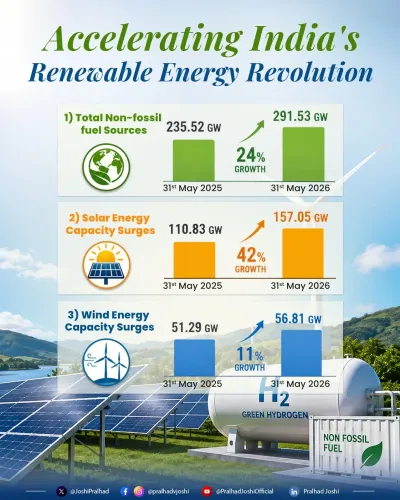
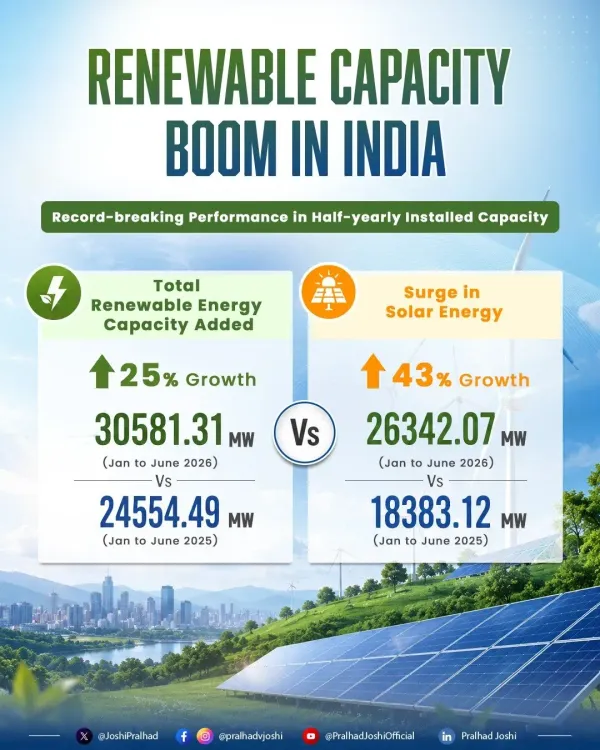
India added 30,581.31 MW of renewable energy in the first half of 2026, a 25% year-on-year rise, with solar power contributing 26,342.07 MW — a 43% jump. Union Minister Pralhad Joshi shared the milestone, underscoring India's accelerating clean energy transition under its 500 GW non-fossil capacity target for 2030.
Key Takeaways
India added 30,581.31 MW of renewable energy capacity in January–June 2026 , a 25% increase over H1 2025.
Solar energy contributed 26,342.07 MW of that total, representing a 43% year-on-year growth and roughly 86% of all renewable additions in the period.
The figures were announced by Union Minister Pralhad Joshi on 17 July 2026 .
India's renewable push is tied to its COP26 Panchamrit pledge of 500 GW non-fossil capacity by 2030 and net-zero by 2070 .
India's installed renewable capacity grew from roughly 76 GW in 2014 to over 170 GW by 2023 , with solar consistently leading annual additions.
State-level Renewable Purchase Obligation compliance and grid integration remain key challenges for translating central capacity additions into uniform energy access.
Union Minister of New and Renewable Energy Pralhad Joshi announced on Friday, 17 July 2026 that India added 30,581.31 MW of renewable energy capacity in the first half of 2026, marking a 25% year-on-year growth over the same period in 2025.
Context
Sharing the milestone on X, Joshi highlighted that solar energy was the primary driver, with 26,342.07 MW added between January and June 2026 — a 43% increase compared to the first half of 2025. The minister credited the momentum to the leadership of Prime Minister Narendra Modi, describing the trajectory as part of India's 'unwavering commitment to accelerating the clean energy transition.'
The figures indicate that solar alone accounted for roughly 86% of total renewable additions in the six-month period, continuing a multi-year trend of solar outpacing all other renewable sources in annual capacity additions.
Policy Backdrop
India's renewable push is anchored in the Panchamrit commitments announced at COP26 in 2021, which include achieving 500 GW of non-fossil fuel capacity by 2030 and reaching net-zero emissions by 2070. The country's installed renewable capacity stood at roughly 76 GW in 2014 and had grown to over 170 GW by 2023, driven by steep declines in solar tariffs and consistent central and state policy support.
The National Solar Mission, launched in 2010 under the National Action Plan on Climate Change, set an initial target of 20 GW of solar capacity by 2022 — a target that was subsequently revised sharply upward as deployment accelerated. The International Solar Alliance, co-founded by India and launched in 2015, further embedded solar expansion as a diplomatic and energy-security priority under the Modi government.
Stakeholders and Impact
The capacity additions have direct implications for renewable energy developers, state electricity boards, and industrial consumers seeking to meet renewable purchase obligations. Faster solar deployment also supports India's broader goal of reducing dependence on imported fossil fuels, with energy security increasingly framed alongside climate commitments.
State-level compliance with Renewable Purchase Obligations (RPOs) remains a critical variable: uneven state-level uptake has historically been a bottleneck, and the pace of central-level additions does not automatically translate into uniform grid integration across all states.
What's Next
With 30,581 MW added in just the first six months of 2026, India's annual renewable addition trajectory is on course to set a new record if the second half maintains comparable momentum. Analysts and policymakers will watch for any mid-term review of the 2030 non-fossil capacity target at upcoming parliamentary sessions or international climate forums, as sustained growth at this pace could prompt an upward revision of India's stated ambitions.
Point of View
Reinforcing the government's narrative that India's energy transition is accelerating on its own terms rather than under external pressure. The 43% solar surge is particularly significant: it suggests that earlier investments in manufacturing capacity, transmission infrastructure, and tariff policy are now compounding. However, the headline capacity figure must be read alongside state-level grid absorption and RPO compliance data, which have historically lagged central-level ambition. If the H2 2026 trajectory holds, India could enter the next major climate negotiation cycle with a credible case for revising its 2030 non-fossil target upward.
NationPress
17 Jul 2026
Frequently Asked Questions
How much renewable energy capacity did India add in the first half of 2026?
India added 30,581.31 MW of renewable energy capacity between January and June 2026, a 25% increase over the same period in 2025, according to Union Minister Pralhad Joshi.
What is India's renewable energy target for 2030?
India has committed to achieving 500 GW of non-fossil fuel capacity by 2030 as part of its Panchamrit climate pledges announced at COP26 in Glasgow in 2021.
Why is solar energy growing so fast in India?
Solar energy growth in India has been driven by sharp declines in solar tariffs, supportive central and state policies, the National Solar Mission, and India's push for energy self-reliance. In H1 2026, solar additions grew 43% year-on-year.
Who is Pralhad Joshi and what ministry does he head?
Pralhad Joshi is a senior BJP leader from Karnataka who serves as Union Minister of Consumer Affairs, Food and Public Distribution, and Minister of New and Renewable Energy in the Government of India.
What is India's net-zero target year?
India has committed to achieving net-zero carbon emissions by 2070 , as announced under the Panchamrit framework at the COP26 climate summit in 2021.