Pralhad Joshi Meets UAE AI Minister in Dubai on Ed-Tech Ties

Synopsis
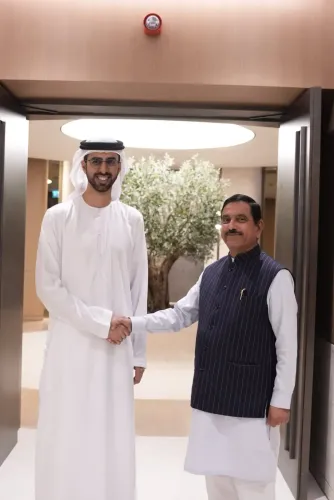
Union Minister Pralhad Joshi met UAE AI Minister Omar Al Olama in Dubai on 19 November 2026, discussing AI-based learning, joint research via the IIT Delhi-Abu Dhabi campus and MBZUAI, SPARC scheme expansion, and a proposed standing India-UAE dialogue on AI in education.
Key Takeaways
Pralhad Joshi met UAE Minister of State for AI Omar Al Olama in Dubai on 19 November 2026 .
Discussions covered AI-based learning, digital infrastructure for education, STEM, teacher training, and responsible classroom technology use.
The IIT Delhi Abu Dhabi Campus was proposed as a platform for joint AI research with MBZUAI .
The SPARC scheme (launched 2018) was identified as a funding bridge for collaboration in AI, climate, renewable energy, manufacturing, and space.
Both sides exchanged insights on the UAE's national K–12 AI curriculum and teacher AI-upskilling programmes.
Minister Joshi proposed a sustained, structured India-UAE dialogue on AI in education to future-proof both countries' school systems.
In Dubai on Thursday, 19 November 2026, Union Minister Pralhad Joshi sat down with Omar Al Olama — the UAE's Minister of State for Artificial Intelligence, Digital Economy and Remote Work Applications — to chart a deeper India-UAE partnership across AI, education, and emerging technologies. The conversation covered everything from classroom AI tools to joint doctoral research, signalling that the two countries are moving their tech partnership well beyond trade corridors.
What was on the table in Dubai
Posting in Kannada, Minister Joshi outlined a wide-ranging agenda: AI-ಆಧಾರಿತ ಕಲಿಕೆ ('AI-based learning'), digital infrastructure for education, STEM pedagogy, teacher training, and the responsible use of technology inside classrooms. The two ministers also exchanged notes on the UAE's national K–12 AI curriculum — a programme that already embeds AI literacy from school level — and on UAE teacher-upskilling initiatives that India could learn from as it scales its own education reforms.
IIT Delhi–Abu Dhabi and MBZUAI as the research engine
One of the sharper proposals to emerge from the meeting: using the IIT Delhi Abu Dhabi Campus as the institutional home for joint AI research with the Mohamed bin Zayed University of Artificial Intelligence (MBZUAI), the world's first graduate-level AI-focused research university, based in Abu Dhabi. The pairing makes structural sense — both institutions carry government mandates to advance applied AI, and an overseas IIT campus on UAE soil removes the bureaucratic friction of a purely remote collaboration.
SPARC scheme as the funding bridge
Minister Joshi also flagged the SPARC scheme — India's Ministry of Education programme launched in 2018 to fund academic and research collaboration between Indian institutions and top global universities — as a vehicle for joint work in AI, climate-change mitigation, renewable energy, advanced manufacturing, and space technologies. SPARC has historically connected IITs and IISc with counterparts in the US, Europe and Israel; bringing UAE institutions formally into that network would be a meaningful expansion of its geographic reach.
A partnership deepening its tech layer
Thursday's meeting is part of a steady widening of the India-UAE relationship. The two countries signed a Comprehensive Economic Partnership Agreement in 2022, which opened new lanes for trade and people-to-people ties. Since then, both sides have been working to operationalise tech collaboration through institutional channels — IIT campuses, bilateral research schemes, and aligned national AI strategies. The UAE's National Strategy for Artificial Intelligence 2031 and India's own AI mission provide compatible policy scaffolding for exactly the kind of academic linkages discussed in Dubai.
Joshi closed with a forward-looking proposal: a sustained, structured dialogue between India and the UAE specifically on AI in education — a standing channel, not a one-off ministerial visit. Whether that dialogue takes formal shape at the next India-UAE Joint Commission meeting will be the number to watch.
Two of the world's fastest-growing economies, sharing a vision of AI-powered classrooms — the question now is how quickly the institutional paperwork catches up to the ambition.
Point of View
Anchoring them in its most important Gulf relationship. By proposing a standing dialogue on AI in education — rather than a one-time announcement — Joshi is trying to institutionalise the collaboration in a way that survives ministerial cycles. The IIT Delhi-Abu Dhabi and MBZUAI pairing is particularly significant: it channels Gulf sovereign investment in AI research through India's most prestigious technical brand, potentially setting a template for other overseas IIT campuses. How much of this translates into funded projects under SPARC will be the real measure of ambition.
NationPress
19 Nov 2026
Frequently Asked Questions
Why did Pralhad Joshi visit Dubai in November 2026?
Minister Joshi travelled to Dubai to meet UAE Minister of State for AI Omar Al Olama and discuss deepening India-UAE cooperation in artificial intelligence, education technology, and emerging research fields.
What is the IIT Delhi Abu Dhabi Campus and why does it matter here?
The IIT Delhi Abu Dhabi Campus is an overseas extension of the Indian Institute of Technology Delhi established to expand academic and research ties. Joshi proposed using it as a base for joint AI research with MBZUAI, the UAE's graduate-level AI university.
What is the SPARC scheme?
SPARC — Scheme for Promotion of Academic and Research Collaboration — was launched by India's Ministry of Education in 2018 to fund joint research between Indian universities and leading foreign institutions. It was discussed as a funding mechanism for India-UAE AI and technology collaboration.
What did India and the UAE agree on AI in schools?
The ministers exchanged views on the UAE's national K–12 AI curriculum and teacher AI-upskilling programme. Minister Joshi also proposed a standing, sustained India-UAE dialogue on AI in education to future-proof both nations' school systems, though no formal new agreement was announced.