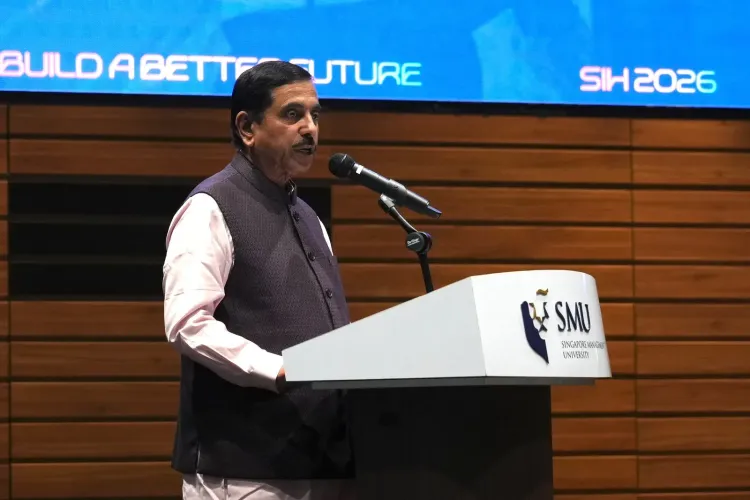
Pralhad Joshi addresses 4th Singapore-India Hackathon at SMU
Synopsis
Union Minister Pralhad Joshi addressed the 4th Singapore-India Hackathon 2026 at Singapore Management University alongside Singapore's Education Minister Desmond Lee, calling for innovation sandboxes and sustained mentorship to move student ideas into real-world solutions under the India-Singapore Comprehensive Strategic Partnership.
Key Takeaways
Union Minister Pralhad Joshi addressed the inaugural of the 4th Singapore-India Hackathon 2026 at Singapore Management University on 15 November 2026 .
Singapore's Minister for Education Desmond Lee and India's High Commissioner Dr Shilpak Ambule were present at the ceremony.
The event brought together 120 student innovators from India and Singapore along with industry partners and faculty.
Joshi highlighted NEP 2020 , the Smart India Hackathon (launched 2017), and Bharat Innovates as cornerstones of India's innovation ecosystem.
The minister called for innovation sandboxes , deeper institutional collaboration, and sustained mentorship to translate prototypes into deployable solutions.
The hackathon series is rooted in the India-Singapore Comprehensive Strategic Partnership established in 2015 .
A hundred and twenty young innovators from two nations, one stage, and a mandate to build solutions that outlast the event itself — Union Minister Pralhad Joshi opened the 4th Singapore-India Hackathon 2026 at Singapore Management University (SMU) on Sunday, 15 November 2026, anchoring the ceremony in the shared vision of Prime Minister Narendra Modi and former Singapore Prime Minister Lee Hsien Loong.
Joshi addressed a gathering that brought together Singapore's Minister for Education Desmond Lee, India's High Commissioner Dr Shilpak Ambule, SMU Vice President Prof. Lim Sun Sun, and AICTE Chairman Prof. Yogesh Singh — a lineup that signals just how seriously both governments treat this platform. The minister called the hackathon a living expression of the India-Singapore Comprehensive Strategic Partnership, established in 2015, and of a bilateral relationship that has steadily widened from trade and defence into the talent pipeline of tomorrow.
From Smart India Hackathon to Singapore: the innovation arc
Joshi spotlighted three pillars of India's domestic innovation push — the National Education Policy 2020, the Smart India Hackathon (launched in 2017), and the Bharat Innovates programme — as the foundation from which the bilateral edition draws its energy. NEP 2020's emphasis on multidisciplinary, experiential learning maps directly onto what a cross-border hackathon demands: students who can think across domains, not just execute within silos. Smart India Hackathon, which has grown into one of the world's largest student innovation contests, provides the institutional muscle and mentorship culture that the Singapore edition now internalises.
The minister's ask went beyond coding sprints and presentation rounds. He pushed for innovation sandboxes, sustained mentorship, and deeper university-to-university institutional collaboration — the kind of scaffolding that moves a clever prototype toward a deployable, real-world solution. That shift in language — from 'ideas' to 'solutions' — is deliberate and worth noting.
120 innovators, one strategic signal
The 120 student innovators from India and Singapore are not merely participants in a competition. Each edition of the hackathon has served as a proof-of-concept for the two countries' ability to co-create talent-development pipelines rather than simply exchange delegations. AICTE, India's apex technical education regulator, has been central to this — its chairperson's presence at the inaugural underlines the institutional weight behind the series.
The involvement of industry partners alongside faculty also reflects a conscious design choice: problems posed at the hackathon are drawn from real sectoral challenges, ensuring that the best student solutions have a credible pathway to adoption rather than a shelf in an archive. Joshi's emphasis on 'empowering young minds to collaborate, create and develop solutions for a better tomorrow' fits neatly into India's broader diplomatic posture of soft-power export through education and innovation.
What the bilateral partnership looks like on the ground
The India-Singapore Comprehensive Strategic Partnership covers defence, finance, digital connectivity and education. The hackathon series is one of the more visible education-track deliverables. With both nations deepening cooperation on digital infrastructure and startup ecosystems, the institutional momentum built through four editions of this event creates a natural conduit for follow-on university MoUs, joint research grants, and cross-border incubation arrangements — areas worth watching as outcomes from the 2026 edition are assessed in the months ahead.
Four editions in, the Singapore-India Hackathon has moved from novelty to fixture. The question it now needs to answer is whether its best ideas make the leap from prototype to product — and whether the institutional architecture Joshi is calling for will be in place to catch them when they do.
Point of View
More about measurable pipeline outcomes. With AICTE's institutional weight now firmly behind the series, it aligns with New Delhi's broader push to position India as a co-creator of global talent rather than merely a supplier of it. The four-edition run also sets a precedent for replicating similar bilateral hackathon formats with other strategic partners.
NationPress
15 Nov 2026
Frequently Asked Questions
What is the Singapore-India Hackathon?
The Singapore-India Hackathon is a bilateral student innovation competition held jointly between India and Singapore, operationalising the two countries' Comprehensive Strategic Partnership in education and technology. The 4th edition was held at Singapore Management University in November 2026.
Who attended the 4th Singapore-India Hackathon 2026 inauguration?
The inaugural ceremony was attended by Union Minister Pralhad Joshi, Singapore's Minister for Education Desmond Lee, India's High Commissioner Dr Shilpak Ambule, SMU Vice President Prof. Lim Sun Sun, AICTE Chairman Prof. Yogesh Singh, and 120 student innovators from both countries.
What is the India-Singapore Comprehensive Strategic Partnership?
The India-Singapore Comprehensive Strategic Partnership was established in 2015 and covers cooperation across defence, finance, digital infrastructure, and education — including the bilateral hackathon series.
What is Smart India Hackathon and how does it relate to the bilateral event?
Smart India Hackathon is India's national student innovation contest, launched in 2017 by AICTE and the government to promote grassroots problem-solving. It provides the institutional and mentorship model on which the Singapore-India bilateral hackathon is built.
What did Pralhad Joshi say at the Singapore-India Hackathon 2026?
Joshi emphasised India's innovation achievements under NEP 2020, Smart India Hackathon and Bharat Innovates, and called for innovation sandboxes, sustained mentorship and deeper institutional collaboration to translate student prototypes into real-world solutions.