Pralhad Joshi Shares Sanskrit Verse Defining Bharat
Synopsis
Union Consumer Affairs Minister Pralhad Joshi shared a classical Puranic Sanskrit verse on X defining Bharat as the land north of the ocean and south of the Himalayas, invoking India's ancient civilizational identity on 22 October 2026.
Key Takeaways
Minister Pralhad Joshi posted a Puranic Sanskrit shloka on X on 22 October 2026 .
The verse defines Bharat as the land lying north of the ocean and south of the Himalayas , and its people as descendants of Bharati.
The shloka belongs to ancient Puranic literary tradition and is one of the earliest textual definitions of the Indian subcontinent as a unified entity.
The post carries no accompanying policy message — the verse stands alone as a civilizational statement.
BJP leaders have a broader pattern of using classical Sanskrit verses in public communication to highlight cultural and historical continuity.
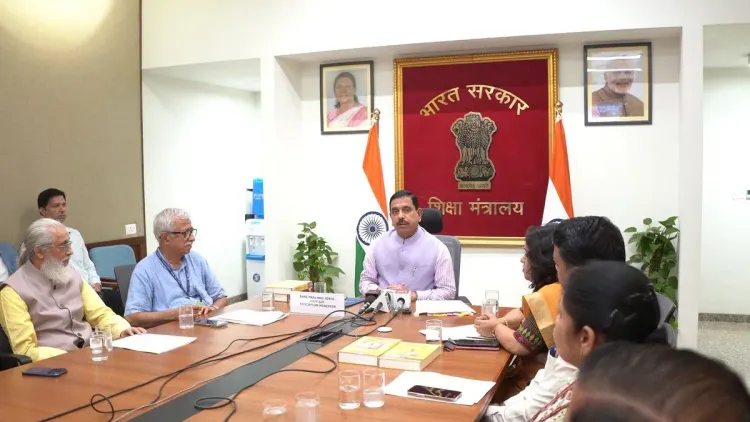
A Sanskrit shloka older than recorded history — and a Union Minister's quiet reminder of what it means to be Indian. On Thursday, 22 October 2026, Union Consumer Affairs Minister Pralhad Joshi posted a celebrated Puranic verse on X, invoking the ancient geographical and civilizational definition of Bharat.
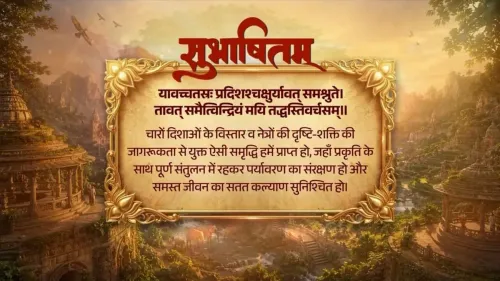
The verse reads: 'उत्तरं यत् समुद्रस्य हिमाद्रेश्चैव दक्षिणम् । वर्षं तद् भारतं नाम भारती यत्र सन्ततिः ॥' — translated as: 'That which lies north of the ocean and south of the snowy mountains is called Bharat; there dwell the descendants of Bharati.' In two lines, the verse maps an entire civilisation — from the Himalayas in the north to the seas in the south — and names its people as inheritors of a living tradition.
A Verse That Has Outlasted Empires
The shloka belongs to the Puranic literary tradition and is among the earliest known attempts to define the Indian subcontinent as a single, named entity. Long before modern cartography, Sanskrit scholars understood Bharat not as a political boundary but as a cultural and geographic continuum — a landmass defined by its natural frontiers and animated by a common civilizational identity. The verse has endured across centuries of upheaval, surfacing in classical texts, temple inscriptions, and now the timelines of senior elected representatives.Why BJP Leaders Return to This Shloka
The choice is not accidental. BJP leaders have periodically anchored their public communication in Sanskrit verses and Puranic references, weaving a thread between classical heritage and contemporary governance. Posting such a verse without elaboration carries its own signal — the verse speaks; the minister steps aside and lets it. For Joshi, a senior Karnataka leader who holds the twin portfolios of Consumer Affairs, Food and Public Distribution and New and Renewable Energy, the post marks a deliberate pivot into cultural idiom, distinct from the policy announcements that fill most of his feed. The timing — a mid-week October afternoon, with no immediately identifiable national commemoration — underscores that the gesture is devotional and civilizational rather than tied to a calendar event. It is the kind of post that travels quietly, shared by those who recognise the verse and stopped by those who do not, working on both audiences at once. The shloka will keep circulating. It always has.Point of View
Long-running BJP communication strategy of anchoring national identity in pre-colonial, Sanskritic frameworks — a soft-power move that sidesteps policy debate entirely and speaks directly to a culturally literate audience. By letting a two-line shloka stand without commentary, Joshi signals conviction rather than explanation. The verse's geographic framing — Himalayas to ocean — also quietly reinforces the idea of Bharat as a natural, indivisible civilizational unit, a subtext that resonates with the party's broader position on national integration. As such cultural posts accumulate across BJP leaders' timelines, they form a cumulative ambient narrative about India's identity that is distinct from, but parallel to, formal governance messaging.
NationPress
22 Oct 2026
Frequently Asked Questions
What Sanskrit verse did Pralhad Joshi post on X?
Pralhad Joshi posted the Puranic shloka 'उत्तरं यत् समुद्रस्य हिमाद्रेश्चैव दक्षिणम् । वर्षं तद् भारतं नाम भारती यत्र सन्ततिः ॥', which translates as: 'That which lies north of the ocean and south of the snowy mountains is called Bharat; there dwell the descendants of Bharati.'
What is the meaning of the shloka about Bharat?
The verse is a classical Sanskrit definition of Bharat, describing it as the land bounded by the Himalayas in the north and the ocean in the south, inhabited by the people known as Bharati — one of the earliest textual expressions of a unified Indian civilizational identity.
Where does this Sanskrit verse defining Bharat come from?
The verse belongs to the Puranic literary tradition of ancient India. Its precise source within the Puranas is a matter of scholarly discussion, but it is widely cited as one of the foundational geographical definitions of the Indian subcontinent.
Why do BJP leaders share Sanskrit shlokas on social media?
BJP leaders regularly use classical Sanskrit verses in public communication to emphasise India's ancient civilizational heritage and cultural continuity. The practice is part of a broader effort to connect contemporary governance and national identity with pre-colonial, Sanskritic traditions.
Who is Pralhad Joshi?
Pralhad Joshi is a senior BJP leader from Karnataka and currently serves as Union Minister of Consumer Affairs, Food and Public Distribution, and Minister of New and Renewable Energy in the Indian government.