Joshi Questions Karnataka Over Caste Rule for PMGKAY Ration
Synopsis
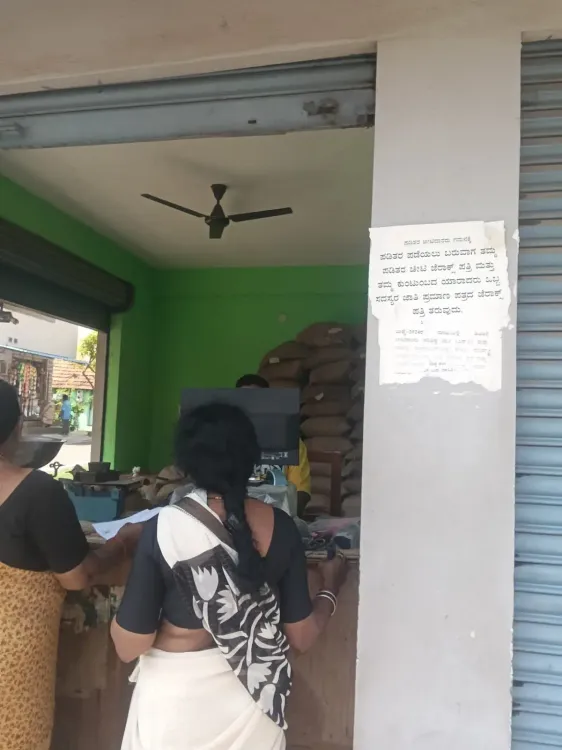
Union Consumer Affairs Minister Pralhad Joshi has challenged the Karnataka government for allegedly making caste certificates mandatory for PMGKAY ration access, calling it unlawful and contrary to the scheme's economic-need-only eligibility criteria. He has directed his office to seek full details and protect beneficiary rights.
Key Takeaways
Union Minister Pralhad Joshi accused the Karnataka government of requiring caste certificates for PMGKAY ration access, a condition not authorised under the scheme.
PMGKAY , launched in March 2020 , provides free food grains to economically vulnerable households under the NFSA 2013 based solely on economic criteria.
Ration cards are already linked with Aadhaar and biometric authentication, making additional document requirements redundant under existing central policy.
The One Nation, One Ration Card scheme guarantees portability of ration access across all states, with no provision for state-level eligibility add-ons.
Joshi has directed his ministry office to gather complete details and take action to protect the rights of affected beneficiaries.
The dispute is part of a broader pattern of centre-state friction over welfare scheme implementation in Congress-governed Karnataka.
Union Consumer Affairs Minister Pralhad Joshi on Saturday, 20 June 2026, sharply questioned the Karnataka government over reports that poor beneficiaries under the Pradhan Mantri Garib Kalyan Anna Yojana (PMGKAY) are being asked to produce caste certificates to access their monthly ration entitlements, calling the requirement unlawful and a violation of the fundamental right to food.
Context
In a bilingual post in English and Kannada, Minister Joshi posed a pointed question: 'ಹಸಿವಿಗೆಲ್ಲಿಂದ ಬಂತು ಜಾತಿ?' ('How does caste have anything to do with hunger?'). He challenged the Congress-led state administration to explain under what authority it had made a caste certificate mandatory for ration distribution under a centrally funded scheme whose eligibility criteria are rooted exclusively in economic need.
Joshi stated that under Prime Minister Narendra Modi's government, 'access to food is a fundamental right of every citizen' and that 'ration benefits are provided solely on the basis of economic need, not caste.' He also noted that ration cards have already been linked with Aadhaar and biometric authentication systems are operational, making the additional caste-certificate requirement redundant and burdensome.
Policy Backdrop
PMGKAY was launched in March 2020 during the COVID-19 pandemic to provide free food grains to priority households identified under the National Food Security Act (NFSA) 2013. The NFSA itself established legal entitlement to subsidised food grains based on Socio-Economic Caste Census (SECC) data, with economic vulnerability — not caste — as the determining criterion.
The One Nation, One Ration Card (ONORC) scheme, piloted in 2019 and rolled out nationally by 2021, allows any NFSA beneficiary to draw their ration from any fair price shop across the country. Joshi invoked this portability guarantee to question why the Karnataka government was imposing 'arbitrary and unnecessary local conditions' on top of a nationally standardised system. Aadhaar linkage for ration cards has been progressively mandated since 2017 for deduplication and biometric authentication, further rendering manual document checks at the distribution point unnecessary.
Stakeholders and Impact
The beneficiaries most directly affected are poor and marginalised ration card holders in Karnataka — the very population PMGKAY was designed to reach without procedural barriers. Joshi argued that forcing these citizens to travel to government offices every month carrying caste certificates imposes a compliance burden that defeats the purpose of a digitally authenticated, portable system.
The dispute reflects a recurring pattern of centre-state friction over the implementation of centrally funded welfare schemes in opposition-governed states. Similar disagreements have emerged around Ayushman Bharat and the Pradhan Mantri Awas Yojana (PMAY) in states not governed by the BJP, where the central government has accused local administrations of layering additional eligibility conditions onto nationally defined criteria. Joshi's use of the hashtag #CongressFailsKarnataka signals the BJP's intent to frame this as a political accountability issue ahead of any administrative resolution.
What's Next
Minister Joshi announced he has directed his office to 'seek complete details on this matter and ensure that the rights of beneficiaries are protected,' indicating a formal inquiry process has been initiated at the central ministry level. He also asserted that 'no authority has the right to issue unlawful notices that obstruct food grains from reaching the plates of the poor,' suggesting the ministry may issue a directive to the Karnataka food department if the notices are found to violate NFSA and PMGKAY guidelines.
The Karnataka government's response — whether it clarifies, modifies, or withdraws the notices in question — will determine whether this remains a political flashpoint or escalates into a formal centre-state compliance dispute. With ONORC portability rights and Aadhaar-based authentication already in place as the legal framework for ration access, any state-level requirement that goes beyond these parameters is likely to face scrutiny from the Union Ministry of Consumer Affairs, Food and Public Distribution.
Point of View
Elevating what might otherwise be a bureaucratic dispute into a rights-and-federalism argument. By invoking the ONORC portability guarantee and Aadhaar authentication infrastructure, he positions the central government as the guarantor of a clean, caste-neutral delivery system against a state accused of introducing identity-based friction. The BJP's use of the hashtag #CongressFailsKarnataka signals this will be prosecuted as a political narrative in Karnataka, a state the party is keen to recapture. If the Karnataka government does not swiftly clarify or withdraw the notices, the ministry's formal inquiry could set a precedent for central oversight of state-level PDS implementation practices.
NationPress
20 Jun 2026
Frequently Asked Questions
What is PMGKAY and who is eligible for it?
PMGKAY, or Pradhan Mantri Garib Kalyan Anna Yojana, is a central government scheme launched in March 2020 that provides free food grains to priority households identified under the National Food Security Act 2013. Eligibility is based on economic need as determined by SECC data, with no caste-based criterion.
Can the Karnataka government make a caste certificate mandatory for ration under PMGKAY?
No authority under PMGKAY guidelines permits a state government to add caste-certificate requirements; the scheme's eligibility is defined solely by economic criteria set by the central government under the NFSA. Union Minister Pralhad Joshi has called any such notices 'unlawful.'
What is the One Nation One Ration Card scheme?
One Nation One Ration Card is a central scheme that allows any NFSA beneficiary to access their ration entitlement from any fair price shop anywhere in India, regardless of the state where their ration card was issued. It was piloted in 2019 and rolled out nationally by 2021.
Why is Aadhaar linkage relevant to the ration caste certificate controversy?
The central government has mandated Aadhaar linkage and biometric authentication for ration cards since 2017, creating a digital verification system that makes additional manual document checks — such as caste certificates — redundant and inconsistent with the established national framework.
What action has Pralhad Joshi taken against Karnataka over this issue?
Minister Joshi has directed his ministry office to seek complete details on the notices issued by the Karnataka government and to ensure that the rights of PMGKAY beneficiaries are protected, signalling a formal central inquiry into the matter.