July 13, 1931: How Kashmir's fracture reshaped South Asian geopolitics
Synopsis
A single day in 1931 — 22 deaths outside Srinagar Central Jail — did more than spark communal violence. It fractured the shared identity of Kashmiriyat, weakened the Maharaja's hand against British imperial pressure, and set in motion a chain of events that produced Partition, the Gilgit coup, and a geopolitical contest over South Asia's northern frontiers that remains unresolved more than nine decades later.
Key Takeaways
On 13 July 1931 , police fired on protesters outside Srinagar Central Jail , killing 22 people — triggering Kashmir's first major communal rupture.
The unrest weakened Maharaja Hari Singh's negotiating position, contributing to the 1935 lease of the Gilgit Agency to British administration.
Sheikh Mohammad Abdullah emerged as the Valley's dominant political figure; the All Jammu and Kashmir Muslim Conference was formed in 1932 and converted into the National Conference in 1939 .
Two opposing historical memories of the same event — political awakening for Kashmiri Muslims, communal insecurity for Kashmiri Pandits — have shaped the region's politics for over 90 years .
Strategic analysts argue that British Cold War calculations favouring Pakistan as a pro-Western ally directly influenced the Kashmir settlement of 1947 .
Constitutional changes after 2019 have altered Jammu and Kashmir's legal framework, but historical reconciliation between communities remains incomplete.
On 13 July 1931, police opened fire on a crowd gathered outside Srinagar Central Jail, killing 22 protesters. The incident was not an isolated act of state repression — it was the moment when Kashmir's simmering social tensions crystallised into competing political identities, setting in motion a chain of consequences that would shape the Partition of India, the accession of Jammu and Kashmir, and the broader geopolitical contest over South Asia's northern frontiers that persists to this day.
The tragedy, analysts argue, must be read neither as a straightforward democratic uprising nor as a purely communal confrontation. It was the crucible in which legitimate economic grievances, religious identity and imperial strategy fused — with consequences no single party fully intended or controlled.
Kashmir Before the Firing: Fault Lines Without a Break
Under Maharaja Hari Singh and the Dogra monarchy, Jammu and Kashmir carried genuine structural inequities into the 1930s. The Muslim majority faced inadequate representation in government services, heavy taxation and limited administrative opportunity. The Great Depression had devastated the Valley's silk and shawl industries, deepening unemployment across communities.
Kashmiri Pandits, though a small minority, held significant positions in civil administration — a consequence of centuries of investment in education, scholarship, Sanskrit learning, Persian administration and later modern civil services. Their presence in governance was part of Kashmir's civilisational heritage rather than merely a product of Dogra patronage. They were, however, acutely protective of the State Subject protections introduced in 1927.
The broader social identity of Kashmiriyat — a tradition of shared cultural coexistence — remained the dominant frame. Fault lines existed, but they had not yet hardened into an irreversible communal divide.
The Trigger and Its Immediate Aftermath
The immediate spark was the arrest of Abdul Qadeer, whose public speech had openly challenged the Maharaja's authority. During his trial at Srinagar Central Jail, thousands assembled outside demanding access to the proceedings. As tensions escalated, state authorities opened fire on the crowd, killing 22 protesters.
What followed compounded the rupture. Communal violence spread across parts of Srinagar, with attacks on Hindu-owned properties and loss of lives on both sides. The atmosphere of coexistence that had long defined Kashmiriyat suffered its first major political fracture.
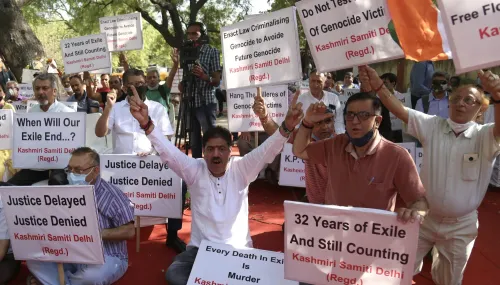
Two entirely different historical memories emerged from the same event. For large sections of Kashmiri Muslims, 13 July became a symbol of political awakening and resistance against autocratic rule. For many Kashmiri Pandits, the subsequent violence generated a lasting sense of insecurity and vulnerability. Both memories would continue to shape Kashmir's politics for decades.
Political Realignment and the Rise of Sheikh Abdullah
The events of July 1931 transformed the Valley's political landscape. Sheikh Mohammad Abdullah emerged as the most consequential political figure of the era. The All Jammu and Kashmir Muslim Conference, formed in 1932, gave organised expression to Muslim political aspirations. By 1939, Sheikh Abdullah had converted it into the National Conference, seeking to build a broader secular movement.
Despite that ideological shift, the emotional memories of 1931 remained potent. Political mobilisation increasingly drew on religious identity, making a full restoration of earlier social harmony difficult. Notably, this was the third major political realignment in the Valley within a generation — each one making the next harder to reverse.
Imperial Strategy and the Gilgit Lease
Kashmir's internal divisions did not develop in a vacuum. They unfolded as the British Empire was acutely focused on the northern frontiers of the princely state — particularly Gilgit, which overlooked routes connecting Central Asia, Afghanistan, China and the Indian subcontinent — as part of its strategic competition with the Soviet Union.
Maharaja Hari Singh had resisted direct British control over this frontier. However, the political instability following 1931 weakened his negotiating position. In 1935, the Maharaja leased the Gilgit Agency to the British administration, enabling London to consolidate its strategic position along the northern frontier. Historians differ on how directly 1931 caused this outcome, but there is broad agreement that the unrest increased British leverage over the state's strategic affairs.
From 1931 to 1947: The Long Consequence
By 1947, political identities within Jammu and Kashmir had become deeply polarised. The British withdrawal from India coincided with competing national aspirations, communal tensions and strategic calculations over the northern frontiers. The subsequent tribal invasion, the accession of Jammu and Kashmir to India, the Gilgit coup led by Major William Brown, and Pakistan's control over large portions of the former princely state permanently altered the region's map.
A significant body of strategic scholarship argues that British policymakers regarded Pakistan as a more dependable partner for protecting access to the Middle East and containing Soviet influence during the early Cold War. According to this reading, every key decision in the Kashmir settlement was shaped, at least in part, by this calculus.
More than 90 years later, Kashmir continues to live with the consequences of those divisions. Constitutional changes after 2019 have altered the legal framework of Jammu and Kashmir, yet historical reconciliation between communities remains incomplete. From an Indian strategic perspective, analysts argue that a durable settlement will ultimately require addressing the unresolved status of Pakistan-occupied territories, whose separation has defined the region's security environment since 1947.
What remains beyond dispute, according to the author — a former diplomat and strategic affairs expert — is that peace cannot be built by ignoring history. The story of 13 July 1931 is ultimately the story of how legitimate grievances, communal anxieties, political mobilisation and imperial strategy intersected at a single critical moment, widening the deepest crack in Kashmiri society and setting the terms of a geopolitical contest whose consequences endure across South Asia.
(Views expressed are those of the author, a former diplomat and strategic affairs expert, and are personal.)
Point of View
Handing external powers a lever they used to reshape Kashmir's strategic geography through the 1935 Gilgit lease and, ultimately, the 1947 settlement. The British Cold War bet on Pakistan as a reliable Western proxy is not a fringe argument — it is documented in strategic literature — yet it rarely features in mainstream Indian commentary on Kashmir. Until the psychological and territorial consequences of 1931 are addressed together, constitutional reorganisation alone will not produce durable peace.
NationPress
15 Oct 2026
Frequently Asked Questions
What happened on 13 July 1931 in Kashmir?
On 13 July 1931, state police opened fire on a crowd gathered outside Srinagar Central Jail during the trial of Abdul Qadeer, killing 22 protesters. The incident triggered communal violence across parts of Srinagar and marked the first major political fracture in Kashmir's shared social identity of Kashmiriyat.
Why is July 13, 1931 considered a turning point in Kashmir's history?
The day crystallised competing political identities — political awakening for Kashmiri Muslims and communal insecurity for Kashmiri Pandits — from what had previously been shared social grievances. These divergent memories shaped every major political development in the Valley over the following nine decades, from the rise of Sheikh Abdullah to the events of 1947 and beyond.
How did the 1931 unrest affect British strategic interests in Kashmir?
The political instability following 1931 weakened Maharaja Hari Singh's negotiating position against British pressure. In 1935, the Maharaja leased the strategically vital Gilgit Agency — overlooking routes to Central Asia, Afghanistan and China — to the British administration, consolidating imperial control over Kashmir's northern frontier.
Who was Sheikh Mohammad Abdullah and what role did he play after 1931?
Sheikh Mohammad Abdullah emerged as the Valley's most influential political leader in the aftermath of 1931. He helped found the All Jammu and Kashmir Muslim Conference in 1932 and later converted it into the secular National Conference in 1939, though the emotional legacies of 1931 continued to shape political mobilisation along religious lines.
What is the connection between the events of 1931 and the Kashmir dispute today?
Analysts argue that the internal fractures of 1931 intersected with British imperial strategy, ultimately contributing to Pakistan's control over large portions of the former princely state after 1947. The unresolved status of those territories continues to define South Asia's security environment, and historical reconciliation between Kashmiri communities remains incomplete more than 90 years later.